
Effects of crop load on fruit quality in ‘Rosy Glow’ apples
This article originally appeared in the Summer 2021 edition of AFG, available online here.
Higher crop loads have an adverse effect on fruit quality, a five year research experiment has shown.
Varying the crop load of apple trees is a tool that can be used by growers to produce fruit of a particular size range to suit market requirements. For example, leaving a larger number of fruit on the trees will result in smaller fruit since the limited amount of photo assimilates produced by the trees must be distributed amongst a greater number of fruit.
Care needs to be taken, however, since there are limits to the crop load — number of fruit per unit of trunk cross-sectional area (TCSA) — some cultivar scan sustain before they tip into a biennial bearing cropping pattern, where excessive numbers of fruit one season cause a reduced number of flowers the following season, potentially resulting in a lower crop load, yield, and income for the farmer.
Similar to the effect on fruit size, crop load also affects the quality of the fruit, and a recent experiment conducted by Agriculture Victoria at Sanders Apples, a commercial orchard at Three Bridges in the Yarra Valley, has highlighted these effects.
The experiment studied the effect of crop load on return bloom and fruit quality in ‘Rosy Glow’(marketed as Pink Lady) apples and showed that as well as reducing return bloom, particularly after prolonged high crop loads over several seasons, higher crop loads also have negative effects on fruit quality.
The experiment ran for five seasons. Thirty trees in their 3rd leaf had one of five crop load treatments applied: 10, 50, 100, 150 or 200 per cent of the normal grower practice of eight fruit/cm2 trunk cross sectional area (TCSA). This was done either on a constant crop load regime (same crop load each year), or a variable crop load regime (alternating high-low year-to-year, e.g., 10 per cent became 200 per cent; 150 per cent became 50 per cent. The number of flower clusters on each tree was counted manually each season at full bloom to determine return bloom, and the clusters thinned by hand to leave the required number of fruit per tree.
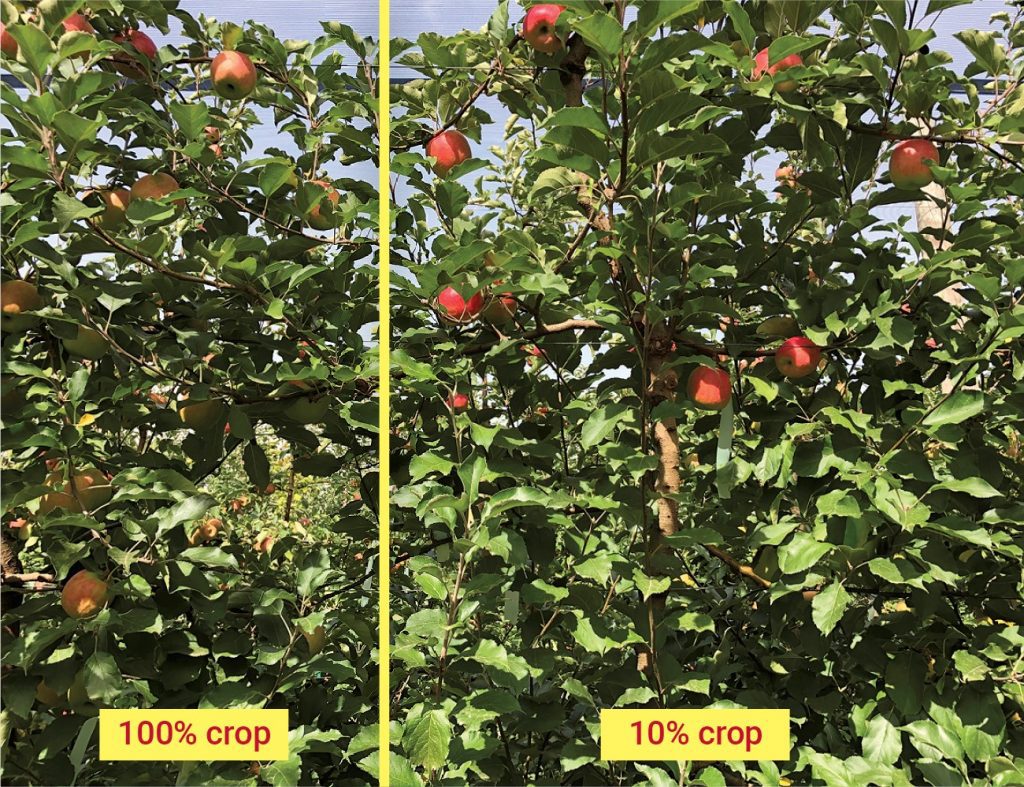
Figure 1: Comparison of ‘Rosy Glow’ fruit colour from a tree with a normal crop (far left) and a tree with 10% of the normal crop load (centre-right). Photo taken late March 2019.
From approximately 28 days before harvest, a random sample of fruit on each tree was tagged and measured weekly with a DA-meter. These non-destructive measurements of Index of Absorbance Difference (IAD) were used to determine the effects of crop load on changes in fruit maturity and to predict ideal harvest times. Two fruit harvests were conducted each season, the first occurring when the average maturity of the ‘100 per cent’ treatment (i.e., grower practice) reached the target IAD value (IAD = 1.1).
At this harvest, all fruit perceived to have similar or less green background colour than fruit at the target IAD value were picked, or a minimum of 20 fruit per tree for comparative purposes. The second harvest occurred approximately two weeks later. All harvested fruit were counted and weighed to obtain total yield and average fruit weight, and a range of fruit measurements (fruit weight, colour, flesh firmness and soluble solids concentration) were conducted on a random subsample of 20 fruit per tree.
The results showed that, on average, fruit from the higher crop load treatments developed less colour intensity and matured approximately one week later than fruit from trees with a normal crop load, whereas fruit from the lowest crop load trees developed more colour intensity, as shown in Figure 1, and reached maturity almost two weeks earlier. The differences in colour intensity could be due to a number of factors such as the greater competition for assimilates in high crop load trees.
There was a consistent strong negative correlation of soluble solids concentration with crop load, as shown in Figure 2. This effect was not significantly different for constant and variable crop load trees, indicating that the effect was a function of the carbon balance in the trees during the growing season. Although soluble solids concentration values varied year-to-year, fruit from the highest crop load trees were generally 2.5–3 °Brix lower than those from trees with the lowest crop loads.
The effect of crop load on flesh firmness varied depending on whether the trees had a constant or variable crop load treatment. Flesh firmness was not affected by crop load for the constant crop load treatments, whereas there was a strong negative correlation of firmness and crop load for variable crop load trees. This indicates there may be a carry-over effect of the previous season’s crop load, and that consistent crop loads year to year are more likely to yield consistent flesh firmness.
Comparison of data from the final two seasons of the experiment, when tree canopy was approaching full size and the crop load treatments had taken effect, showed that target constant crop loads of100 per cent and 150 per cent of normal grower practice produced the highest yields overall.
However, the 150 per cent treatment trees were not able to achieve their target crop loads in these seasons due to reduced flowering and fruit drop during the growing season, which is indicative of stressed trees due to an overly high crop load. These trees also produced fruit with soluble solids content below 13 °Brix in these seasons, which is below the quality specifications of Pink Lady. These results indicate that the normal grower practice of eight fruit/cm2 TCSA was the best crop load for consistent high yields year-to-year, and better fruit quality than higher crop loads.
In summary, the experiment showed that higher crop loads resulted in smaller, later maturing fruit, which had less colour and soluble sugars.

Figure 2: Relationship between soluble solids concentration (SSC) and actual crop load [fruit/cm2 TCSA] of each ‘Rosy Glow’ plot tree for the 2019–20 season.
Acknowledgements: This article is a component of the apple and pear industry’s PIPS3 (Productivity, Irrigation, Pests and Soils) program of research and development funded by Hort Innovation, using the Hort Innovation Apple and Pear research and development levy, contributions from the Australian Government and co-investment from Agriculture Victoria. Hort Innovation is the grower-owned, not-for-profit research and development corporation for Australian horticulture.




