
Cultural control of apple scab
Gordon Brown reviews Spanish research demonstrating the effectiveness of leaf removal for control of black spot.
Black spot or scab of apples and pears is caused by different species of Venturia (V. inaequalis on apples and V. pirina on pears). Both have a similar life cycle and both are major diseases requiring many applications of fungicides for control. The seasonal life cycle of Venturia (Figure 1) starts in spring when prolonged wet weather promotes the release of ascospores which infect the young leaves and flowers. After this, an extreme number of fungicide sprays are needed to protect trees from this devastating disease. Even so, in a wet season, control with fungicides can be inadequate, leading to substantial economic losses.
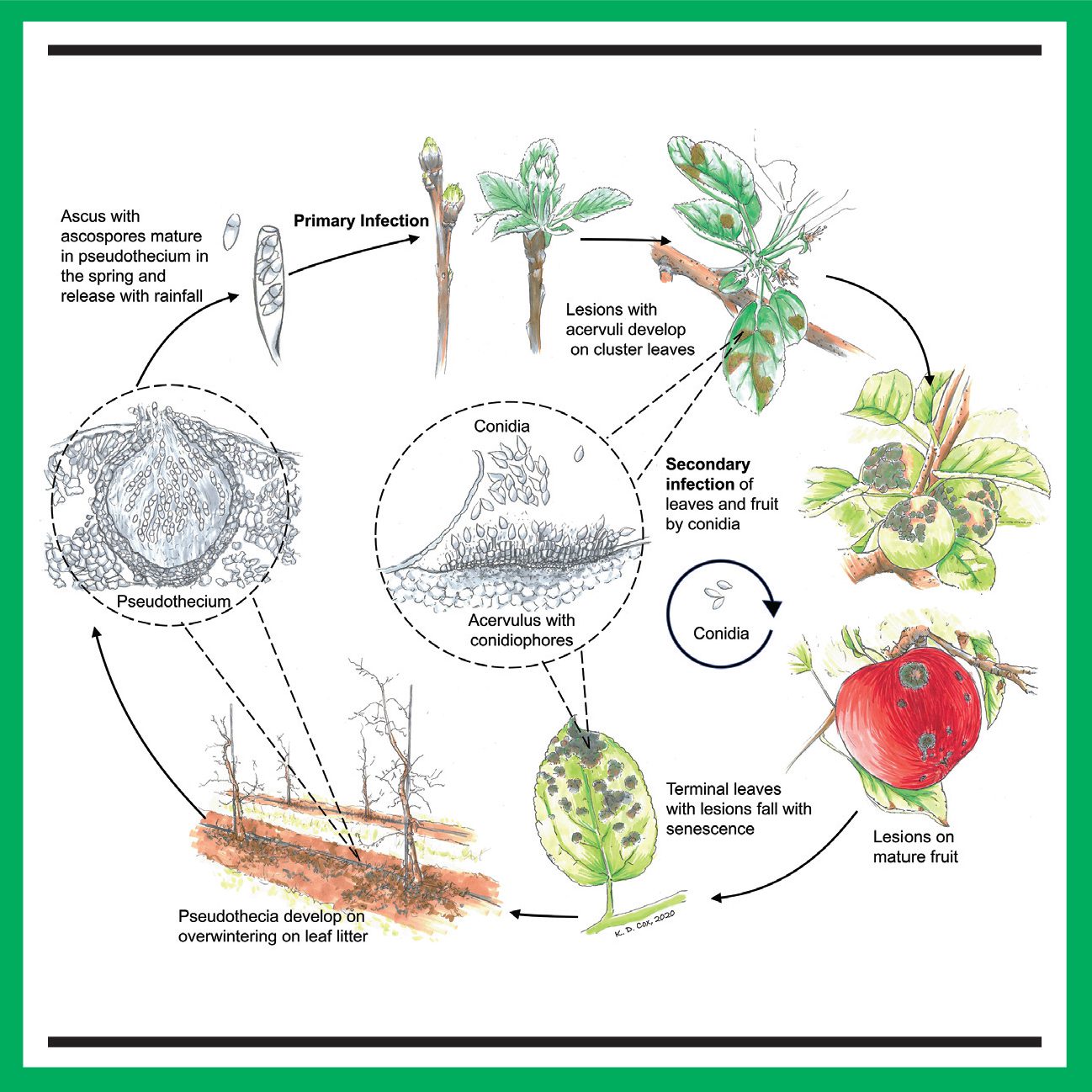
Figure 1: The life cycle of black spot. During winter black spot grows in old infected leaves on the ground (1) and in spring it produces ascospores (2) which are ejected into the air and carried to young leaves, flowers and fruit by the wind and raindrops (3). About two weeks after infection, characteristic black spots appear (4) which produce conidia spores (5) that infect other parts of the tree (6) and, under favourable conditions, the secondary infection cycle is repeated several times. Source: Hetherington S and Monroe A (2009) Integrated pest management for Australian apples & pears, Industry & Investment NSW and Apple and Pear Australia Ltd. Orange, NSW.
Over the last 40 years control of this disease has focused on the use of fungicides or other materials to prevent germinated spores from infecting trees or to kill the disease in fresh infections. This reliance on fungicides is associated with the development and promotion of new, effective fungicides by the various chemical companies. The problem is that the disease is developing resistance to many useful fungicides, control is often poor and consumers are developing resistance to the use of pesticides. Back in the late 1960s, prior to the development of effective modern fungicides, research was revealing the usefulness of removing fallen leaves over winter to reduce the abundance of spring ascospores and subsequent disease infection. By the 1980s, research had optimised this treatment and the practice was being promoted to industry.
With current issues around the use of fungicides, control of primary inoculum on fallen leaves is a useful strategy. There are several ways of achieving this, from physical removal of the leaves from the orchard through to encouraging the breakdown of leaves with urea sprays and physically crumbling leaves with mulching mowers in autumn and early winter. In this edition of AFG I will be reviewing recent Spanish research, over four years, demonstrating the effectiveness of leaf removal for disease control. This article will focus on the first three seasons as no black spot was encountered in the fourth season.
Initially in this trial, two different orchards were used for two years; 2020 and 2021. One of the orchards was a conventional orchard while the second was an organic orchard. At both sites, in mid-winter, the leaves were raked to the space between the tree rows prior to being picked up by a tractor-driven vacuum and removed from the orchard. In the following growing season these trees were sprayed with the normal fungicides used in the rest of the orchard. This treatment was compared with the standard spray program used in the orchard without leaf removal, as well as a treatment that received no disease control treatments at all. A fourth treatment that had no impact on black spot is not being covered in this review.
Results
At both sites, the level of fruit damage in the untreated control was substantial, with greater than 60 per cent of fruit with symptoms of black spot. The fungicide sprays used dramatically reduced the level of damage to more manageable levels (Figure 2). Unfortunately, there were still economically significant levels of fruit damage – greater than 10 per cent – in the organic orchard with the organic fungicides alone treatment.
Importantly, the combination of fallen leaf removal in winter with the application of fungicides in the following season caused a further reduction in the incidence of damage to the fruit. For the organic orchard, in the combined treatment, the incidence of black spot on the fruit was approaching one third that of the pesticides alone treatment. For the conventional orchard, the results were even more pronounced, with the combined treatment leading to a 75 per cent reduction in the incidence of fruit with black spot. This resulted in less than one fruit out of 100 having the presence of a black spot due to Venturia.
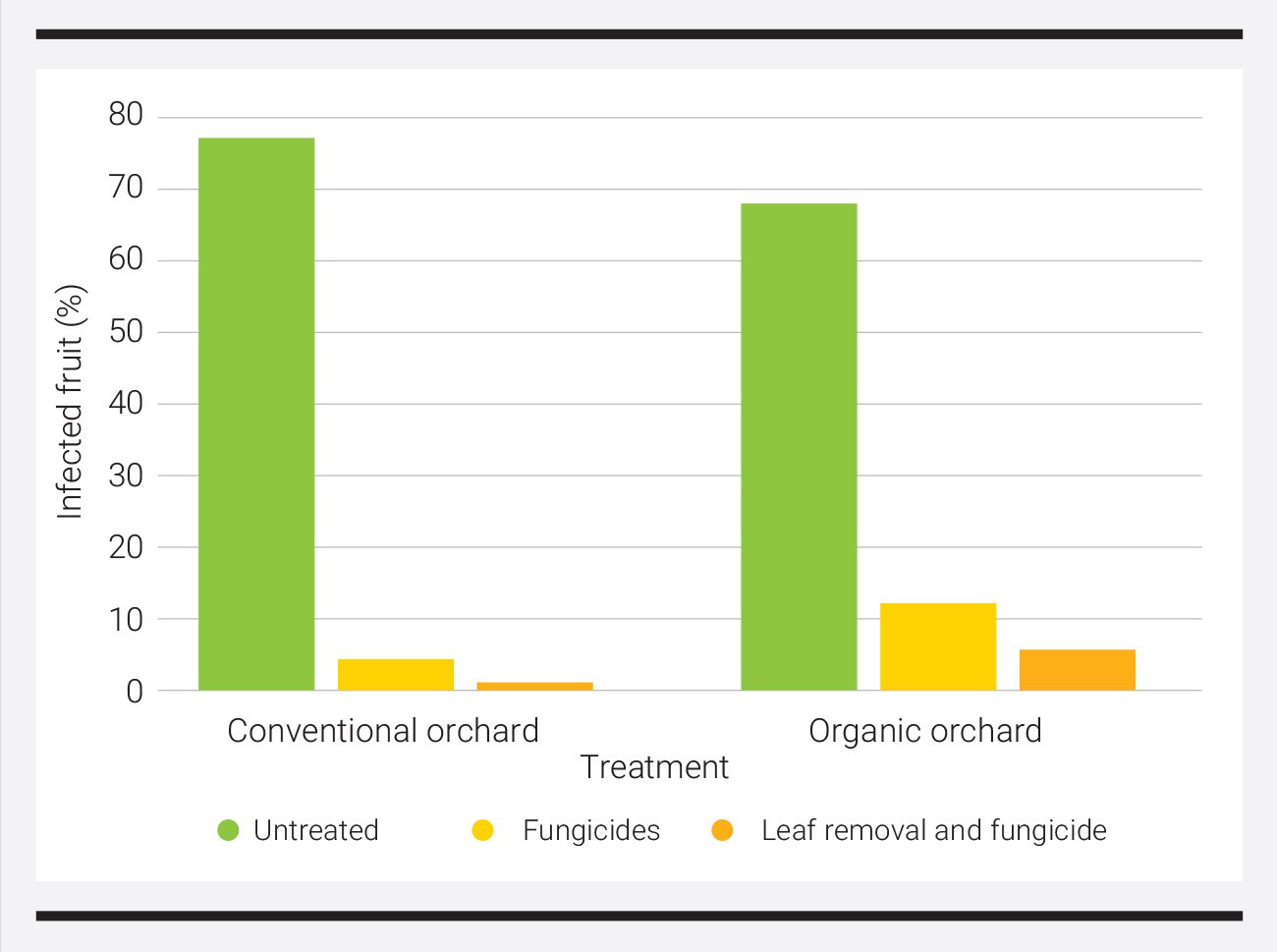
Figure 2: The percentage of fruit with visible symptoms of black spot damage averaged across two seasons for two production systems.
To check the validity of these results, in the following season, six different orchards were selected to compare fungicide alone treatment versus a leaf removal with fungicide treatment. While one orchard had no symptoms of black spot, the combined treatment in the remaining five orchards all had dramatically reduced incidence of black spot on the fruit in the combined treatment (Figure 3). Averaged across the five orchards, there was a 77 per cent reduction in black spot on the fruit due to the removal of the fallen leaves in mid-winter. This is a similar result to that observed in the conventional orchard in the previous two seasons. The combined treatment resulted in close to one fruit in every 200 having an observable black spot on it. This confirms the usefulness, reliability and effectiveness of fallen leaf removal for reducing the initial inoculum of black spot and increasing the effectiveness of fungicide sprays.
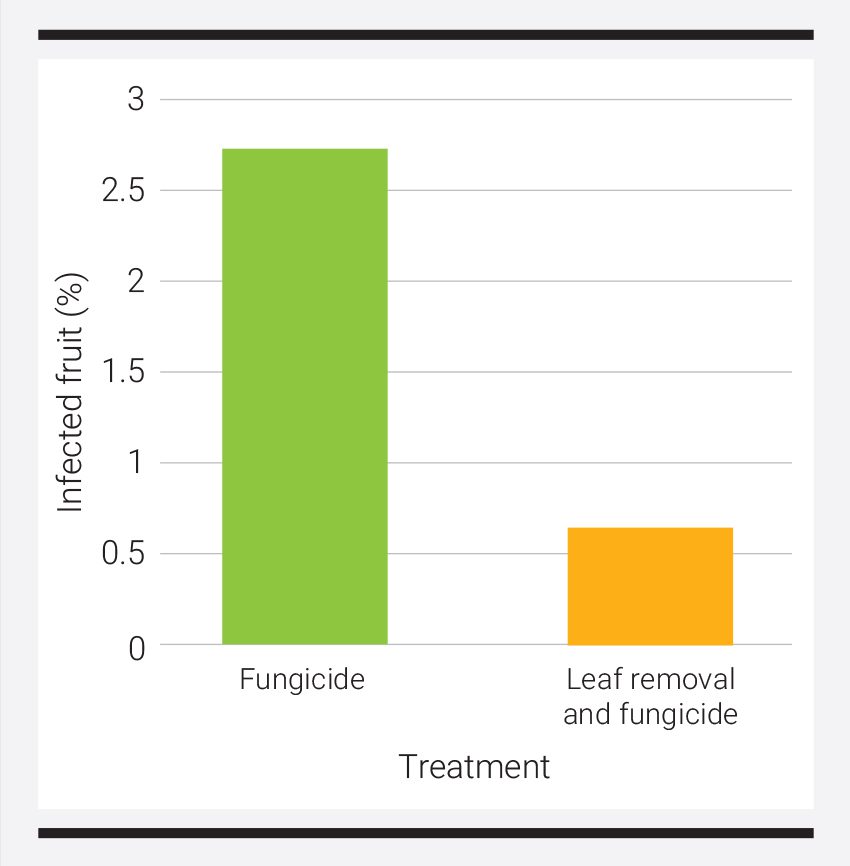
Figure 3: The improvement in black spot control on fruit by winter leaf removal in addition to the use of fungicides averaged across five orchards.
A feature of leaf removal is that if it occurs in winter and most of the leaves are removed, the treatment is effective. As Australian growers generally do not have access to large vacuum equipment, we will rely on encouraging the breakdown of fallen leaves to achieve similar results. As microbial breakdown of fallen leaves takes a long time to occur compared to the vacuum method, it is important to start this approach as soon as possible after harvest. This usually begins with the application of a urea spray to provide nutrients for the breakdown microbes to use and to promote leaf drop. The next step usually involves breaking the leaves into little pieces using mulching mowers. Without special equipment to mow under the trees, this involves a method of getting the leaves out from under the trees and into the inter-row space where mowers will have access to them. This may be a new use for air blowers to assist with autumn leaf removal from the trees and to blow the leaves out from under the trees and into the mowable space on the other side. Again, the earlier in the winter period that this is done the better.
Take home messages
- Black spot/apple scab survives over winter on the fallen leaves on the ground underneath apple trees.
- In spring, during wet weather, the fungus living in the fallen leaves produces ascospores that infect young leaves and flowers.
- If the fallen leaves are destroyed or removed during winter there are fewer ascospores in the orchard in spring to infect the new growth.
- By destroying or removing the fallen leaves in winter, the level of control achieved with fungicides during the growing season is dramatically enhanced, resulting in increased yield of blemish-free fruit.
Further reading
Boualleg NJ, Salomon MV, Vilardell P, Aramburu B and Cabrefiga J (2024) “Control of apple scab in commercial orchards through primary inoculum management”, Agriculture, 14(12):2125. https://doi.org/10.3390/agriculture14122125.
The APAL website and APAL YouTube channel have several articles, webinar recordings and videos about the management of black spot, including methods of control of primary inoculum on fallen leaves. Visit https://apal.org.au/?s=black+spot and www.youtube.com/@AppleandPearAustraliaLimited/search?query=black%20spot.
This article was first published in the Winter 2025 edition of AFG.



