
Container trees prove fruitful for orchards

Special ‘ribbed’ pots increase aeration and allow the roots to be air-pruned as they reach the outside, prompting the young tree to grow a flourishing root system.
When Richard Guthrie considers the future for commercial fruit orchards, he sees container-grown trees as integral to a world of increasing automation and limited availability of land.
“Workers are lining up to get on machines like apple picking platforms in orchards and our people really like the ease of working on the Ellepot system, where bench-grafted trees are grown in specialised trays on racks set at waist height,” says Richard from Galgate Nursery at Stanley in north-east Victoria.
“Added to that, we have limited access to fresh ground to produce trees for commercial growers unless we fumigate. That’s a very expensive process and to fumigate year in, year out is not good for soil health in the long term.”
In the past two years Richard has produced 20,000 trees in the Ellepot propagation system, where trees grow in propagation plugs that are120mm wide and 240mm deep in a mixture of peat, perlite and steam-treated wood waste, wrapped in paper and placed loosely in special six-cell trays. Rather than being solid-walled, the tray cells have four open ‘ribs’ that increase aeration enabling the roots to be air-pruned as they reach the outside. This prompts the young tree to grow a flourishing root system that enables an easy transfer into the ground in its original plug.
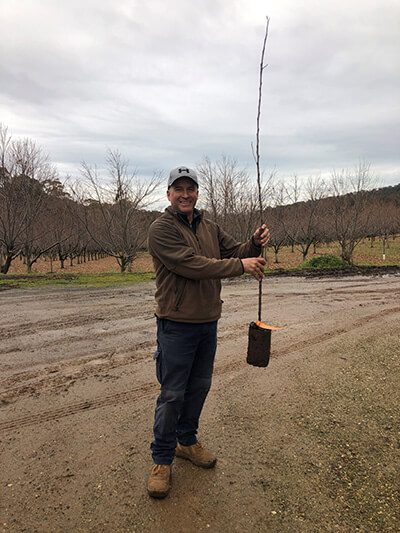
Richard Guthrie, Galgate Nursery, says he is using a using a third of the amount of land to produce the same number of trees, and the trees are more consistent.
The system rules out transplant shock, but Richard says the expected smooth transition wasn’t apparent at first when they were planted in a commercial orchard.
“An eighth of the block was planted to A grade bare rooted trees and the rest was planted to potted trees which we expected to hit the ground running, but they were noticeably slower to develop,” he recalls.
“However, they had caught up by midsummer and by the end of the growing season, the Ellepot trees were growing better than the bare rooted and none had died.”
Richard produces a 1200mm standard bench-grafted trees on traditional rootstocks such as M9, M26 and MM102, but says growers are beginning to ask about rootstocks that have replant tolerance, such as JM1 and JM7. He is currently developing land to produce another 20,000 trees in Ellepots, including a large run of tissue cultured JM1 rootstock for future tree sales.
“Growers may not realise that prior to Ellepots, when I got an order for 1000 trees I actually had to put 1200–1300 in the ground to allow for variables like the soil, wind, frosts and animal damage,” says Richard. “With a double tray Ellepot system in racks, I am using a third of the amount of land to produce the same number of trees without that variability. And they’re consistent – I can just about put a spirit level along the tops of the trees as they grow.
“From my end we can plant whenever we want and deliver trees when growers want them rather than waiting to lift the bare rooted trees when they’re dormant.”
He admits the Ellepot system has required a big outlay in terms of up-front capital but says it’s similar in cost to the bare rooted production system.
“It’s initially more expensive to set up racks and buy Ellepot stock but if I add up the tractors, fumigators, ploughs and planters associated with growing a tree in the field plus the cost of land to lease or purchase, I don’t think there’d be much in it.”

The Galgate Nursery bench-grafted trees are grown in specialised trays on racks set at waist height and connected to irrigation/fertigation systems.
Richard has teamed up with Tasmanian agronomist Peter Morrison from Twin Rivers Nursery in his quest to learn more about the Ellepot system.
Peter invested in an Ellepot-making machine from Denmark to produce 120mm pots that allow for bigger root volume, after being introduced to the system by a friend three years ago. “It’s the most nervous I’ve been about making a business decision in my life because I thought that growers may not accept potted trees and that I wouldn’t be able to grow a big enough tree to plant out, but I’m happy to say I couldn’t have been more wrong on both counts!” Peter says. The convenience of the container system has become more critical as the supply of workers dries up due to the Covid-19 pandemic, he says, and the Ellepots are no more than 5–10 per cent dearer than bare rooted trees.
“More and more experts are saying that in 10years’ time there won’t be a tree grown in the ground. From an agronomy point of view, we should be able to grow a better tree in an Ellepot because the treatment is uniform and there are cost savings from efficiency of labour,” Peter says. The simplicity of the container trees makes it an easy process for growers to plant them in the or-chard, he says.
“They don’t come in their trays – they’re removed and stacked in their plugs singly in a bin, much the same as bare rooted trees. Growers don’t have to do any more than keeping them a bit moist prior to planting. There’s no removal of paper,” Peter says.
While world practice is to bring grafted trees out of the Ellepots at one year, Peter is currently trialling two-year-old trees in the container system.
“The most important goal is to have a bigger tree at the end of the season. I’ve visited several growing areas on the mainland and in Tasmania in the past year and I’m very disappointed at how poorly a lot of young trees have taken off,” he says. “There are multiple factors at play – the biggest is going into replant soil, which affects apples more than any other crop; the next is the type or breed of rootstock; and probably equal with that is the perception of growers that they’re feeding the trees really well with nutrients, when they’re not.
“As a fruit-growing agronomist I like to calculate what nutrients I’m putting on trees in kilograms per hectare per year but a lot of growers don’t do that. A tree should be able to fill its space in four years and to see orchards where the tree won’t fill the space in 10 is a concern.”
For more information on Ellepot container-grown trees, read about the orchard trials in Ardmona.


