Colouring in pears
Leaf blowing experiment gives insights into blush colour development in pears.
Light is a crucial element for development of red colour in pome fruit and it is the foundation of practices of leaf blowing and installation of reflective mulches. However, these practices are only used in higher value apple crops. Their efficacy in blush pears – and the potential for detrimental impacts, for example, sun damage – is unknown.
Last year researchers at Agriculture Victoria began undertaking a series of experiments to evaluate colour management in pears as part of the PIPS 4 Profit Pear production systems for future climates (AP22002) project. These experiments include efficacy and economics of leaf blowing, reflective foil, evaporative cooling and spray-on products, and will continue in the coming seasons.
The leaf blowing experiment
Typically, leaf blowing is performed late in the growing season to expose fruit and consequently enhance red colouration prior to harvest. When harvest coincides with hot weather – as it does for blush pears that mature in January and February – increasing fruit exposure brings risks of increased sun damage. Early season leaf blowing has not been considered for apples because colour development occurs late in the season. By contrast, red colour is present in many blush and fully red pears throughout the season. Early season leaf blowing could therefore offer a mechanism to increase red intensity and coverage and allow time for fruit to acclimatise and develop natural protection from high light exposure. However, red colour development in pears is dynamic and gains early in the season could be lost if canopies regrow and shade the fruit again.

Leaf blower set up for use in Open Tatura trellis.
An experiment was designed to not only test the efficacy of leaf blowing blush pears ‘late’ (17 January 2024) but also ‘early’ (16 November 2023) and twice in a season (‘early+late’). The cultivar ANP-0131 (marketed as Ricó™) trained to Open Tatura trellis and grown in a commercial orchard was used in this study. Treatments were applied to whole rows, with five replicates of each treatment. Fruit colour was assessed by the Green Atlas Cartographer, allowing calculation of the colour development index (CDI) for all visible fruit.

Leaf material removed after a single pass of the leaf blower.
Both early and late leaf blowing improved red colour development at harvest (Figure 1). Early+late leaf blowing produced even greater gains in red colour development. Scanning immediately before and after leaf blowing on 16 November showed a trend for decreased CDI (decreased ‘redness’) in the early and early+late treatments. Given the scans were conducted within 24 hours, the shift in CDI is likely an artefact of increased exposure of fruit revealing a greater portion of green peel, rather than an actual colour response. Scans the day before commercial harvest (26 February 2024) showed CDI was greatest (fruit were reddest) in ‘early+late’ treated rows. In addition to indicating redness of fruit, CDI has previously been shown by the team to correlate with percentage blush coverage; meaning that increased blush coverage is predicted in response to leaf blowing as well as the increase in redness of blushed peel.
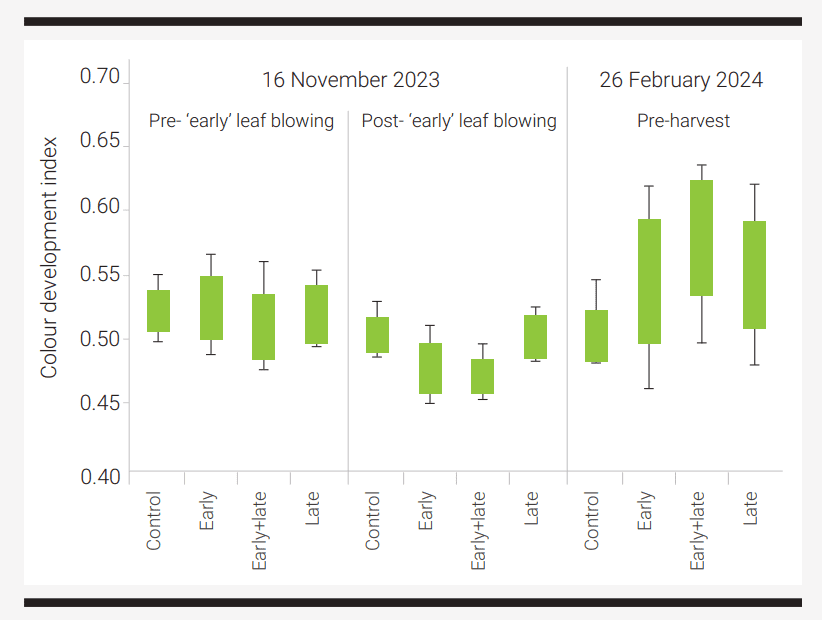
Figure 1: Colour development index (CDI) assessed by Green Atlas Cartographer pre- and post- ‘early’ leaf-blowing, and one day prior to commercial harvest. Treatments were applied to whole rows and box plots indicate range, mean and median of values for control, early, early+late and late leaf blowing treatments.
Improvements in CDI were associated with decreased canopy density (Figure 2). Where canopies remained particularly dense after leaf blowing, fruit colour was poor. These areas of poor colour within a block will require additional methods to improve fruit colour, for example, summer pruning to open the canopy or restricting irrigation to control vegetative vigour.
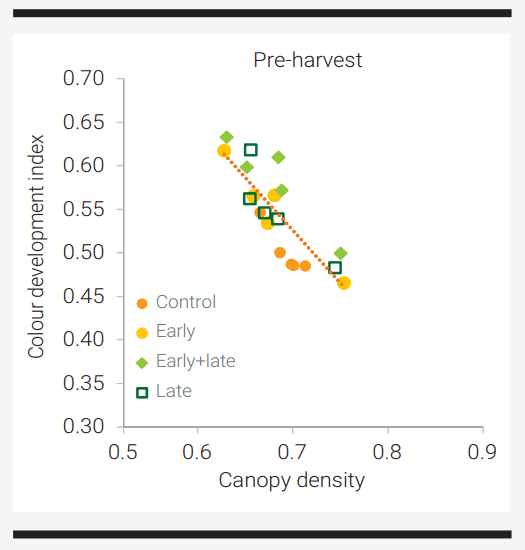
Figure 2: Mean colour development index (CDI) and canopy density of control, early, early+late and late rows.
Acknowledgement
 This study is a component of the PIPS 4 Profit Pear production systems for future climates (AP22002) project, funded by Hort Innovation, using the Hort Innovation Apple and Pear research and development levies, contributions from the Australian Government and co-investment from Agriculture Victoria. Hort Innovation is the grower-owned, not-for-profit research and development corporation for Australian horticulture.
This article was first published in the Spring 2024 edition of AFG.