
WA family legacy of quality apple production
The Fontaninis are combining the old and new, by continuing a family legacy of growing fruit, while embracing innovation.
Husband and wife team Trevor and Carmel Fontanini are gradually stepping back and handing the reins of running their 128-hectare property to their children Lucy and Joe.
The siblings are now fourth-generation orchardists at the lush, idyllic Manjimup in south-west Western Australia.
Following their parents’ lead, they continue to trial carefully selected apple varieties and growing systems. The family has also diversified into growing avocadoes.
Variety selection
One of the varieties the Fontaninis are particularly excited about it is the WA-developed Bravo™ branded apple.
Trevor said it’s an attractive apple with a deep burgundy colour and white flesh, which has a sweet, crisp taste. The family is hopeful export trials of the new variety will go well.
The apple was developed at WA’s Department of Primary Industries and Regional Development’s Manjimup centre.
“It’s under controlled planting and we’re among a handful of growers in this region and there’s a couple of growers in the Donnybrook region, Perth Hills and a few over east,” Trevor said.
The Fontaninis planted 6,000 trees, or about 2ha, of Bravo three years ago. They are in the process of erecting permanent netting over the trees.
All up, they have about 14ha of apples, and 6ha of avocadoes. Trevor said they plan to expand the avocado plantings by a few hectares in the next few years.
They also planted two newer varieties of Galas – Cherry and Alvina – last year, which will eventually replace the Royal Galas “…that have been around for a long time”, according to Trevor.
Joe, who has worked at the orchard since he left school 12 years ago and now manages the orchard, said the Cherry and Alvina Galas were more brightly coloured and easier to pick.
They also planted 1,200 trees of the new early, US-developed Fuji variety, Fiero.
Trevor said the Belgium-developed Kanzi® had also proved to be a “very nice apple” and popular.
The family grows Granny Smith, Rosy Glow and other Fujis as well.This season they pulled out their original Cripps Pink trees because they decided the variety was no longer financially viable for them to grow.
“We continuously look at new varieties because we have to keep up with the trends,” Trevor said.
“Varieties can fall out of fashion, so you’ve got to be right on top of growing new varieties.”
Joe and Lucy said the trend cycle seemed to be getting quicker.
“Every season there seems to be something different,” Joe said.
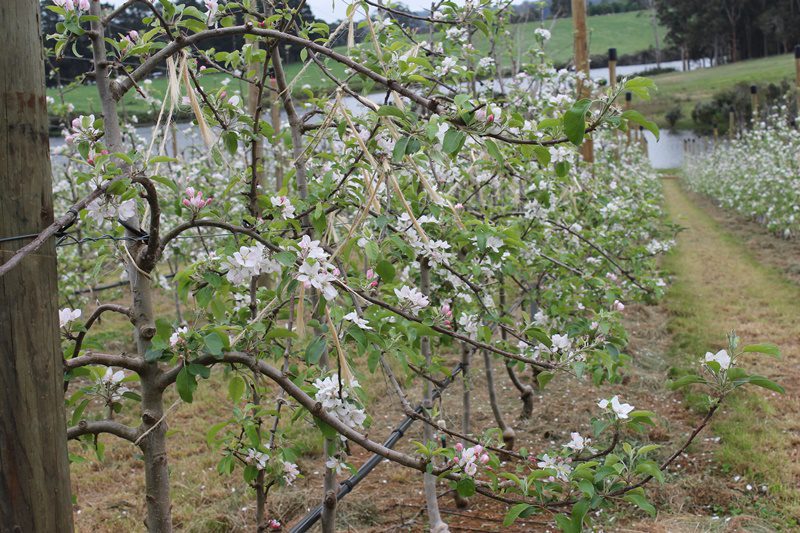
These trees that will produce Bravo™ branded apples were planted three years ago. Their branches are tied down in using the Mafcot system.
Orchard management
Fortunately, by using the best available rootstocks, close plantings and other modern management techniques, they get a small amount of production in their trees’ second year and good production in their third.
“The cost of planting orchards is horrendous, so you’ve got to get your production back as quickly as possible,” Trevor said.
They pick varieties that should grow well in the area, which has a mild Mediterranean climate, with generally cool, wet winters (with very few frosts) and warm, dry summers. According to the Bureau of Meteorology, Manjimup has an average annual rainfall of 994.2 millimetres.
“In the past quite a few years, the annual rainfall has dropped away – we still get enough to fill our dams, but it’s definitely dropped away,” Trevor said.
The large dams capture the water used in the under-tree sprinkler system throughout the orchard.
Lucy said it wasn’t until five or six years after a new variety was planted that they would know that it would produce well in their region and would be popular with retailers.
“I am, and I’m trying to teach the kids to be too, pretty ruthless with varieties that don’t perform or aren’t returning good enough money. We get out very quickly, we don’t have them sitting there,” Trevor said.
Joe said the fertile Karri loam soils weren’t deficient in any one nutrient, so their fertiliser regime ensures all the vital nutrients were kept “topped up”. They fertilise through the irrigation system and do a bit of spreading.
They alternate which blocks have soil tests done each year, and Trevor said if there was a variety that looked “a bit wayward”, they often had the soils tested two years in a row. They also do regular leaf samples.
Their work to improve efficiency in the orchard also involves trialling different growing systems. These include the 2D system that involves attaching branches to horizontal wires, as well as a cordon system.
“Both end up like a wall; they’re just different ways to make your wall,” Trevor said.
They have planted their new orchard of Bravo apple trees using the Mafcot system; which means they tie the branches towards the ground with string.
Lucy, who joined the family business two years ago, trains the trees and she said while it wasn’t difficult to do, it did take time.
Joe said the systems made pruning, thinning and picking easier and more efficient, and they seemed to produce well.
Their production figures include:
- Granny Smith (grown on open V trellis, planted more than 15 years ago) – get up to 100t/ha and 85-90t/ha regularly. Trevor said the system was easy to manage and still produced well.
- Rosy Glow – get around 90t/ha consistently every year
- Fuji – production varies year to year, have got up to 60t/ha
- Royal Gala – get up to about 40t/ha, will be replaced with newer varieties in coming years
- Kanzi® –the more mature 1ha of the variety produced close to 70t last year

Trevor Fontanini with two-year old Fiero Fujis on a 2D planting system.
Managing pests
Pest management is also vital for the orchard’s productivity.
Trevor said while they all do a “fair bit of visual monitoring”, Lucy had taken the lead on pest monitoring.
They have traps for apple months and other insects and do regular leaf samples, including to monitor for mites.
“We take 25 leaves out of each block at random and under the microscope, we look for eggs, predators and use that to determine when to spray,” Trevor said.
“We spray because we have to, not because we want to.”
As part of their HACCP accreditation, the Fontaninis keep a spray diary and record other management practices.
Aiming for quality
Under Joe’s management and Lucy’s induction and other support, the apples are picked by backpackers, with harvest starting in late February and going through to mid-May.
“We try to pick our crop in two picks,” Trevor said. “If you get that higher percentage off in the first pick, it just leaves a small percentage for the second, when you get to the third pick, quality and returns deteriorate.”
He said they chose varieties that lent themselves to two picks.
Joe said they do a lot of grading in the field to ensure they deliver only high-quality fruit for packing and storage at Newton Brothers’ Orchard in Manjimup, which also markets the fruit. Trevor said much of it is sold to Coles and Woolworths and some into the wholesale market in Perth.
“We have to send the best quality we can to the shed, because when you’re paying for storage, you can’t afford to store poor quality,” Trevor said. “Good pack-outs are very hard to get, so you’ve got to send in as high quality as you can.”
The family has worked with horticulture adviser Marcel Veens for many years, and he visits the operation three or four times a year.
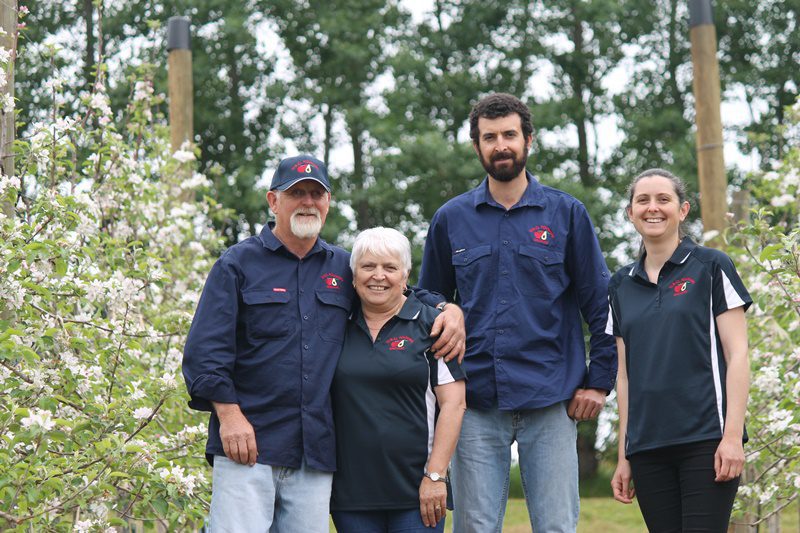
Husband and wife team Trevor and Carmel Fontanini with their children Joe and Lucy.
Future Orchards
The Fontaninis’ orchard has been a focus orchard in the Future Orchards® program for the past two years – a strategic levy investment under the Hort Innovation Apple and Pear Fund.
Their involvement includes opening their books and submitting data to AgFirst consultant Steve Spark, from New Zealand.
They’re also taking fruit measurements, conducting trials and have hosted a few orchard walks.
“It’s been good to get other opinions and advice,” Joe said.
“Steve helps us think about how we’re going and what we could improve.”
Lucy has recommenced fruit sizing each week during growing season, after Trevor did it a few years ago.
Susie Murphy White of Pomewest helps size the fruit every second week and she puts the data into a graph.
“I measure fruit every week and put it on a graph. If they’re not growing by 2-3mm or their growth drops away, we might need to water more, put on more fertiliser, unless there’s another explanation like a heat wave,” Lucy said.
As part of the Future Orchards program, the family planted a new orchard two weeks ago to do a fumigation trial.
The 24 by 100 metre orchard is separated into five 20-metre-long strips, on each of which they have applied one treatment from the four fumigants and the biological alternative under trial.
The trial is testing the effectiveness of two biofumigants (mustard grass and, in an Australian first, Ethiopian Cabbage); two chemical fumigants (methane sodium and chloropicrin); and finally Serenade Prime, a formula that contains spores of a beneficial bacterium that lives on plant root surfaces and in the soil and can develop a mutually beneficial relationship with the plant.
Lucy and Joe will go on a horticulture group study tour of New Zealand in January, guided by Steve Spark and Ross Wilson, also of AgFirst.

A Future Orchards® trial of five fumigant and alternatives is being run on the Fontanini farm. This orchard was planted two weeks prior to the photo being taken.
Family business
Trevor and Carmel have run the family orchard for decades, and have decided to gradually give the day to day responsibilities to their adult children.
“I’m going to start stepping back and giving them the reins, I’m still going to be around because I love it,” Trevor said.
“I’ve been here 51 years since I left school and it’s a good lifestyle, but it’s getting tougher.
“We do our best for quality, but as our production costs, including wages, keep going up, we’re not getting enough for our fruit.”
Trevor said as a result, they needed to raise tonnages per hectare and produce the fruit more efficiently.
“It’s beautiful once your tree’s up and growing. It’s beautiful when the end of the season comes, and it starts again, and when there’s apples on the trees and they look beautiful,” Carmel said.
Lucy and Joe said seeing fruit in the bins and appreciating all the hard work the team had put into it, was satisfying.



