
Beekeeper’s insights into pollination outlook
Note: This article was written in July 2023 prior to the detection of new Varroa mite cases at additional sites in NSW in August and September. For the most up-to-date information about the Varroa mite emergency response, visit https://www.dpi.nsw.gov.au/emergencies/biosecurity/current-situation/varroa-mite-emergency-response.
Trevor Monson, a beekeeper and pollination service provider of more than fifty years, shares his insights into what the future holds for Australian honey bees and pollination services.
They may be just a couple of centimetres long, but they’re a giant in our industry – and so are the specialists who handle them. Honey bees, and beekeepers, are at the forefront of many orchardists’ minds right now, thanks to last year’s Varroa mite outbreak and its threat to vital pollination services and crop yields.
So, what is being done – and what can growers do – to help these minute but mighty pollinators continue to thrive in an uncertain new world?
Trevor Monson, a beekeeper and pollination service provider for fifty years, and industry-leading pollination specialist, is reassuringly realistic, but optimistic.
Trevor heads up Monson’s Honey and Pollination, a fourth-generation beekeeping family business. Over half a century of caring for his own bees and those of others – whose hives Monson’s trucks to and fro across the country to pollinate a raft of crops ranging from apple, pear, almond, cherry and blueberry to melons and avocados – he has built up a formidable knowledge of bees.

A biosecurity officer testing hives for Varroa mite. Photo: NSW DPI
Trevor said while the containment of last year’s outbreak of the deadly Varroa mite in New South Wales had seen movement restrictions, which played havoc with crop pollination, lifted for the current season, he believed the spread of Varroa was inevitable, but could be managed.
“I’ve travelled nearly all over the world and seen a lot of these headaches first-hand,” he said. “There’s nowhere in the world where the Varroa mite has ruined the pollination industry.”
“Last year was very difficult because the border closed, and we ended up being 58,000 hives of bees short for the Victorian almonds as a result.
“Since then, the biosecurity authorities are convinced that they’ve got it controlled – or not necessarily controlled, but they’ve got it contained in that area. I’m comfortable with the word ‘contained’ at the moment. Eventually it’s going to get out of that containment line, and we’ll have to live with it.”
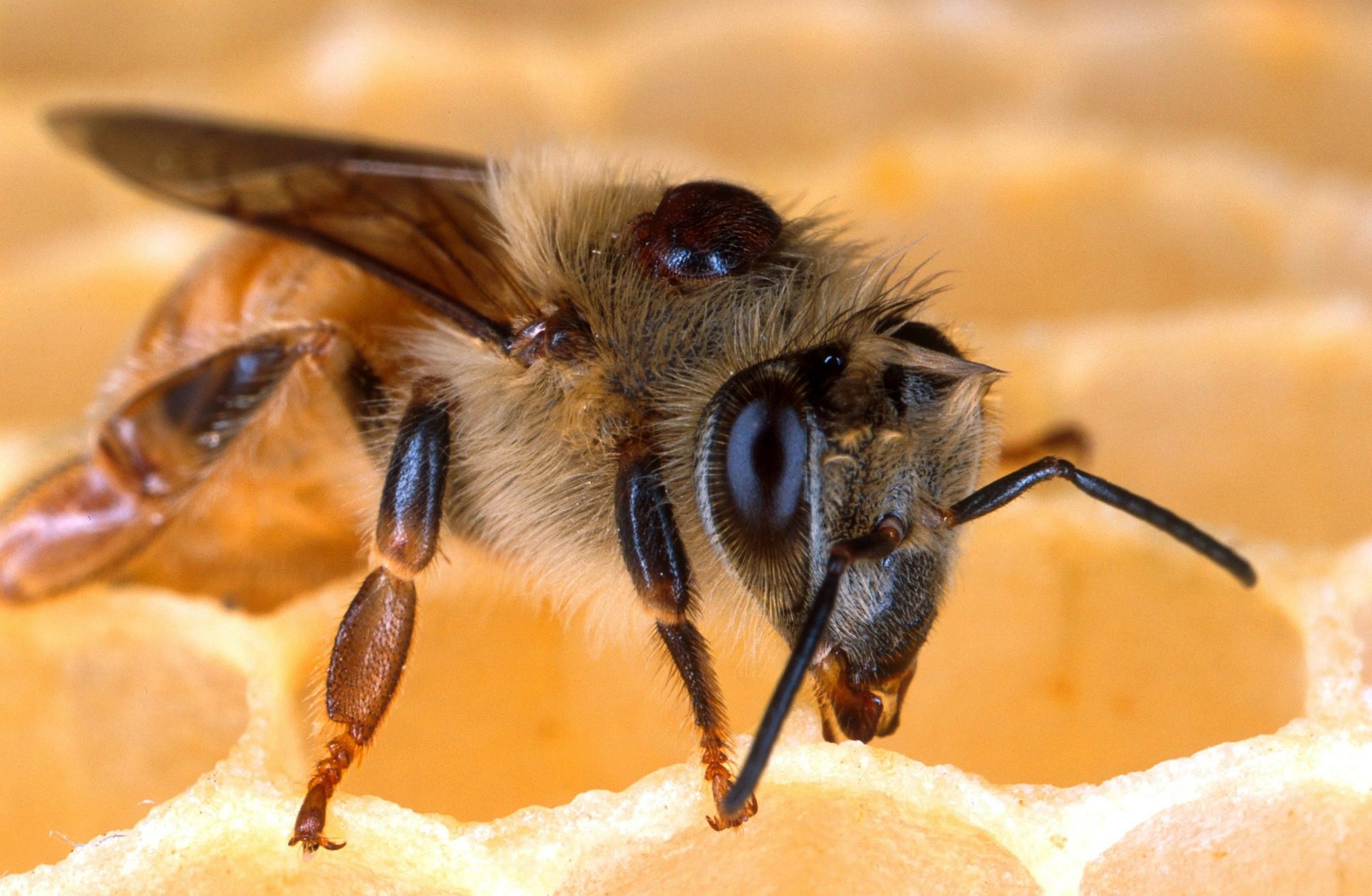
Varroa mites (Varroa destructor) are tiny reddish brown external parasites of honey bees. Photo: NSW DPI
Living with it may look quite different depending on how you currently go about pollinating your crops.
Trevor echoes the warnings of bee researchers1 that if the parasitic mite Varroa destructor becomes established in Australia, it may increase reliance on managed hives and costs of pollination.
“The potential for Varroa to disrupt wild populations of honey bees – which up to a third of Australian growers exclusively rely on for pollination – means that those who don’t already have pollination services secured may suffer the most if Varroa becomes endemic,” he said
“It is moving; every now and then they’re finding new sites of it. One of the last ones was fairly close to a national park, which is a bit of a worry because if it got into the wild bees in the trees, we would have some trouble containing it.
“What it means is that people who have been getting free pollination from wild bees in hollow trees in the bush, or bees that weren’t managed, are going to lose access to that, and so the demand for managed hives for pollination is going to increase.”
This might seem like an obvious win for the pollination industry, but Trevor said beekeepers would need to ensure management practices were up to scratch to avoid losing bees.

Trevor recommends going spray-free while hired hives are in the orchard
“Beekeepers with well-managed hives are going to survive and do quite well, but there’s a cost and energy involved in doing that,” Trevor said. “If you don’t do it properly, you’re going to lose your bees. Those first couple of years are the telling years, but it can be managed. It’s managed everywhere else in the world. It’s just another cost and another bit of energy.”
Trevor is keeping up to date with the latest research on how to manage Varroa without decimating beneficial insect populations. Along with innovative hive baseboard designs that dump Varroa mites and hive beetles into a bath of acid, breeding programs are in full swing to try to develop a Varroa-resistant super bee.
“There are breeding programs of bees that groom one another a bit more aggressively, that groom these things off. Then there are other methods – the Varroa prefers to breed in the drone brood, so some people are running pure drone combs and then taking them out and destroying them before both the drones and the Varroa mites hatch.”
Of course, it’s likely going to be many years before these new breeds are ready to go, so what’s being done in the meantime?
For beekeepers, Trevor said it was all about keeping an eagle eye on their hives. “The real thing is for beekeepers to monitor. There’s a certain level where the mites get to – three mites per hundred bees or something like that – then it’s time to treat. And if you don’t, and it gets away from you, it’s a lot harder to get the thing back under control.”
Tune into hive health
Growers can improve pollination outcomes by taking steps to support bee health, including avoiding spraying during pollination, increasing pollen diversity and paying attention to hive placement under nets.
“Integrated pest management is key,” Trevor said. He recommends a hyper-vigilant spray regime that focuses on the gentlest possible alternatives and going completely spray-free while hired hives are in the orchard.
“Spray before the hives arrive, or at night with something gentle,” he said.
Even fungicides that were once thought harmless to bees should be avoided while the hives are on your property. And, while it might mean doing several sprays, avoid tank mixes wherever you can.
“You can understand that a grower wants to put three different things in the tank and only do one shift,” Trevor said, “but that changes the whole chemical structure of the spray. One of the papers I read indicated that tank mixes can increase the toxicity by a thousand per cent.”
Trevor said nets, while favoured by growers for crop protection and fruit quality, can confound bees and lead to lower levels of hive health, depending on the type of net. Cross-hairs in the netting can trap bees, and canopies that hang too low can disorient them.
“With some of the nets, if you put bees in the middle of a netted orchard, they’ll fly straight up to where the sunlight or the sky is, and then when they come back they baulk at the net,” Trevor said. “It comes down to placement.”
“We’ve done a fair bit of experimentation with the bees, and being on the edge of the netting and having different colours for orientation and a different style of netting on the walls, so the bees can fly through it, all helps.”
And Trevor said forcing bees to live on just one type of pollen – while it might seem ideal for even pollination – will only land you an unhappy bee, and one that is less fit to do the job in the orchard.
“In the old days, everyone wanted to destroy every weed that had a flower on it so they only had the flowers from the almonds or cherries or apples, but we understand now that a varied diet is way better for the bees and the bees are a lot healthier,” he said.
“Don’t slash all those wild weeds that are up the middle unless it’s for frost control, because if you slash them, then the bees are going to fly straight out of your orchard to the paddocks where they can find them.”
Trevor said this could mean leaving sections of weeds to grow unchecked, or planting inter rows or specialised forage plant blocks that provide extra variety for visiting pollinators.
“Though be careful with your plant selection, as you don’t want to also attract thrips or aphids,” he warned.
Perhaps most obviously, Trevor said one of the best things growers can do for their borrowed bees is consider where they place the hives.
“Through the 50 years that I’ve been pollinating and advising on all crops, I still think that the placement of bees is really important,” he said. “We need bees to fly what I call sideways to cross-pollinate. They can be forced to cross rows by making the group a bit bigger, but it forces them to fly in circles and across rows. If you put the bees at the end of the row, they are naturally just going to fly down the row.”

Bees that have a varied pollen diet are happier and healthier
A lifelong passion
While Varroa mite may be the immediate threat on everyone’s mind, Trevor said when it comes to beekeeping, the most common problem was even trickier to fix.
Bees can only be shifted at night. As the sun comes up, the instinct to locate blossom and mobilise the hive kicks in.
“The biggest problem with beekeeping is the night work: travelling at night when the bees are all home in bed. I used to think it was a romantic lifestyle, but it’s really not a family lifestyle.
“They have been experimenting in the US with refrigerated vans and air vents to shift bees in the daytime,” Trevor said. “They net bees so they can’t escape. In California for almond pollination, they bring bees from Minnesota in netted semitrailers and it’s 5,000 miles.
“You could sort of improve the lifestyle of that, but over there they’re spoilt, they just ring up a contractor and they load the truck and the beekeeper wanders off, but Australian beekeepers haven’t got to the point of trusting someone else to cart their bees.”
At 76, with a son, son-in-law and nephew now all part of the beekeeping dynasty, you’d forgive Trevor for taking more of a backseat these days. He’s doing just the opposite.
One thing you can count on in an increasingly uncertain world of pollination is Trevor’s unfailing enthusiasm – and his willingness to look to the cutting edge of innovation to support his life’s passion.
“Unlike a lot of beekeepers, I’m interested in butterflies and blowflies and native bees and all sorts of things as pollinators,” he said. “Pollination has been my life. It still excites me.”

Anthony Kachenko, oversees Hort Innovation’s pollination research to support Australia’s fruit growing industry
Anthony Kachenko, Hort Innovation
Anthony Kachenko is no stranger to the plight of the humble honey bee. In fact, as General Manager of Production and Sustainability Research and Development at Hort Innovation, he’s overseen Hort Innovation’s support for Australia’s fruit growing industry in the form of pollination research swell to a tidy $60 million.
“It is a fairly large area of investment for us, for some very obvious reasons – namely making sure that pollination-dependent industries continue to thrive into the future, with the current conditions around Varroa mite or other potential pests,” Anthony said.
While Varroa mite is at the forefront of many minds, Hort Innovation’s pollination research is broader and deeper than just this most recent threat. There’s research in the works across everything from the viability of managed alternatives to European honey bees, to how nets affect pollination rates, and developing insecticide-resistant honey bees to better protect our pollination security.
The catch is that research takes time and many of these projects are in their early to middle stages. This means it’s going to be a while before we see, for example, the outcome of some very exciting work being run out of the University of Sydney on a Varroa-specific biopesticide. Early results, Anthony says, may very well be promising.
“It’s a biological approach. There are different proteins within honey bees and Varroa mites, and the biopesticide will target those and disrupt the insect hormones. It doesn’t affect honey bees, but it can target Varroa mite and small hive beetle.”
Creating a protein-specific pesticide means that the substance in development won’t be harmful to mammals, birds, or non-target insects, reflecting Hort Innovation’s general approach of putting sustainability first. But more importantly, is the biopesticide project likely to be a viable tool in defending Australian bees from this particular threat?
“If we can prove the formulation, then yes. When I look at the different approaches globally around Varroa mite, most rely on hive management or chemical applications. We do have to look at safer alternative approaches.”
Very exciting stuff for anyone involved in pollination, even if it is just a year into testing.
As for current research outputs, a project on hive stocking rates has found evidence to suggest that three hives per hectare is just about right for hired hives in apple orchards.
Research on netting and its impacts on pollinators is another major area of effort. One big takeaway from current projects is to get those hail nets up as high as you practically can. According to Anthony and the researchers, higher nets make it much easier for bees to navigate your orchard, and can therefore result in better pollination. Rice nets that necessarily have lower canopies can be improved by opening the sides, which helps the bees orient themselves, but be aware you may lose some to the temptation of resources outside the orchard.
As for native and stingless bees, while they are a valuable asset to any pollination effort, don’t expect to be hiring in managed hives of them any time soon. It seems that some things stay wild, regardless of how much research we might put towards managing them.
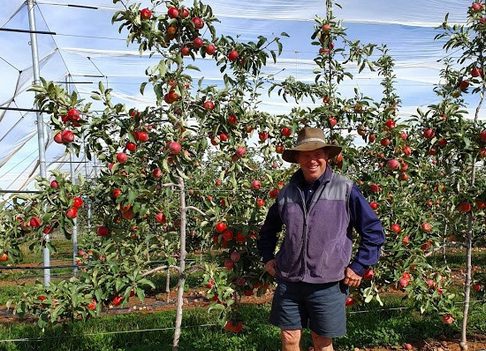
Ian Pearce, Stoneleigh Orchard, started hiring in hives in 2020 following the drought that had impacted the activities of native pollinators.
Ian Pearce, Stoneleigh Orchard
Up until the spring of 2020, Ian Pearce of Stoneleigh Orchard in Orange, New South Wales, relied entirely on wild and native bees to pollinate his crops. Then came the drought. It hit the fruit hard and also seriously impacted the activities of native pollinators.
“After the drought, our cherries were starting to come out and I was wandering around looking for bees – native bees – and none came,” Ian said.
Fortunately, they were able to hire in some domestic hives from an apiarist, albeit late in the season, which, as Ian said, “saved our bacon”.
Since then, they’ve seen their local bee population rise again, along with the many other pollinating insects that call the region around Stoneleigh Orchard home.
Like many of us, though, Ian has taken the lessons of 2020 seriously. Every season, Stoneleigh Orchard now hires in a few hives of domesticated bees – only around 16 for the 20-hectare orchard. Ian considers it a necessary bit of risk management.
“It’s not a huge expense for us. We just see it as we don’t want to miss out, or have a poor pollination because we haven’t been bringing the bees in. We don’t want to get caught out.”
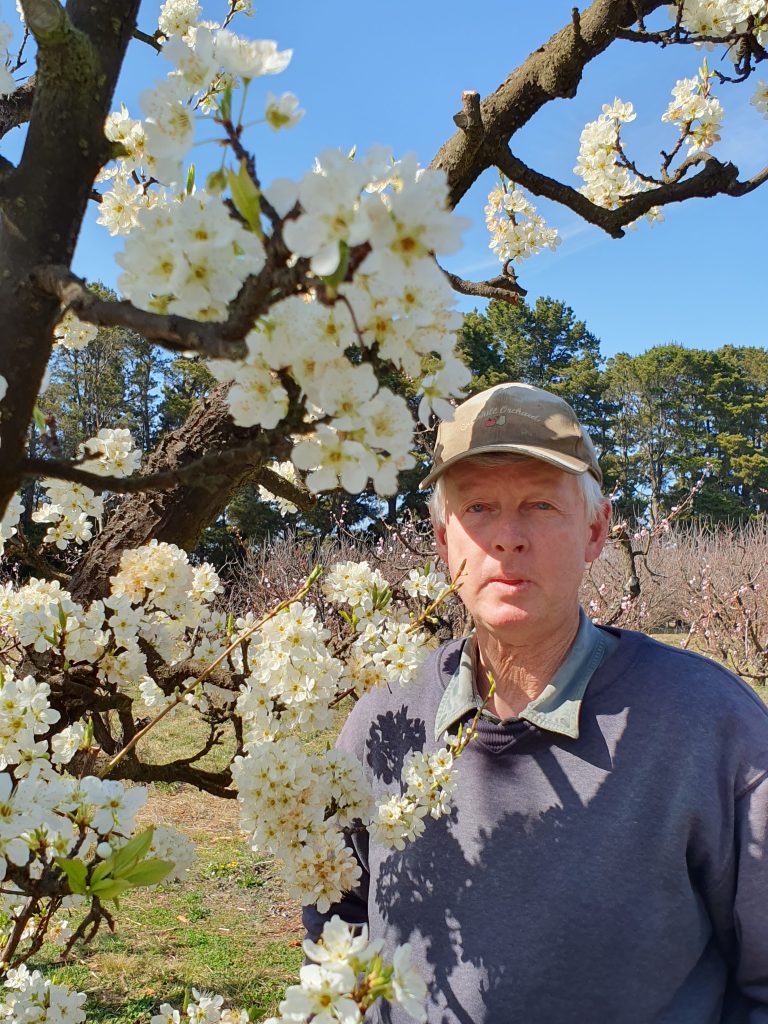
Warren Yeomans relies on local pollinators to set the fruit at Greenhill Orchards.
Warren Yeomans, Greenhill Orchards
Warren Yeomans of Greenhill Orchards near Armidale, New South Wales, has learned to tolerate a little untidiness in service of the wild bees that live on his property.
“I know three or four sites where there are wild European honey bees in trees, and I keep an eye on them. I just make sure that they’re surviving. I try not to disturb the trees or the habitat around them,” Warren said.
Wild European honey bees need dead and dying trees to make their hives in, which means Warren has come to prioritise leaving pockets of native bush to go through their own cycles in their own time.
It’s an approach that has paid off for Greenhill Orchards, which now relies almost entirely on local pollinators to set its fruit.
“I have had pollinators in a couple of times, but generally overall it’s very negligible, any introduced pollinating. I’d say 99 per cent of the time I’ve relied on bees that are in the environment around me.”
With the threat of Varroa mite unignorable – if it got into wild bee populations, it would be likely to wreak havoc on these vital populations – Warren is taking his role as an arm’s-length bee caretaker seriously.
“I’m trying to improve the amount of native vegetation I have, encouraging regrowth and trees. Of course, that’s a very long-term proposition, but you need dying trees with holes in them for the bees to inhabit. We do have a rather significant amount of various ages of vegetation, and we certainly want to maintain that so we have new trees coming up as the old ones gradually deteriorate.”
When you’re living alongside wild pollinators, your pest management practices come into play as well.
“We are very careful with what spraying applications we use, to take care of the bees as well. You look at the risk – looking for the lowest toxicity with maximum benefit.”
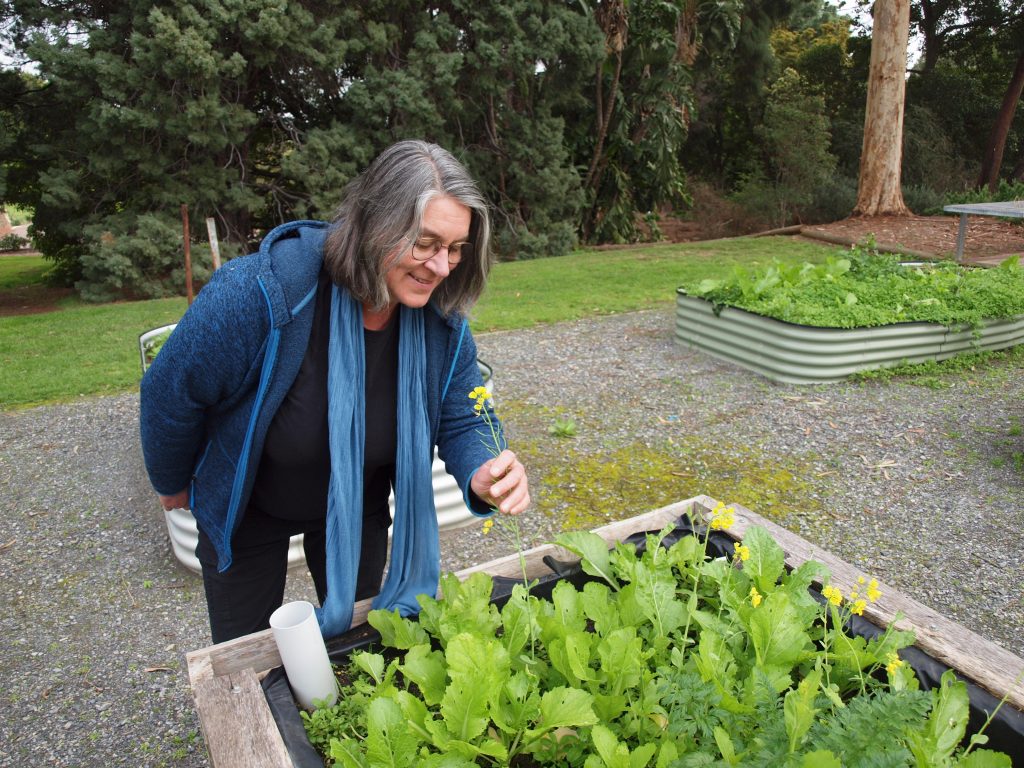
Katja Hogendoorn, University of Adelaide, has spent years studying pollination patterns and the effects of all kinds of variables on fruit set and beehive health
Katja Hogendoorn, University of Adelaide
Dr Katja Hogendoorn of the School of Agriculture, Food and Wine at the University of Adelaide has some advice for orchardists. As a researcher who has spent years studying pollination patterns and the effects of all kinds of variables on fruit set and beehive health, she’s in an excellent position to provide it.
With so much focus at the moment on the future of pollination services, it’s a great time to be tuning in to the latest from the field studies. And as is often the case, the results are a mixed bag. For those of us using hail and rice nets, the placement of the hives is paramount – not just for getting the ideal rate of pollination, but for maintaining your relationship with your apiarist.
Katja’s research looked at how both types of commonly used orchard nets affect hive health, pollination and bee behaviour, and got some interesting outcomes.
“Basically our main question was, Do you open or close the nets for the bees to perform?” she said. “What we found there was that when the bees can get out easily – because the hives are on the edge so they can get out into the open, or because the roof is open above the hive, or because it’s bird nets where the bees can get through – in those situations, the hives will stay healthier and the bees get a large variety of pollen in, but they get less apple pollen in. And when the hives are in the middle under the nets and the roof above is closed, the health of the hive goes down a bit, but they get more apple pollen, which indicates that they’re better pollinators.”
So what’s an orchardist to do with this information?
“If you put your hives under nets in the middle of your orchard,” Katja said, “then you will get better pollination – twice as good probably – but the hive strength will go down. So you have to pay your beekeeper a bit more per hive.
“On the other hand, if you place the hives near the edges, you allow the bees to go outside and so the pollination is less good – you probably need more hives.”
Alongside her bee behaviour studies, Katja has also run fascinating projects using mobile polliniser varieties. It’s almost exactly what it sounds like: potted polliniser trees are loaded onto slow-moving, autonomous trolleys that creep through the orchard. These mobile pollination stations are meant to fill in the gaps that can occur in the middle of long rows, where fruit set can be compromised.
“We found very much that in the middle of long rows you get insufficient bee activity under the net,” Katja said. “And what we found was that in those spots, provided there is some bee activity at least, the mobile polliniser units increased the sets – they can double the set.”
But don’t let your futuristic fantasies run wild just yet. It turns out, Katja said, “in the other spots, where there is sufficient bee activity, the mobile polliniser units don’t help.”
Factor in the investment of setting up the mobile polliniser units – growing the varieties in pots, maintaining them, setting up and maintaining the autonomous trolley system – and you’re looking at a significant outlay.
“On the whole,” Katja said, “while it works in the areas of low set, we don’t think it’s economically feasible.”
This article was first published in the Spring 2023 edition of AFG.



