
Sterile insect technology for control of codling moth

TIA Senior Research Fellow, Dr Sally Bound is leading the pilot program which is taking place across three apple orchards in Tasmania’s Huon Valley. Photo: Michele Buntain
A pilot sterile insect release program for controlling codling moth is being evaluated in three Tasmanian apple orchards.
Codling moth (Cydia pomonella) is a major pest in all Australian pome fruit production regions except Western Australia, where codling moth is not present. It is one of the most economically damaging pests of apples, causing direct damage to fruit as it feeds. If left unchecked, codling moth can damage 50–90 per cent of fruit, decimating the crop. Codling moth also infests quince, pear, nashi, summer fruit, walnut and chestnut.

Figure 1: Codling moth adult (left). Photo: Whitney Cranshaw, Colorado State University, Bugwood.org
Codling moth larva (right). Photo: Gyorgy Csoka, Hungary Forest Research Institute, Bugwood.org
Current management strategies include monitoring, mating disruption, biological control and chemical pesticide control. While these strategies can be effective, application of pesticides can disrupt beneficial insects, substantially affecting integrated pest management (IPM) systems. Neglected orchards as well as roadside and unmanaged backyard fruit trees pose a real threat as they provide a source for reinfestation of commercial orchards. Sterile insect technology (SIT) in tandem with other IPM-friendly methods has enormous potential to change the way codling moth is managed in Australian apples.
Sterile insect technology
The use of SIT is a relatively new strategy being developed for a range of pests, with fruit fly being a prime example of SIT technology in Australia. The method is an environmentally friendly way of controlling insect pests that can work well in conjunction with other IPM methods.
SIT programs work by flooding the wild population with large numbers of sterile males to substantially reduce the number of fertile eggs produced. When this is repeated over a number of seasons, the population crashes and infestations drop below damage threshold levels.

Figure 2: Sterile codling moth in laboratory (left).
Figure 3: Sterile codling moth caught on trap (right).
Successful codling moth SIT programs
In Canada, SIT has been successfully used for codling moth control since 1992, with an area-wide approach reducing wild codling moth populations by 94 per cent. A corresponding 96 per cent reduction in pesticide use for codling moth has been a win-win situation for both growers and the environment. A program commenced in the Hawkes Bay region of New Zealand in 2014 with sterile codling moths (SCM) imported from the Okanagan-Kootenay Sterile Insect Release (OKSIR) facility in British Colombia, Canada. Treated regions of Hawkes Bay have recorded an impressive 98 per cent reduction in the catch of wild moths after only a few years of the program.
Sterile insect production
Codling moths are sterilised (made infertile) with highly controlled low-dose gamma radiation (200 Gy) at the OKSIR facility in Canada. This dose of irradiation sterilises the female moths and produces a high level of sterility in the male moths so that very few viable offspring are produced from wild-sterile matings. The same technology is used to produce sterile fruit fly which are currently produced and released in Australia to eradicate fruit fly outbreaks in pest free areas. The sterile codling moths can be distinguished from wild moths due to a permanent internal pink-red dye marker from the larval diet (Figures 2 and 3).
Pilot study in Australia
A pilot sterile codling moth release program is currently underway in Tasmania. The project will assess sterile moth viability and competitiveness, determine the logistics of importation and release, and undertake an economic assessment of the release program, with the aim of developing recommendations for adoption and integration of sterile releases into an IPM program. Now in its second year, the project has successfully developed secure entry pathways for importing SCM into Australia from the Canadian OKSIR facility. Quality control tests have been undertaken to check moth viability on arrival. Trial releases commenced in late October 2022 in three selected apple orchard blocks in Tasmania’s Huon Valley region and continued on a weekly basis until mid-February 2023.
The sterile adult moths are airfreighted from Canada each week. They are packed in small ‘dixie’ cups and chilled to ensure the moths remain dormant until release. Moths are gently hand distributed throughout treatment blocks at the rate of 6,000 moths per hectare per week (3,000 male moths per hectare per week). In New Zealand, moths are released by drones over commercial orchards. If sterile codling moth releases are adopted by the Australian apple industry, this method could also be used here.
Monitoring is an important part of the program to indicate numbers of both wild and introduced sterile moths. Traps in both moth release blocks and nearby control sites are checked weekly for counting wild and sterile moths. Fruit assessments are also being undertaken in the orchard to determine the incidence of damage.
The import, release and monitoring program will be repeated in the 2023–24 season.

Left to right: Cup of moths ready for release; decanting moths into insulated flask prior to field release
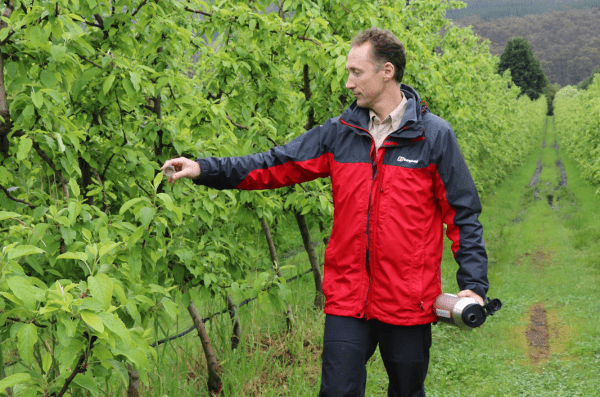
Dr Guy Westmore distributing moths along the tree row.

Dr Guy Westmore undertaking quality testing on the sterile moths.

Assessing codling moth damage in the orchard.
More information
Visit the TIA project page, sterile codling moths for apple pest management: www.utas.edu.au/tia/research/research-projects/projects/sterile-codling-moths-for-apple-pest-management
Read the frequently asked questions on the project page: www.utas.edu.au/tia/research/research-projects/projects/sterile-codling-moths-for-apple-pest-management/sterile-codling-moth-faq
Find out how sterile fruit flies are helping to bring down Qfly numbers: https://apal.org.au/sterile-fruit-flies-helping-to-bring-down-qfly-numbers/
Funding
This project has been funded by Hort Innovation, using the apple and pear research and development levy and contributions from the Australian Government. Hort Innovation is the grower-owned, not-for-profit research and development corporation for Australian horticulture.
This article was first published in the Autumn 2023 edition of AFG.



