
Managing and funding emergency plant pest responses
Biosecurity emergencies require a fast and effective response, but how is this managed and funded?
The response to the recent Varroa mite incursion highlights the scale and coordination of an emergency plant pest (EPP) incident response.
The Emergency Plant Pest Response Deed (EPPRD) is an agreement between the Australian Government, Plant Health Australia (PHA), state and territory governments, and national plant industry bodies.
The EPPRD provides a consistent and national approach for managing and funding responses to EPP incursions. APAL is a signatory to the EPPRD. This means APAL can be directly involved from the onset in decision-making about mounting and managing an EPP response. The EPPRD also details where affected owners may be eligible for reimbursement of certain direct costs that arise as a result of implementing an approved response plan, commits to risk mitigation and provides performance standards for government parties and emergency response resources.
The EPPRD is underpinned by PLANTPLAN, the nationally endorsed operational guidelines for an EPP incursion response.
As a signatory to the EPPRD, APAL is a partner in an agreement between plant industries and government to cooperate in the management of EPPs. With this partnership come a number of responsibilities that are either obligatory, due to APAL being a signatory, or are expected from its levy payers or other participants in the biosecurity continuum.
APAL is expected to provide representatives to the Consultative Committee for Emergency Plant Pests (CCEPP) and National Management Group (NMG) meetings and, if necessary, be a part of any expert panel that may be required to provide advice to the aforementioned bodies. These and other activities are termed ‘Normal Commitments’.
Although APAL is responsible for its commitments under the EPPRD, any incursion is managed by the host state or territory. Normal Commitments also require that state-based bodies have the appropriate training so that they perform their tasks during an incursion.
When incursions occur, industries are expected to provide Industry Liaison Coordinators to operate at the state or national level and based in the State Control Centre, as well as Industry Liaison Officers in the Local Control Centre. APAL staff are trained in the EPPRD to fill these roles during an incursion.
Funding pest eradication
The Emergency Plant Pest Response Levy (EPPR levy) provides a mechanism for the industry to fund eradication activities to reduce the threat of exotic plant pests.
The current EPPR levy, which is 0.05 of a cent per kilogram for all domestic and export apples and pears, is collected by the federal government and managed by PHA. It was last changed in October 2017 to raise funds to repay the apple and pear industry’s share of costs to respond to an outbreak of Varroa mite in Queensland and exotic fruit fly in Torres Strait.
To make a change to the rate of the EPPR levy, an industry body needs to undergo a process of consultation with Department of Agriculture, Fisheries and Forestry, which includes an assessment of the benefits and costs to industry of a change to the levy, a public notification period of any levy amendment, including a 30-day objection period. The final decision on the levy rate change is made by the Department.
Pest categorisation
Government and Industry parties share the costs of the approved response plan based on the pest’s potential impacts on public health, environment or amenity values, regional and national economies, trade and market access, and control or production costs.
Based on these potential impacts, the categorisation group can assign emergency plant pests to one of four categories, which in turn determine the funding ratio.
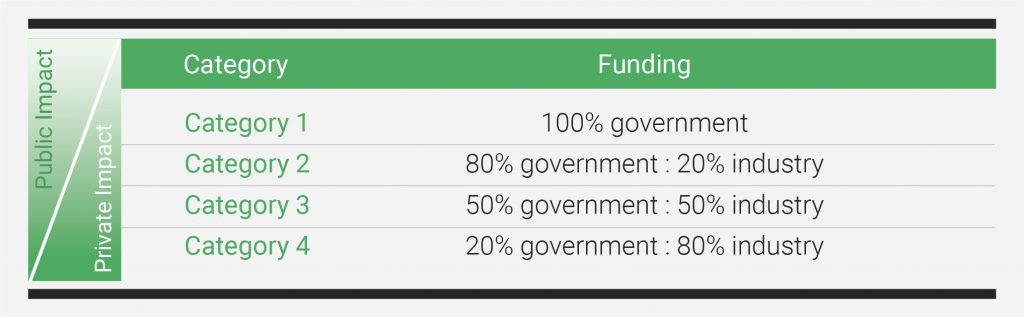
Pest categorisation funding ratio. Source: Plant Health Australia
For more information on emergency plant pest responses, the EPPRD levy and how industry contributions to the cost of emergency responses are set, visit the Department of Agriculture, Fisheries and Forestry’s Biosecurity Levies web page.
This article was written by Rose Daniel, Technical Manager – APAL, and was first published in the Summer 2022 edition of AFG.



