IPDM in focus: woolly apple aphid management
This article was first published in the Winter 2022 edition of AFG. It was prepared by Emily Crawford, Agriculture Victoria, using information from the revised Integrated Pest Disease and Weed Management manual for Australian Apples and Pears (IPDM manual), Hort Innovation, October 2021.
The IPDM manual provides guidance on developing an IPDM (integrated pest and disease management) plan for your orchard to identify, monitor and manage key pests, diseases and weeds through an integrated approach that aims to disrupt life cycles and prevent susceptibility while encouraging and nurturing beneficial species that can act as natural control agents in your orchard.
This article is part of a series of articles that focus on implementation of IPDM.
The woolly apple aphid is a serious pest of apple production in all Australian fruit growing regions. It can affect all parts of the tree, resulting in direct damage to fruit, limbs and roots and a gradual decline in tree health.

An infestation of woolly apple aphid on the stem of an apple tree with the small wasp parasite to the right and above the aphids, and numerous aphid “mummies” – aphid shells with an emergence hole through which a parasitic wasp emerged. Photo: Agriculture Victoria
Monitoring
In Australia, aerial colonies of woolly apple aphid (WAA) (Eriosoma lanigerum) are often kept under control by using insecticides applied for other pests such as codling moth. Root colonies of WAA are more likely to cause serious damage because they escape these insecticides. It’s therefore necessary to monitor the orchard to determine which trees should be treated with a soil drench (see Responsible use of pesticides). During late summer or autumn, apple trees with woolly apple aphid colonies or damage should be identified and marked for treatment early the following season. The presence of established aerial colonies is a good indication that root colonies are also present. Pay attention to old pruning wounds and damaged bark. Brightly coloured plastic flagging is useful for marking affected trees, but a written record of infested trees should also be kept. A written record ensures that where flagging is blown off or pulled off by birds, trees can still be found and treated. It also provides a useful historical record which can be used to determine how successful pest management has been. Colonies can be assessed using a 1–5 rating score presented in Chapter 3 of the Australian Apple and Pear IPDM manual (see For more information).
Prevention and good orchard management
Varieties
High-density plantings on dwarfing rootstocks return better yields, result in better quality fruit and are becoming the industry norm; however, modern dwarfing rootstocks are generally not as resistant to WAA infestation as older rootstocks. This problem is exacerbated in high-density plantings because WAA moves easily from tree to tree where canopies overlap.
The Malling-Merton series are resistant to WAA. The least vigorous of these rootstocks is the semi-dwarfing variety MM102. MM102 provides an option for orchardists with high-density blocks where WAA is likely to become a problem on more susceptible varieties. Experience in orchards has shown that MM102 is often suitable for replant soils, but note that this rootstock is susceptible to Phytophthora and there is limited information on its performance under Australian conditions.
Remove suckers
Suckers or water shoots at the base of the tree and on major scaffold limbs are tender and become a favoured site for the development of early generations of the aphid as it migrates from the roots to the tree canopy. Removal of water shoots removes this convenient bridge.
Pruning
Most of the damage caused by WAA occurs below ground. Therefore, pruning can only assist in the management of infestations, but summer pruning to remove large colonies will help. Painting large pruning wounds also discourages WAA from establishing colonies. Because of their woolly, waxy coating, it is difficult to sufficiently wet colonies for insecticides to be effective. Pruning will allow better penetration of canopies with insecticide applications.
Management
In Australia the key to good management of WAA is to support biocontrol of the aerial infestations, combined with chemical control of the root infesting phase of the WAA’s life cycle. Applications of insecticides specifically to control aerial colonies of this pest are often unnecessary following effective application of a soil drench.
Responsible use of pesticides
Soil drench: The products need only be applied to infested trees identified and marked during the previous season. Application to other, non-affected trees wastes time and money. A soil drench (insecticide) can be used on trees up to seven years old. Timing is critical and the application needs to be made between green tip and petal fall. Remove any weeds or mulch from around the base of the tree, leaving bare soil. Apply the drench to the soil for a distance of about 15cm from the base of the trunk. Chemical penetration into the soil will be better if the soil is slightly moist. The insecticides become less effective after prolonged exposure to sunlight, therefore running micro-sprinklers for an hour after the drench is helpful but not necessary.
In most cases, application by hand using a lance sprayer from the back of a four-wheel bike is sufficient. Where a substantial percentage of trees are infested – particularly where they are in the same row – special rigs are available for automated application of products to the base of trees. Some orchardists have expressed concern at the cost of this technique. Dependent on soil type and moisture and the age of the tree, it is likely that soil drenches need only be carried out every three years. Careful monitoring of trees should be carried out in the seasons following a soil drench to determine when the next application is needed. Targeted application to infested trees also defrays costs.
Note: Please refer to the Australian Pesticides and Veterinary Medicines Authority (APVMA) website (https://apvma.gov.au/) or speak with a crop advisor about appropriate chemicals that are registered or permitted for use against WAA.
Aerial colonies: At times it becomes necessary to apply an insecticide specifically for the control of aerial colonies of WAA. Before making this application, consider:
- Is the problem restricted to one or two trees in a block? Spot sprays cost less money, are usually more effective and will kill fewer predators of orchard pests.
- Is it likely that biological control agents (see below) will soon control woolly apple aphid without a pesticide application?
Biological control, biorational pesticides and organics
The parasitoid wasp Aphelinus mali is established in all Australian apple-growing regions. It is particularly effective in warmer areas and seasons. The wasp has a higher developmental threshold temperature than WAA as an adaptation that ensures it becomes active after WAA has progressed beyond the crawler stage. The wasp lays its eggs into the aphid and first instar crawlers do not provide adequate food to produce female wasps and only male wasps emerge. By synchronising with development of later WAA instars, the wasp ensures it can produce female offspring that can go on to parasitise more WAA. In cooler areas such as the New South Wales Tablelands, Tasmania and parts of Victoria, parasitoid activity may appear to lag behind that of its host and growers might think they need to apply a pesticide to control the WAA. The real reason that the WAA infestation is building up is more likely to be that poor choice of sprays against codling moth and light brown apple moth has impacted the parasitoid and the other important predator, the European earwig. Neither the wasp nor earwig can easily reach the root colonies unless the ground dries up and cracks, so trees with a history of heavy WAA infestations should be treated with a soil drench before the wasps become active.
Aphelinus mali is a parasitoid which lays more than one egg in each of its WAA hosts. Eggs can be laid in all stages of aphid growth but the parasitoid only emerges from its host as it approaches adulthood. Parasitised aphids become inflated, lose the ability to secrete their woolly covering and turn into black mummies. The adult wasp emerges from the mummy through a large, irregular hole cut in the back of the aphid abdomen. Before deciding to spray aerial colonies during the season, it is important to check the level of activity of Aphelinus mali. Parasitised aphid colonies will have a sparse woolly coating and contain many blackened mummies. If parasitised colonies are widespread, it is probably best to delay insecticide application and carefully monitor aphid levels for the next few weeks.
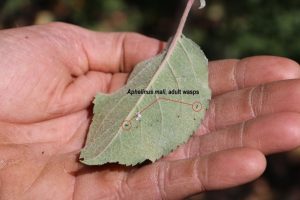
Adult woolly apple aphids (white) and parasitoid wasps (A. mali) (black in circles) present on the underside of an apple leaf. Photo: Kevin Dodds, NSW Department of Primary Industries
Earwigs are a great predator
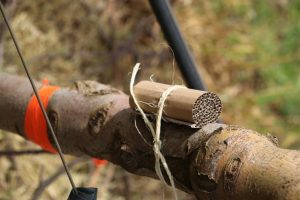
European earwigs are excellent predators of WAA and other pest insects. They can be “farmed” by placing rolled up newspaper or rolled corrugated cardboard bands out in areas where earwigs are likely to congregate, such as alongside wooden fences or in among stacks of timber. Once the rolls have been colonised by the earwigs they can be moved to where WAA infestations need attention.
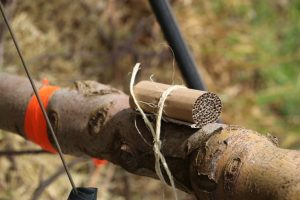
Earwig shelter made from corrugated cardboard, used to monitor for earwig activity. Photo: Kevin Dodds, NSW Department of Primary Industries Photo: Kevin Dodds, NSW Department of Primary Industries.
What you can do this winter
Winter presents an opportunity to collect parasitised WAA colonies. The parasitic wasp Alphelinus mali can be introduced into unparasitised WAA colonies if you or someone you know already has A. mali present in parts of an orchard.
During winter pruning, collect infested branches or twigs early in winter, before spraying, and store them in a coolroom (not in a freezer) until mid-spring. The branches or twigs can then be placed in trees showing signs of aphid infestation in early to mid-spring. As well as introducing A. mali to an orchard, this method can also be used as a supplement to the wasps that survived in the orchard after your first sprays were applied.
Make sure that the parasitised colonies you are storing have plenty of black mummies that do not have holes in them. The holes indicate that the wasp has already emerged.
Other predators worth conserving include syrphid (hover fly) larvae and aphid-eating ladybird beetles such as the common spotted ladybird (Harmonia conformis) and the transverse ladybird (Coccinella transversalis).
Parasitised woolly apple aphid mummies showing exit holes where the adult wasp (or woolly apple aphid parasitoid) has emerged. Presence of mummies indicates the wasp is active in the orchard.Photo: Kevin Dodds, NSW Department of Primary Industries.
For more information:
The Australian Apple and Pear IPDM webpage has a downloadable copy of the IPDM manual.
See pages 307–314 for the section on the woolly apple aphid, including its life cycle, the damage it causes and similar damage caused by other pests.
Also see pages 100–120 for additional information on pesticides and their use.
Acknowledgements: The PIPS3 Program’s Strengthening cultural and biological management of pests and diseases (AP19002) project has been funded by Hort Innovation, using the apple and pear research and development levy, contributions from the Australian Government and co-investment from Agriculture Victoria. Hort Innovation is the grower-owned, not-for-profit research and development corporation for Australian horticulture.