Nanoparticle treatment for leaf spot diseases
Gordon Brown reviews early research into a completely new way of controlling Alternaria and Glomerella leaf spot of apple trees.
In recent years there has been growing interest in the use of nanoparticles for the delivery of nutrients and other active materials to crops. Nanoparticles are miniscule, less than 100 nanometers in diameter and about a million times thinner than a human hair. This small size allows many nanoparticles to pass through cell walls and membranes to deposit themselves and any materials they carry with them directly into the cytoplasm of plant cells. While nanoplastics are examples of nanoparticles – with potential detrimental effects – nanoparticles can also be composed of other materials such as iron, copper and gold. The choice of material has an impact on the efficacy of the treatment being applied and can even have positive impacts without additional active ingredients. For example, excellent results have been found for the control of Botrytis, Fusarium and downy mildew of grapes.
In addition to nanoparticles there is growing research into the use of genetic material (RNA) to either modify the disease infection process or improve plant resistance to disease infection. As nanoparticles can enter a plant cell with a ‘payload’, the combination of a nanoparticle with an RNA payload represents a completely new method of controlling pests and diseases.
These technologies represent a novel and sustainable method for plant disease management, with advantages that include high specificity, reduced environmental impact, minimal off-target effects and potential for little risk of pest resistance development. While disease control has been identified in many crops, the effectiveness of this technology in apple production is relatively unknown.
In the research being reviewed here, Chinese researchers studied the use of iron-based nanoparticles for the delivery of RNA to Golden Delicious trees for the control of what they termed ‘early defoliation disease’. It turns out this disease is a complex of Alternaria leaf spot, Glomerella leaf spot and a third leaf spot not found in Australia. The iron nanoparticle was chosen as it is only 10 nanometers in diameter, is known to be able to enter plant cells and it is extremely biocompatible with efficient holding capacity for RNA.
This research paper is extensive and focused on the genetics of leaf spot infection. It was found that infection of apple leaves with all three leaf spot diseases stimulated the activation of one specific gene in the leaves, which reduces the apple tree’s natural defence systems. After sequencing the gene, they built a matching piece of RNA with the ability to bind to the gene, blocking its function, thereby maintaining the tree’s natural disease resistance. This means that, theoretically, the tree maintains resistance to disease infection, making it difficult for leaf spot diseases to infect.
Trial methods
Trials were then conducted to verify if their binding RNA did improve a tree’s resistance to leaf spot infection. The binding RNA was coated onto iron nanoparticles, then sprayed onto small tissue cultured plantlets of Golden Delicious apple trees. As well as the binding RNA coated nanoparticles some plantlets were left unsprayed, some were sprayed with the binding RNA alone and others were sprayed with only the nanoparticles. Three days after treatment the plantlets were infected with either Alternaria leaf spot or Glomerella leaf spot to observe the level of disease control achieved. The impact of the treatments on foliar death, due to the diseases, was assessed three weeks after the plantlets were infected.
Results
For both leaf spot diseases 100 per cent of the foliar areas died in the plantlets that had not received any treatments. The plantlets that were sprayed with the binding RNA alone had vastly improved resistance to the leaf spot diseases at one week after infection, but this treatment completely failed by two weeks after infection, indicating only a small level of disease control. The plantlets that received the nanoparticles alone resisted disease symptoms for two weeks; however, by three weeks after infection they had severe levels of foliar necrosis. Finally, the plantlets that received the binding RNA coated nanoparticles had no symptoms two weeks after infection and lower levels of foliar damage three weeks after infection than the other treatments (Figures 1 and 2).
In these trials the only treatment where plantlets had a chance of survival was the spray of binding RNA coated nanoparticles, indicating that the combination of these two new technologies working synergistically together provides superior protection from the diseases. More research is needed to verify the impact of these technologies on adult apple trees, as opposed to tissue cultured plantlets, to determine if the control level achieved is commercially satisfactory.
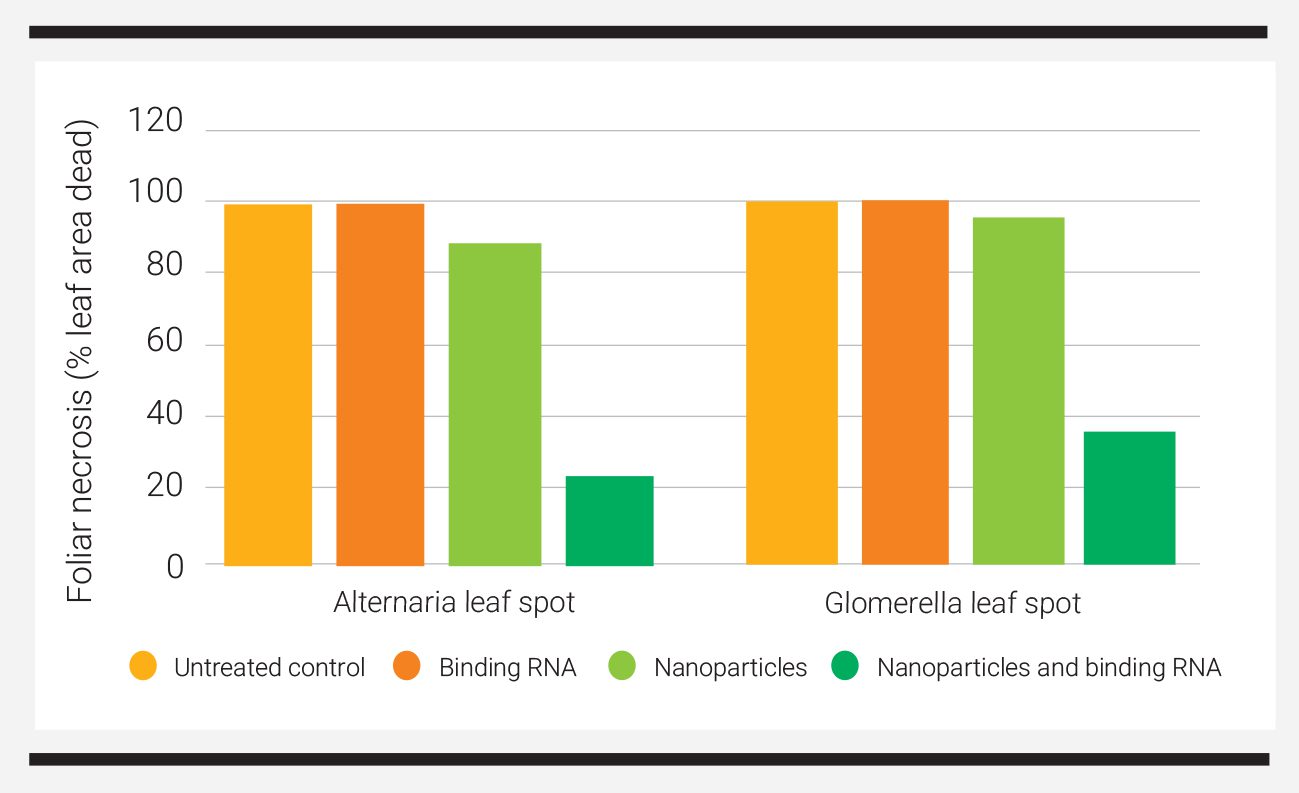
Figure 1: Percentage foliar necrotic area three weeks after infection of tissue-cultured Golden Delicious plantlets with one of two leaf spot diseases and impact of treatments applied three days prior to infection.
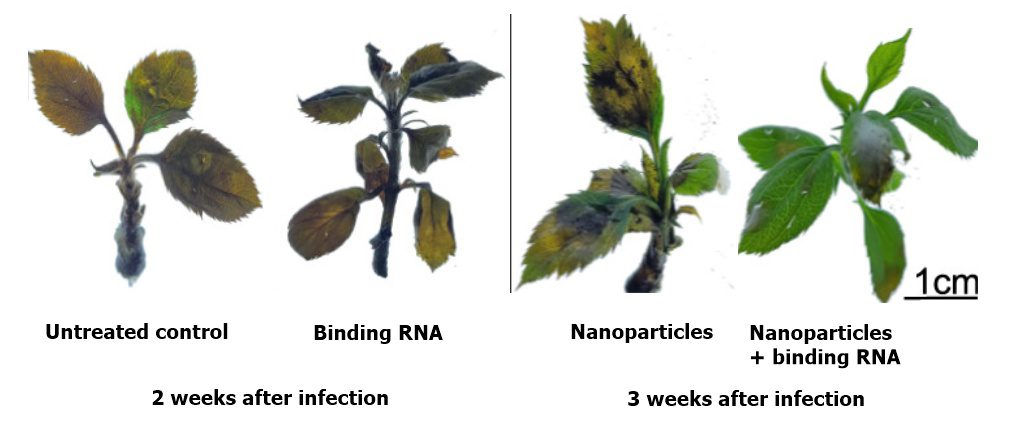
Figure 2: Photos of foliar death of tissue-cultured Golden Delicious plantlets infected with Alternaria leaf spot at two or three weeks after infection and impact of pre-infection treatment on disease infection. Source: Research paper
Discussion
At this stage there are no commercial products available to growers that use these technologies. This paper does, however, highlight that there are new technologies in the pipeline with potential for major impact for pest and disease control. These new technologies have a mode of action that is very different from traditional pesticides. This mode of action has similarities to breeding new cultivars with targeted resistance to pests and diseases. The authors of this paper refer to the protection provided as being transient in nature, implying that the binding RNA is not somehow accidently ‘inserted’ into the DNA of the tree so its genetic engineering crop status will be a point of debate among both scientists and consumers. It will be interesting to see how regulation authorities treat this new mode of action when commercial products are developed.
Take home messages
- Combining two new technologies – the use of iron-based nanoparticles to carry material freely into the cytoplasm of apple tree cells and the use of genetics to identify RNA that can improve apple tree resistance to diseases – achieves excellent control of disease infection.
- This is a new set of technologies which have a very different production and mode of action to the usual chemical pesticide industries.
- At this stage no commercial products are available but these technologies may become mainstay treatments in the future.
- The registration process for this style of material is untried so the path forward will not be straightforward for the early innovative companies who attempt to commercialise these products.
Further reading
This article was first published in the Spring 2026 edition of AFG.