Renovated orchard early crop load strategies in Western Australia
A PIPS 4 Profit trial in Pemberton is investigating how thinning strategies impact canopy fill and subsequent yield in a renovated block.
Western Australia’s demonstration trial of the PIPS 4 Profit Optimising apple production systems (AP22004) project aims to understand how thinning strategies impact canopy fill and subsequent yield in a renovated block. The renovation at Fox Orchards in Pemberton converted a 1.21ha Fuji block to Granny Smith using grafting techniques (Table 1). The existing trees were cut 30cm above the graft, with Granny Smith grafted onto the Fuji interstock.
The trial aims to answer two research questions:
- How does fruit thinning in the first two years impact long-term yield patterns?
- What conditions make in-field grafting more economical than replanting an orchard block?
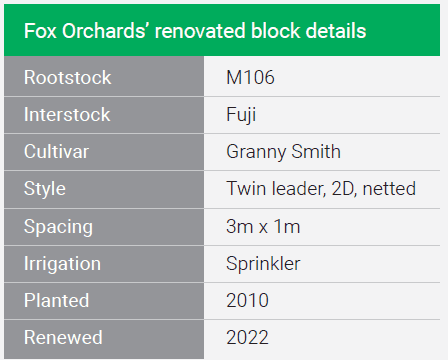
Table 1: Fox Orchards’ renovated block details.
Trial treatments and measurement
The trial selected 40 trees to evaluate in 2024 with different thinning loads: 0–2 fruit per leader (low load) and 6–10 fruit per leader (high load). An additional factor emerged as not all grafts were successful across the block; many trees were trained to two leaders from one graft as demonstrated in Figure 1. High and low load trees were selected from single and dual graft trees, creating four treatments with ten trees in each. While the crop load was determined by the grower during thinning in spring 2023, the researchers selected the trees to undertake the study. Crop load was commercially applied by the grower in subsequent years.
The treatment trees have been monitored for vegetative biomass, fruit yield, blossom density and trunk growth. Green Atlas Cartographer scans with LiDAR technology have measured canopy height, canopy density, flower numbers and fruiting numbers across the block over the 2024, 2025 and 2026 harvest seasons.
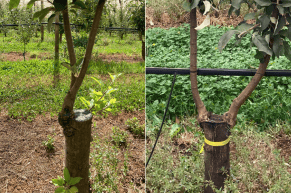
Figure 1: (left) A tree with one successful graft, trained as two leaders, (right) a tree with two leaders from two grafts in the high fruit load condition.
2024–25 results
The 2024–25 season saw different fruit setting behaviour for each of the four treatments (Figure 2). The trees carrying a low fruit load in 2023–24 produced fewer flowers in spring 2024 but set fruit efficiently. High fruit load trees produced more flowers in spring but a difference in fruiting efficiency was seen between the two grafting conditions, with dual graft trees setting the fewest fruit on average.
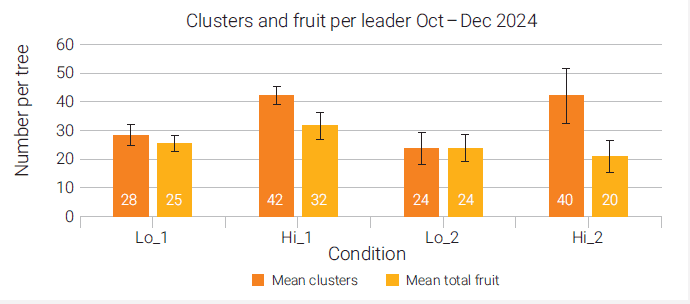
Figure 2: Mean flower clusters per leader in October 2024 compared with mean fruit per leader in December 2024 after thinning. Lo_1 refers to low fruit load in 2023, single graft; Hi_1 refers to high fruit load in 2023, single graft; Lo_2 refers to low fruit load in 2023, dual graft; Hi_2 refers to high fruit load in 2023, dual graft.
The block shows spatial variability in growth relating to the varied grafting success previously discussed. This spatial variability can be seen in Figure 3, showing lower grafting success areas on the right-hand side – these are low-lying land areas, assumed to be associated with waterlogging or poorer soil conditions. No sample trees were selected from this low-lying area.
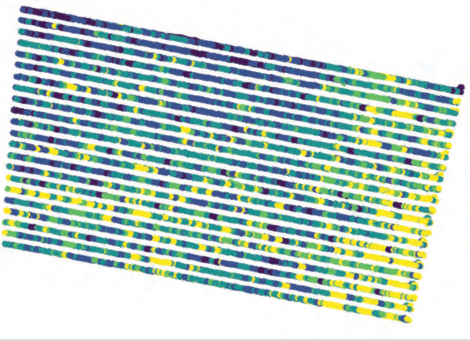
Figure 3: LiDAR Cartographer scan of canopy height at October 2024. Dark blue indicates height above 3m, yellow indicates height below 2m.
In October 2024, 35 per cent of the block had reached 3m or more in canopy height, while 28 per cent remained below 2.5m. No significant differences in fruit quality were seen between the four treatments in 2024 or 2025.
2025–26 results
In 2025 flowering and fruit set data once again showed lower fruit numbers for the low fruit load treatments. The high fruit load conditions set similar levels of fruit from relatively high numbers of flowers.
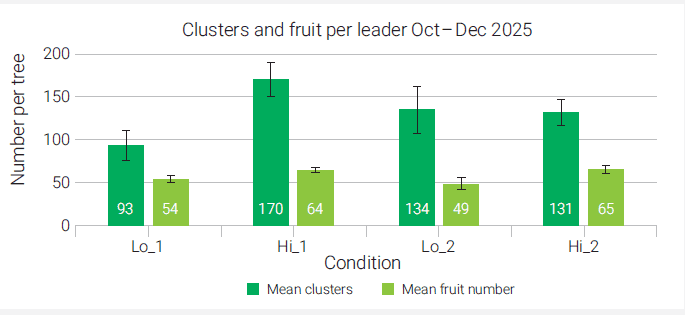
Figure 4: Mean flower clusters per leader in October 2025 compared to fruit set per leader in December 2025
Trees in the higher fruit load treatments have shown higher flower counts and overall fruit counts compared to the low fruit load; however, the dual graft condition does appear to be developing a biennial pattern showing large variability in fruit setting. Dormancy measurements show an average trunk circumference increase of 232.8mm from 2024 to 2025, with no significant differences between treatments.
Across the block, the canopy is reaching full height, with 61 per cent of the block above 3.5m and 19 per cent below 3m. Trees below 3m are mostly replants from the low-lying areas of the block or where grafting in 2022 was unsuccessful. The block is now producing commercial quantities of fruit.
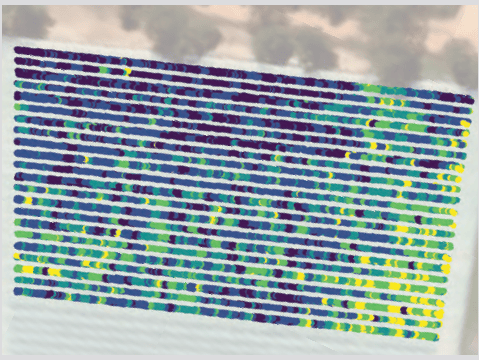
Figure 5: LiDAR Cartograper scan of canopy height at October 2025. Dark blue indicates height above 3.5m, yellow indicates height below 2.5m.
The results seen in the trial so far are unexpected, as the low fruit load treatments were anticipated to outperform the high fruit load by commercial harvest. However, the two low fruit load treatments in 2023 showed higher consistency between the years, which is preferable. The high fruit, single graft condition appears, after two years, to yield consistently despite initially appearing suboptimal during the renovation process. However, the high fruit load condition also shows the highest drop in fruit set which could be a prelude to bienniality. It is unclear how much variation between treatments is due to the influence of the Fuji interstock, which is known to develop biennial patterns, or the soil and spatial effects. Production patterns will need monitoring to verify the shown tendency.
For grower Mat Fox, the trial has been a learning curve.
“This was our first time grafting in the field,” Mat said. “With old ground and old trees, it was a bit unpredictable in places, but we already had the net, trellis and irrigation there so it made sense to give it a go.
“If I had my time again, I’d have engaged a nurseryman from the very start for the grafting. A professional opinion on the best graft for the job, rootstock and how to control the sap flow is crucial.
“However, the block is coming together well now, with good angles and a full canopy,” he said.
The next steps for the project are analysing fruit quality from the April 2026 harvest and deeper economic analysis to answer the second research question: What conditions make in-field grafting more economical than replanting an orchard block?
Further information
Find out more on the PIPS 4 Profit website: https://apal.org.au/pips-4-profit-program
Acknowledgement
 The PIPS 4 Profit Optimising apple production systems (AP22004) project is funded by Hort Innovation, using the apple and pear research and development levy, contributions from the Australian Government, and co-investment from Agriculture Victoria. It is supported regionally by the Tasmanian Institute of Agriculture, Pomewest and NSW Department of Primary Industries and Regional Development. Hort Innovation is the grower-owned, not for profit research and development corporation for Australian horticulture.

This article was first published in the Winter 2026 edition of AFG.