Narrow orchard systems: Trials shed light on NOS in Australian conditions
As narrow orchard system trials in regions across the country reach the end of their second growing year, researchers and growers met to share what they have learnt about early set-up, growth and tree training and what comes next.
Key points
- First trials to carry fruit in coming year
- Cultivar/rootstock differences emerge
- Cordon and vigour management key
- Labour intensive in set-up
Can narrow orchard systems (NOS) deliver the same productivity and labour efficiency benefits in Australia as have been achieved in orchards overseas?
Will the anticipated higher returns justify the significant extra labour and costs of establishment?
The distinctive planar cordon canopies of apples, pears and stonefruit that will help answer these questions are taking shape at experimental and demonstration sites in the Goulburn Valley, Manjimup, Loxton, Batlow and the Adelaide Hills and yielding early insights as researchers and growers gain firsthand experience of the systems under Australian conditions.
What that looks like varies from crop to crop and across the cultivar and rootstock combinations, with some growing well and likely to carry fruit next year and others still well short of the required height.
Common to all is a lot of attention to detail in shoot selection and positioning, training, managing vigour, managing variability in uprights and keeping them well supported.
Project partners, gathering at Agriculture Victoria’s Tatura SmartFarm in late summer for a Narrow orchard systems for future climates project showcase and update session at the end of the second growing season, had plenty of early learnings to share on:
- filling the canopy: cultivar and rootstock
- trellis system: wire spacing, bamboo vs. string vs. clips vs. ringlock
- cordon training: single vs. double, cordon angle, vertical shoot selection
- opportunities for agtech and sensing
- next steps and economic analysis.
Filling the canopy
At Tatura, visitors viewed field experiments established in spring 2024 to compare the effect of three different rootstocks and two canopy heights on the performance of 2m row × 2m tree spaced NOS systems in apples, pears, plum, nectarine and cherry (see Table 1 for apple and pear details).
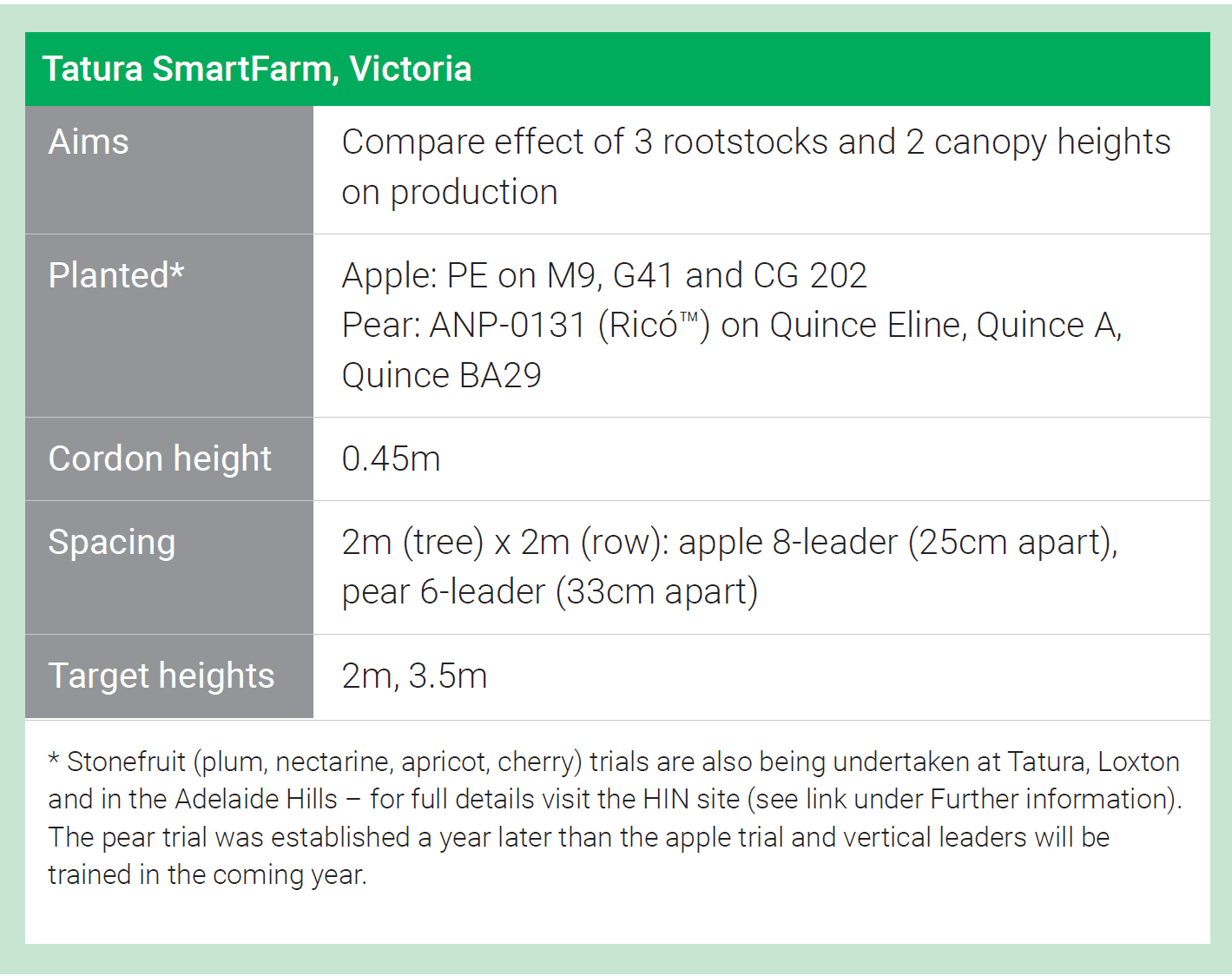
Table 1: Tatura SmartFarm rootstock and canopy height trials on apple and pear. * Stonefruit (plum, nectarine, apricot, cherry) trials are also being undertaken at Tatura, Loxton and in the Adelaide Hills – for full details visit the HIN site (see link under Further information). The pear trial was established a year later than the apple trial and vertical leaders will be trained in the coming year.
In the apple trial, PE whip trees (rods) grafted on two dwarfing rootstocks (M9 and G41) and one semi-dwarfing (CG 202) were headed at 40–50cm when planted in late winter, with 3–4 buds left below the cut to ensure growth of the two cordons. Shoots arising from the lateral buds just below the heading cut were removed in spring to encourage 2–4 flatter shoots to grow out to about 1m during the growing season prior to tying down into the trademark horizontal cordons. Eight vertical leaders (i.e. uprights) arising from the cordon were established in the second season. (To view a video of laying down cordons at the site, see Further information.)
When visited in February 2026, the height of the uprights ranged from 0.25m to 1m.
Agriculture Victoria’s Research Leader, Horticulture Production Sciences, Dr Ian Goodwin, who leads the NOS project, told the group that growth of the PE vertical leaders over the past season had been slower than expected and it would be at least another season before they would carry fruit.
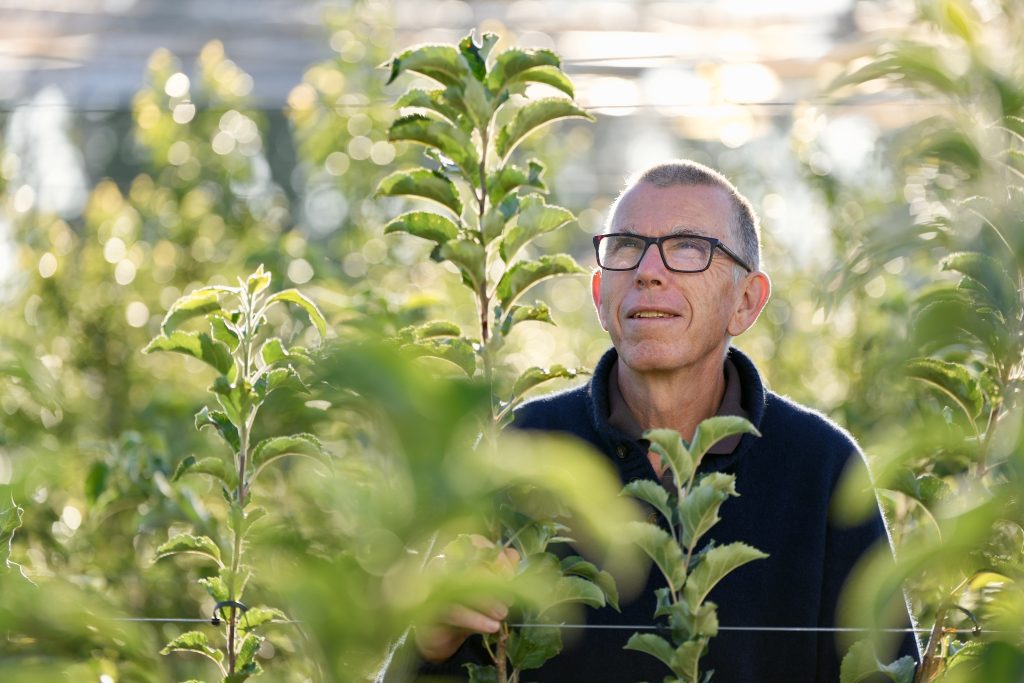
Ian Goodwin inspects vertical leaders on the NOS apple trial site at Tatura SmartFarm in early March 2026. Photo: Brad Clark, Captive Media
“We’d obviously like to see a lot more vigour out of these trees,” he said. “I thought we might have had the leaders up quite a bit higher than where they’re going to get to at the end of this growing season. I definitely don’t want to put any fruit on these; we want to make them keep growing.”
Ian said that some of the lack of vigour could be attributed to the less vigorous PE scion, relative to the Bigbucks Gala planted at the same time at the site. However, it was expected this would be offset by high productivity when established.
“There is a big impact of the scion,” he said. “PE is much slower than the neighbouring block, but there are spurs all over it. If we can get it to the height we want it, it’ll be fantastic because it will just be covered in fruit and we won’t be worried about the vigour of it down the track.”
Shoot competition could also slow growth and Ian said in the cherry trials the vertical leaders were managed by knocking off surplus buds just prior to bud burst, leaving just a few buds at each target position on the cordon.
“You’re selecting the buds you want to grow into those vertical shoots and taking out 70–80 per cent of the buds and so reducing competition,” Ian said.
To give the young trees an extra push, nitrogen rates have been increased. In a side trial, growth promoter ProGibb (GA3) will be applied to the new leaders next year, followed in the third year with Cytolin (GA 4+7 and 6-BA) to promote lateral growth.
Rootstock effect
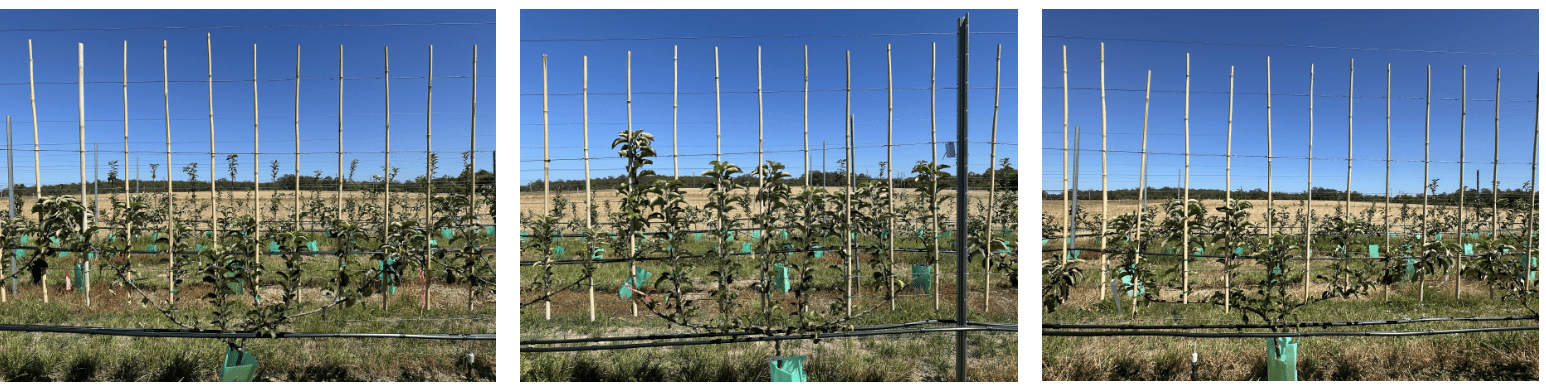
Growth of ANABP 01 (Bravo®) on (left to right) Nic®29, CG 202, and M26 at Manjimup, WA. Photo: WA DPIRD
Rootstocks are a key factor and the effect on growth of a range of dwarfing and semi-dwarfing rootstocks is being tested at both Tatura and by Department of Primary Industries and Regional Development researchers in experimental trials at Manjimup, in Western Australia (Table 2) led by Dr Dario Stefanelli.
In both locations cultivars on semi-dwarfing CG 202 have shown more growth than those on dwarfing rootstocks.
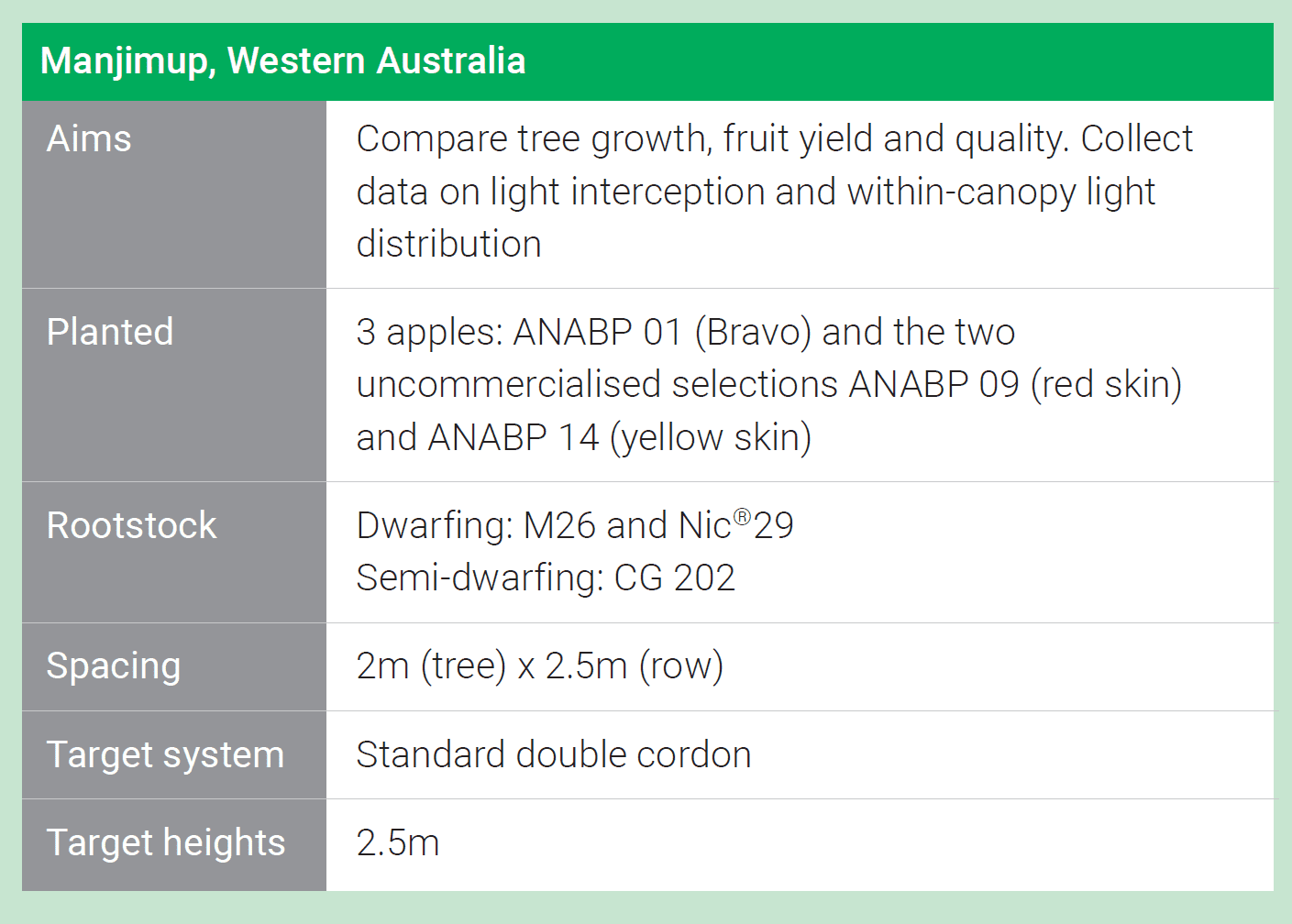
Table 2: Rootstock trial in Manjimup, Western Australia.
Dario said while those cultivar combinations on dwarfing rootstocks had grown less than expected and would not carry fruit for another year, those on the CG 202 had put on good growth and were expected to reach the 2.5m target for vertical leader height in the WA trial in the coming year.
“Quite a few combinations on the CG 202 grew over a metre on most of the eight shoots,” he said.
Those combinations on the CG 202 that had grown well would carry fruit in the coming season, particularly those showing excessive vigour.
“If the centre shoots (i.e. the vertical shoots closest to the trunk) on some of the CG 202 combinations are starting to take over, we’ll put a few fruit on them to slow them down.”
For those CG 202 combinations where the uprights showed even growth, fruit might be hung on the cordon itself to get a more generalised reduction in vigour rather than affecting each single shoot.
Support structures
A side effect of the slower growth in apples was that support wires at 500mm spacing were too far apart to provide vertical leaders with timely support.
While the first support wire at Tatura was lowered to 300mm above the cordon, Ian said it should have been at around 150–200mm to provide the early stability required to maximise growth.
“If you had that wire at 150–200mm, once that lateral gets to 300mm, you can grab it when it’s quite soft and clip it on, creating each one of the vertical leaders where they are and getting them growing straight up,” he said. “That will increase the rate at which they grow.”
Other solutions for providing stability for the young uprights discussed were the use of twine and bamboo canes. In apricot trials in South Australia, mesh trellising (a type of ringlock) is also being trialled as a support structure.
Researchers at Tatura compared bamboo canes and jute twine to clips and wire on a small trial on an apple demonstration block.
Senior Research Scientist Dr Alessio Scalisi said both bamboo and twine worked well, providing support and promoting faster growth in the first year than using plastic clips, however, added significant cost.
“In terms of growth, bamboo stakes and jute twine were pretty similar; bamboo stakes may be a little bit better in terms of speed of development, and the clips were a bit slower.
“It’s not just the speed with the clips, it’s more the shape. They don’t come up straight; that might have slowed them down.”
“The cost difference between clips and the bamboo is huge. Jute twine is cheaper than bamboo, but it is labour intensive to put up.”
NSW DPIRD Temperate Fruits Development Officer Kevin Dodds and NSW grower Jeremy Smart, Tingira orchard, are using bamboo canes to support vertical leaders at a small commercial demonstration block established as part of the project in Batlow (see section on Batlow commercial demonstration block).
Kevin said they had chosen bamboo over twine or clipping to a wire to get vertical leaders in the exact position they wanted and for the ease of instructing tree trainers. Twine had tended to slide and it was hard to tie it to wires without pulling them out of alignment.
Cordon training

The uncommercialised ANABP 14 cultivar on M26 trained as a double crossover cordon at Manjimup Research Station. Photo: WA DPIRD
The cordon/s that form the base of the NOS system can be single, double, or crossover – where the shoots from either side of the trunk are crossed over and bent for training on the opposite side (see above).
As part of the project, the Western Australia researchers are testing the effect of three different cordon systems on the performance of three ANABP cultivars (see Table 3).
The trials will compare the time it takes to fill the canopy space, precocity of fruiting, investment into canopy training and return on investment, with the aim of identifying the best combination of cultivar, rootstock and training system.
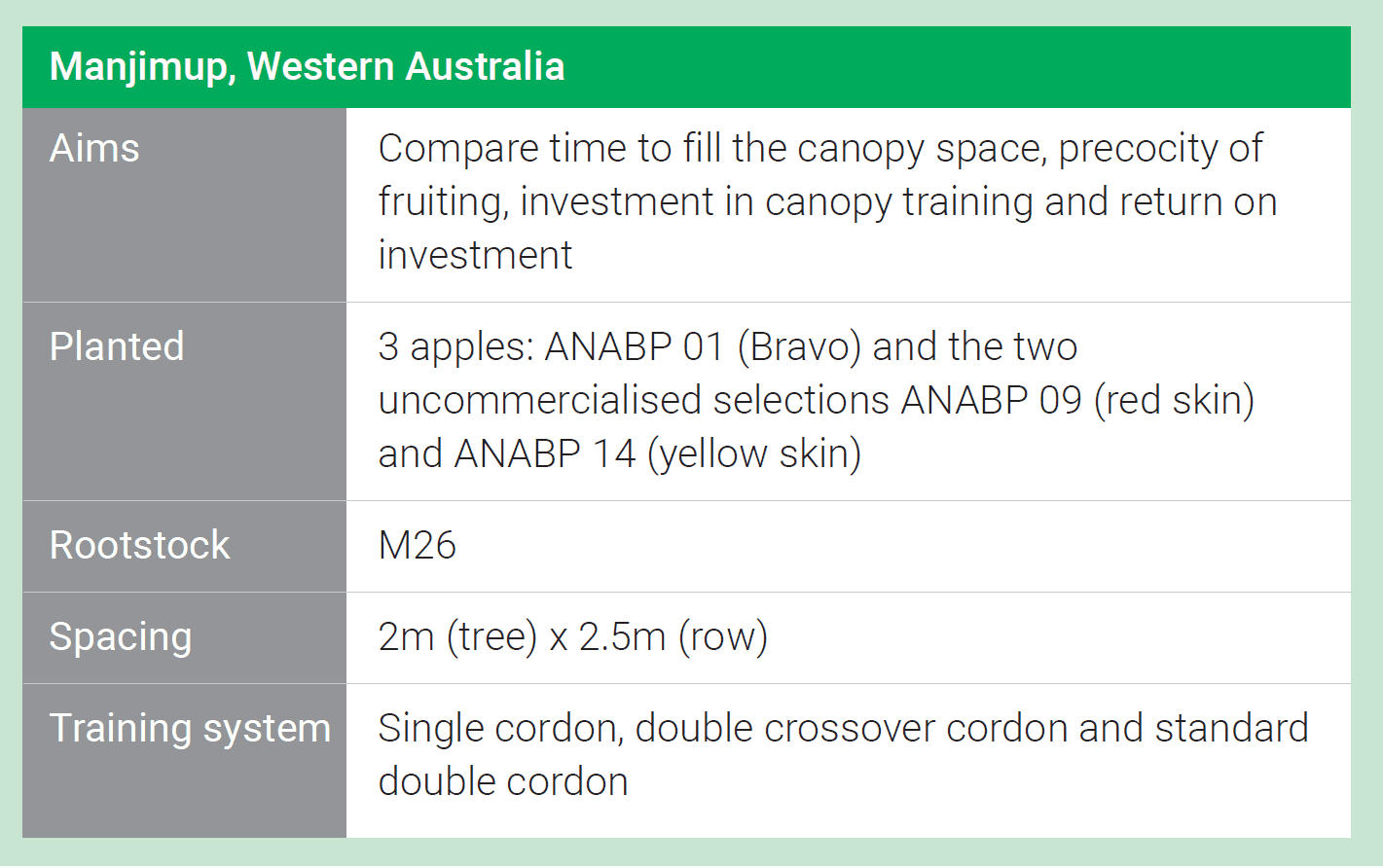
Table 3: Training system trial in Manjimup, Western Australia
Although it is too early to see results, Dario said, based on the Italian experience, the expectation was that the much more substantial bend involved in the double crossover cordon would stimulate earlier fruiting.
But he said the ability to bend the shoot back across the trunk was very variety dependant and care must be taken to avoid snapping it off.
Snapping is also a risk when training single or double cordons and varies between varieties and strength of the tree material being bent. To avoid shoots from the headed rod snapping on bending, the more vigorous upright shoots are knocked off in the trials and lower shoots with a wider angle selected.
“If you can choose, you want a wide angle,” Dario said. “But you can’t always choose.”
Managing vigour
Early tree training makes use of the tree’s tendency – apical dominance – to push shoots up to get cordons to length at which time they are tied down, shifting the apical dominance to promote the growth of vertical leaders from the lateral buds on the cordon.
Achieving the balanced vigour along the cordon and eight vertical leaders is one the practical challenges of establishing the system.
Views expressed by the group at the Tatura showcase day differed on whether this was best achieved by angling the cordon slightly to keep some vigour out to the end of the cordon or laying it horizontally and managing the verticals by removing inner shoots until those farther out had established.
Dr Jill Stanley, Plant & Food Research, New Zealand, said in apricots an angle of 15 degrees was necessary to avoid the vigour running out, but that it differed from crop to crop.
At Tatura, Ian said the apples had been trained horizontally, with the focus on initial vertical shoot training to achieve even vigour along the cordon.
“Any shoot that pops out near the trunk of the tree, you are taking them out and making sure the vertical shoots farther along the cordon are actively growing and are not being out-competed by the ones near the trunk,” he said.
In practice shoots didn’t always emerge at the exact interval required.
In Batlow, where there were gaps between shoots on the cordon, Kevin and Jeremy were able to successfully promote new shoots by cincturing (see Batlow commercial block section). In Tatura, bending shoots was used to reach required spacing.
“You’ll never get them perfectly set out,” Ian said. “It’s a biological system, so you have to come up with workarounds. If you have shoots that are close together you can bend them out.”
Agtech and light modelling
Cordon systems are not new to Australia. Commercial plantings of pears, cherries and apples have been established using the cordon system to create a narrow wall of canopy and fruit, but a significant barrier to planting trees at a narrow row spacing has been the inability to use existing machinery in the narrow rows.
As part of the project, a range of orchard management technology suited to NOS and future automation is being tested at demonstration sites at Tatura and Manjimup, including autonomous mowers, weed and canopy sprayers, the Frucotec platform, mechanical hedging, in-field auto grading technology and a range of internet-based sensors for irrigation and fruit tracking.
A potentially far-reaching part of the research work for orchard design decision-making is the use of a light simulator developed by Dr Liqi Han, of the University of Queensland, in combination with digital twins of the trial orchards made possible by LiDAR technology. Once calibrated, researchers would be able to test the effect of changing orchard design (row spacing and orientation, canopy height and width) on the light distribution and fruit quality in the tree.
Next steps and cost analysis
Establishing NOS is proving, as expected, very labour intensive.
As the trees hit their target height and the narrow, porous canopies reach their full potential for light interception and fruit production, experience internationally has been that they are more labour efficient and productive.
Over the next year researchers will be measuring canopy growth, light interception, flowering and fruit production, as well as water consumption and fruit surface temperature – data from Italy points to less sunburn in NOS systems – to assess if this is the Australian experience.
A cost analysis is a core part of the project, helping the project to derive recommendations for the optimum cultivar, rootstock and tree training system that delivers the best outcome.
Ian said all labour inputs were being recorded and care taken to minimise labour to reflect commercial reality.
Jill told the group that despite the high set up costs, NOS had delivered a higher return in New Zealand.
“The data shows we are getting higher economic return and higher internal rate of return,” she said.
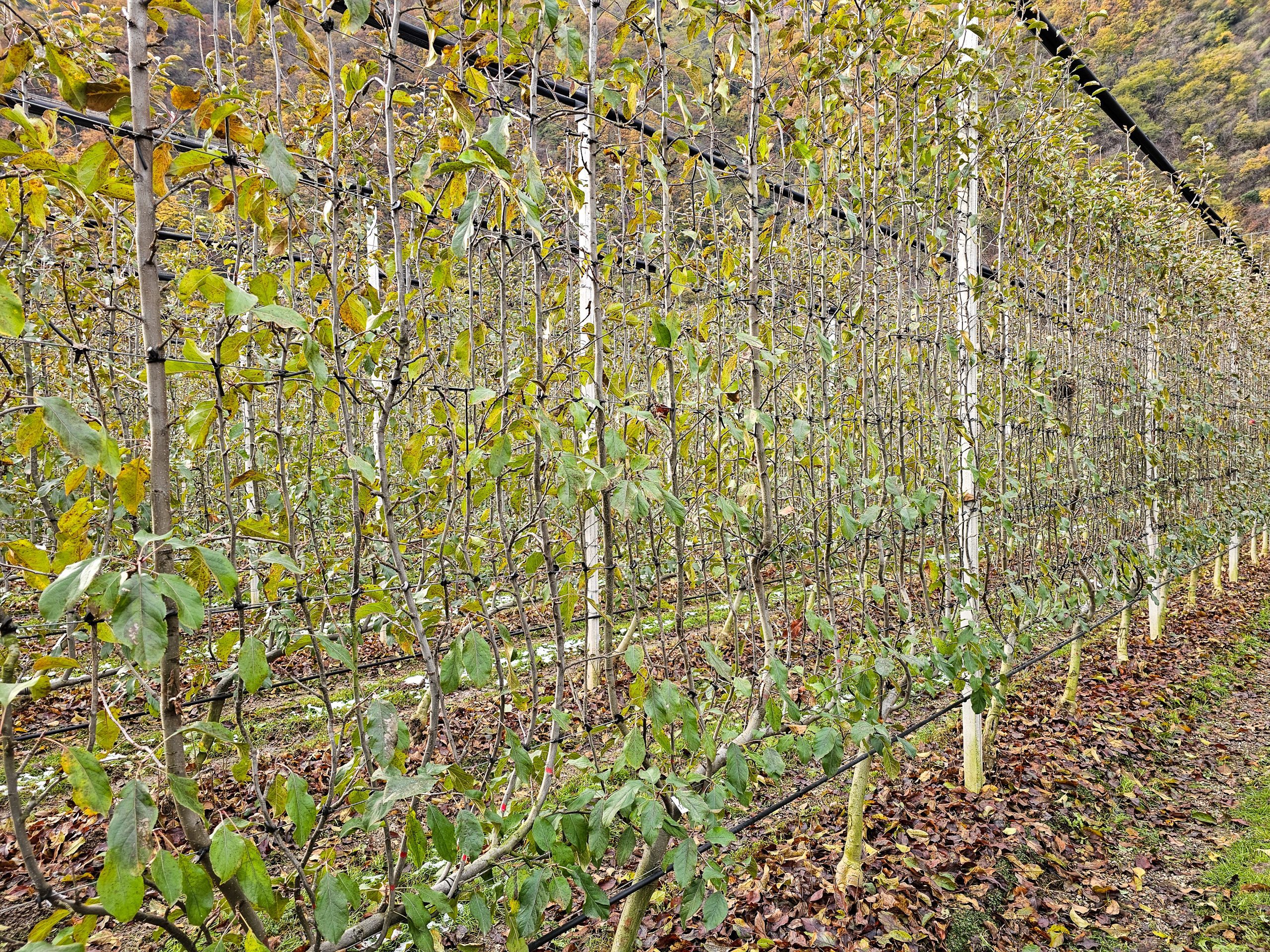
Highly intensive multi-leader trees in Italy. Photo: Nic Finger
Light, productivity and efficiency
The potential benefits of narrow orchard systems (NOS) are significant:
- Better light penetration and interception, contributing to higher yield and quality
- Higher yields from closer rows and higher stem numbers/ha (but less trees/ha)
- Easier vigour management
- Labour efficiency as narrow canopies are easier to manage and harvest
- Better suited to agtech adoption due to narrow 2D canopy.
Featuring less trees planted farther (2–3m) apart, in narrower (2–2.5m-wide) rows, with multiple closely-spaced (25–30cm) vertical leaders forming a 2D planar canopy, NOS have been in use in Europe for over a decade.
NOS differ from other 2D multi-leader systems already widely in use in Australian orchards in that the initial leader or leaders are trained horizontally into ‘cordons’ forming the base of the system – commonly at around 45–50cm above the ground – with the lateral shoots becoming the uprights or vertical leaders.
The cordon can be single, double, or crossover – where the shoots from either side of the stem are crossed over and bent for training on the opposite side.
Very short fruiting spurs and laterals on these vertical leaders form the narrow canopy that is no more than 20–25cm deep on either side of the tree.
Although vertical leaders are closely spaced, a feature of the system is the ‘porosity’ of the canopy which allows light to pass through ‘windows’ on successive rows more consistently down through the canopy, maximising the productive area.
NOS therefore offer intensification (stems/ha), with its benefits of higher productivity and labour efficiency, for a lower tree/ha outlay.
Establishing whether productivity and efficiency gains outweigh early challenges and higher set-up costs and can benefit Australian pome and stonefruit growers is the aim of the Narrow orchard systems for future climates project, which was launched in winter 2023 and runs until spring 2028.
Led by the Agriculture Victoria research team under Dr Ian Goodwin, the $11.25m project has established trials and demonstration sites in Victoria, New South Wales, Western Australia and South Australia in pome and stonefruit.
As well as testing a range of variety and rootstock combinations on a mix of different planting systems for yield and packout, the project will include an economic analysis of returns and costs.
It is funded through Hort Innovation Frontiers, with co-investment from Agriculture Victoria, NSW Department of Primary Industries & Regional Development, South Australian Research and Development Institute, Department of Primary Industries and Regional Development WA, University of Queensland and the New Zealand Institute for Plant & Food Research Limited (Bioeconomy Science Institute) and contributions from the Australian Government.
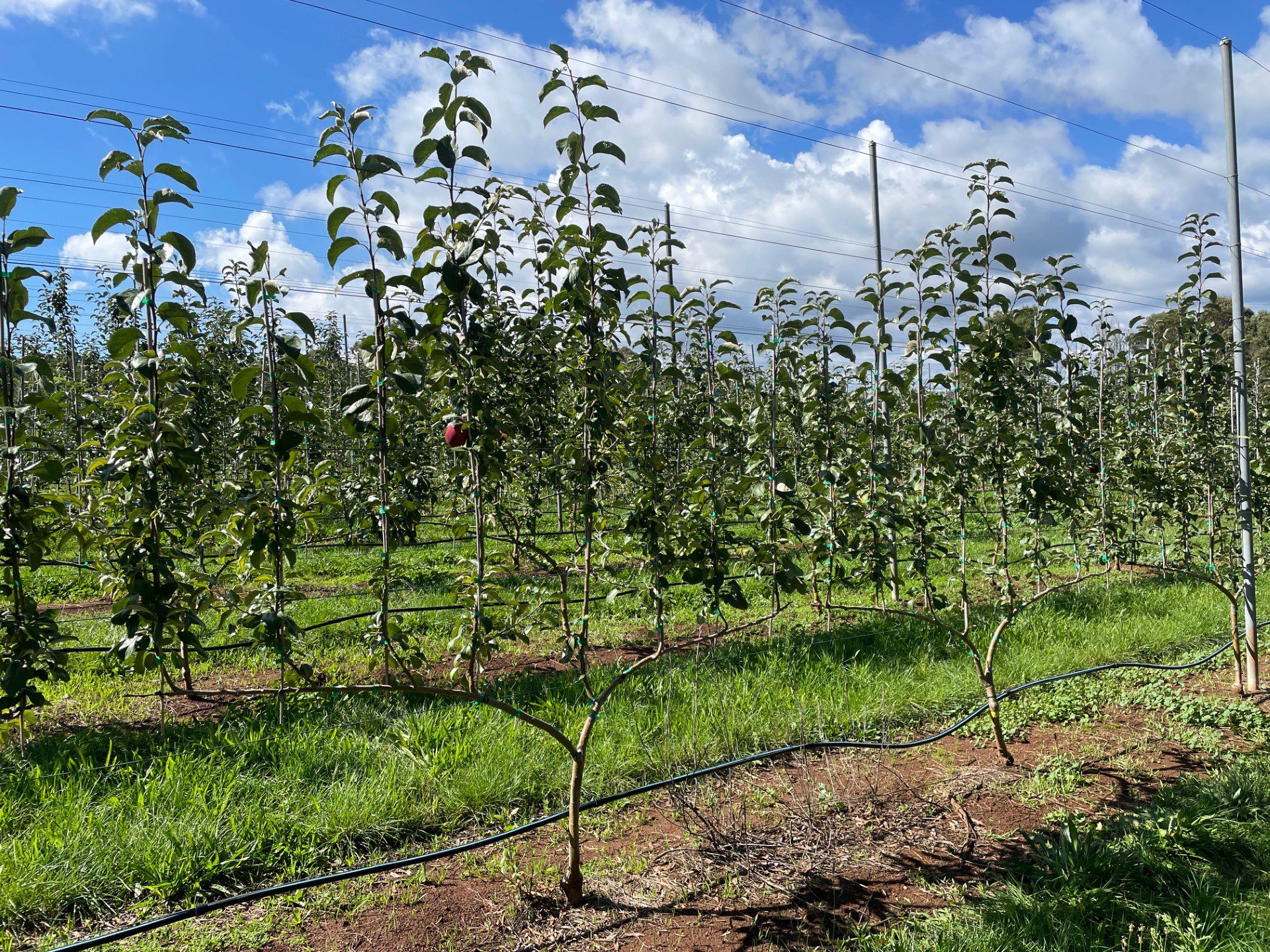
The commercial demonstration block at Tingira in March 2026. Photo: Kevin Dodds
Commercial demonstration block – Batlow
At Tingira orchard in Batlow, NSW, grower Jeremy Smart and DPIRD NSW Temperate Fruits Development Officer Kevin Dodds established one of the earliest blocks in the Narrow orchard systems (NOS) project.
Taking the opportunity in winter 2023 to dedicate part of a new planting of WA38 (marketed as Cosmic Crisp®) to a commercial demonstration block, the pair planted four rows (144 trees) of WA38 on the more vigorous M9 type Nic® 29 rootstock at a 3m row by 2.4m tree spacing and set out to train eight leaders 30cm apart on each cordon.
Although 2–2.5m row widths are being tested under research conditions, Jeremy said they had opted for the slightly wider 3m row spacing in the commercial orchard to accommodate existing equipment.
Tingira has moved row width in progressively from 3.5m to 3m and Jeremy said he would definitely be interested in coming in to 2.5m in the future.
Now at the end of its third growth year, Kevin said the canopy fill was at 60 per cent of final area and most trees had eight leaders and were growing strongly and would carry fruit in the following season.
Speaking at the Tatura showcase, Kevin said one of the things that excited him about the system was the change in language from trees/hectare to stems/hectare which opened up the possibility of talking in linear metres of wood to quantify fruiting wood development and potential yields of the system as is commonly done in horizontal 2D systems.
“It’s a pretty exciting space.”
Filling gaps on the cordon
Among those challenges was how to stimulate shoots to fill gaps along the cordon at the required 30cm spacing.
“We did have situations where we weren’t getting verticals in some positions that we wanted on the cordon,” Kevin said. “As a technique to try and get those growing we got a pair of those cincturing tools and basically did a bit of cincturing at the point where we wanted the shoot to come from. And the response we got to that was really good. In most positions, we were able to stimulate verticals where we didn’t have them.”
Kevin and Jeremy have documented their progress in a series of short, practical videos of the steps taken, challenges encountered and responses they developed. Visit www.hin.com.au/current-initiatives/narrow-orchard-systems-for-future-climates/narrow-orchard-systems-apples.
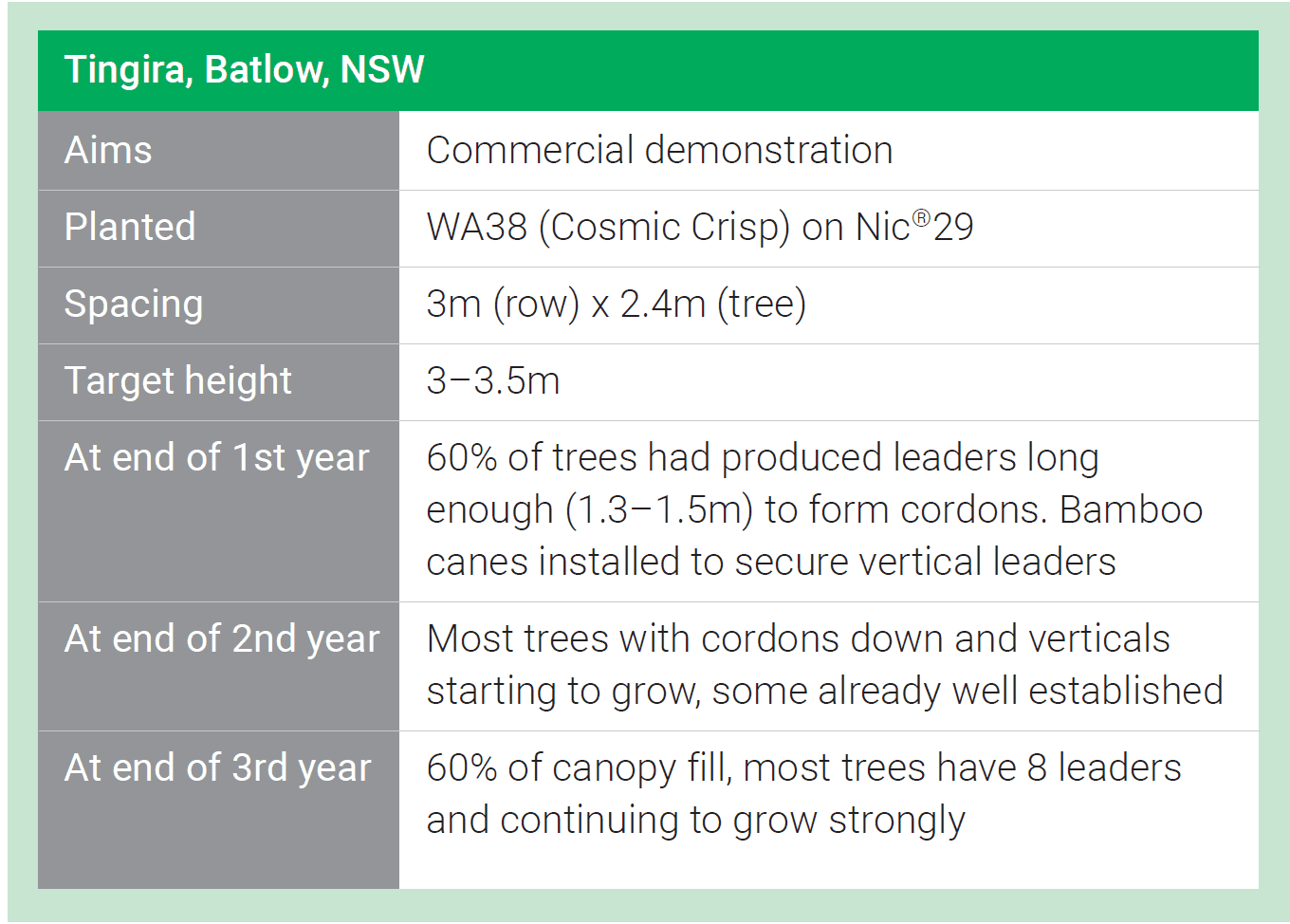
Table 4: Commercial demonstration block at Tingira, Batlow, NSW.
Further information
Websites
HIN site: Narrow orchards for future climates, www.hin.com.au/current-initiatives/narrow-orchard-systems-for-future-climates
AgVic site: Narrow orchard systems, https://agriculture.vic.gov.au/about/research/research-smartfarms/tatura-smartfarm/narrow-orchard-sytems
DPIRD WA: Narrow orchard systems, www.dpird.wa.gov.au/research/research-areas/horticulture-research/narrow-orchard-systems/
Videos
Laying down cordons in narrow orchard systems (Tatura, Autumn 2025), www.youtube.com/watch?v=MCbjkHHmqZ4
Articles
“Canopy design – new systems, same challenges”, AFG Autumn 2025, https://apal.org.au/canopy-design-new-systems-same-challenges/
WA NOS project update – Initial tree training (Year 1), https://wagrower.vegetableswa.com.au/collections/wa-grower-winter2025/wa-narrow-orchard-systems-nos-project-update-initial-tree-tra
This article was first published in the Autumn 2026 edition of AFG.
Acknowledgement
Narrow orchard systems for future climates (AS22002) is funded through Hort Innovation Frontiers, with co-investment from Agriculture Victoria, NSW Department of Primary Industries & Regional Development, South Australian Research and Development Institute, Department of Primary Industries and Regional Development WA, University of Queensland, and the New Zealand Institute for Bioeconomy Science Limited (formerly Plant & Food Research) and contributions from the Australian Government.