Leadership through empowerment
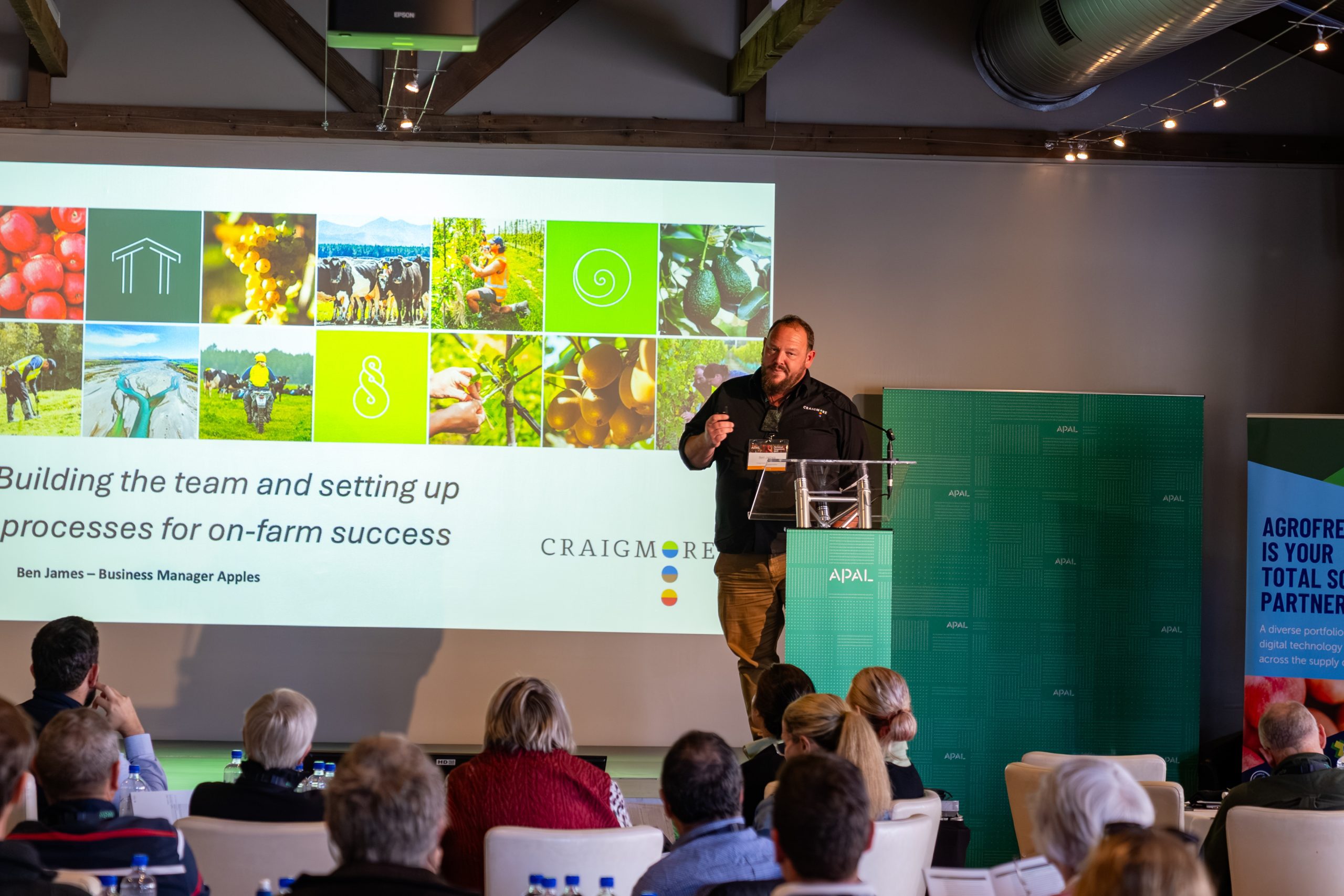
Ben James, Business Manager Apples at Craigmore Sustainables, speaking to APAL Technical Symposium attendees about his leadership journey. Photo: ARC Media
Build your orchard team and set them up for success by creating processes and structures and providing role clarity.
Ben James was in his mid-thirties when a friend offered him some honest advice about where he was going wrong with his management approach.
“I was running around trying to do everything and, to be honest, I was heading towards an early grave. My friend was pretty blunt – I needed to change, or I would end up in a wooden box.”
Craigmore Sustainables, a million-tree property in New Zealand’s Hawkes Bay, is a far cry from the small family orchard where Ben grew up. Reflecting on his management style led Ben to realise he’d been trying to emulate the way his father operated the family business.
“My father did everything, from spraying, driving the tractor, supervising the harvest, clipping, loading the truck, payroll, tax … absolutely everything, end-to-end, in the business. He held the keys to the kingdom. If someone needed to do something, they’d come and ask my dad what to do, and how to do it.”
But that’s not the environment Ben finds himself working in today. A command-and-control approach is unsustainable in modern-day Hawkes Bay, with its massive teams and consolidated environment dominated by corporate structures.
“That got me thinking about what sort of team I needed and the leadership approach I would require to make it work,” Ben said.
The leadership journey
Ben is modest about two major New Zealand fruit growing awards he won early in his career.
“What they proved was the fact that I could grow apples, use machinery and run irrigation systems. But what they didn’t prove was that I could lead people. I knew I was good at growing fruit, but not as good at managing myself, let alone managing other people, and was left wondering why I was struggling to create success.”
From that point, Ben began a seven to eight-year journey to understand teamwork, leadership and people motivation. In 2021 he moved to Craigmore Sustainables and discovered that surrounding himself with people who shared similar values was key to speeding up his growth in the leadership space.
“Our vision is kaitiaki – leaving things better than you found them. What appeals to me is that kaitiaki is about more than the produce; it’s about the environment, the people and the community. One value is Pikorua (bonded), which is essentially about connection and empowerment.”
Ben’s father, he reflected, never ran an empowerment model in his business.
“I’ve decided that it’s one of the most important pillars to my leadership. Since I started on that empowerment journey, I’ve watched the people around me excel and it’s actually created a lot more space in my job.”
Structure is everything
To make empowerment possible, Ben invested his time and effort into creating a structure that works.
“I laboured over how the communication flows up and down through the structure and the team, defining exactly what each of those roles within the team does and what they are responsible for, ” he explained.
Every role in the team has a deliberately specific position description, created through consultation with industry partners, extensive testing and interviews with staff about what their jobs entail, and their responsibilities and accountabilities.
Role clarity
“One of the most important things I’ve learnt through all of this has been the importance of clarity in roles, responsibilities and accountabilities. Who is accountable for what? Is everyone clear about what’s expected of them? The structure we created allows that clarity at every level and also enables the easy flow of communication up and down those levels.”
When it came time to consider his team’s upper management, however, Ben found that position descriptions typically did not have enough detail and contained some grey area, “which is where mistakes tend to happen”. He decided to adopt the RASCI model, which details:
- who is Responsible
- who is Accountable
- who will Support
- who needs to be Consulted
- who the Responsible person needs to Inform.
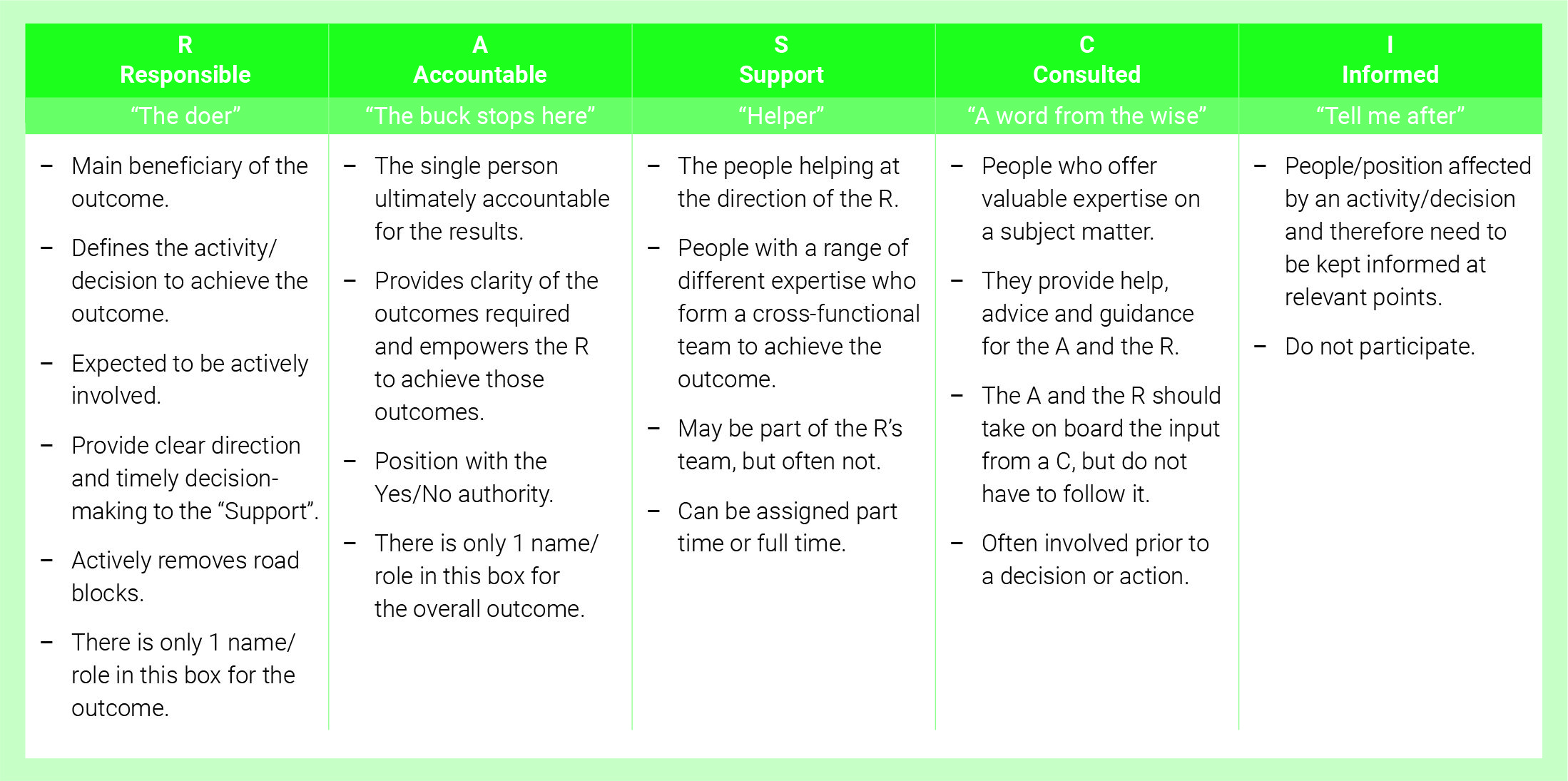
The RASCI model assigns specific roles and responsibilities to individuals within the team.
Today, Ben’s team has a RASCI for most tasks in the business. Ben is generally the ‘A’ (Accountable person), then others in the team are empowered to take control of the project or operation.
“The model helps us put some guardrails around that so the Responsible person knows where to start and stop in their decision-making, ” Ben added.
Ben’s leadership journey has taken him a long way from his father’s centralised management approach. By focusing on leadership through empowerment, Ben and his team have discovered a model that works at scale and will ultimately help achieve kaitiaki – leaving the orchard and its community better than they found them.
This article was first published in the spring 2025 edition of AFG.