South Africa tour gives insights into growing in a low-labour-cost, export focused industry
South African apple and pear growers may have very different costs of production and market orientation to those of Australian growers, but they share common goals of lifting yield, quality and returns.
For 21 Australian and international growers and industry professionals, the 2025 Future Orchards® International Tour to South Africa in early June was a fantastic opportunity to visit orchards, nurseries and packhouses across three regions in South Africa in early June, talk to local growers and exchange ideas and experience.
In an overview provided by peak grower and industry R&D body Hortgro at the start of the tour, attendees learned the South African pome and stone fruit industry is comprised of 1,155 growers producing 2.1m tonnes of fruit from 54,271ha for an average production of 40t/ha.
Unlike Australia which currently exports less than 1 per cent of fresh apples and around 6 per cent of pears, the South Africa industry exports 40 per cent of its fresh production to 86 countries around the world and derives 90 per cent of its income from fresh sales. The biggest markets are Far East Asia, other African countries and the European Union, followed by the UK, Middle East and Russia.
With such a high export volume, customer perception of and tightening international market access rules around chemical usage are putting pressure on available tools.
The tour provided insights into the challenges of growing fruit in a low-chill environment, managing vigour and canopy management, production of container trees, experience of regenerative orchard floor management and different consumer preference and market destinations. With growers present from the United Kingdom, Türkiye, Mexico, India and New Zealand as well as the host growers, it was also a fabulous opportunity for exchanging experiences and ideas with growers from across the globe.
The three regions visited – the Elgin, Grabouw, Vyeboom and Villiersdorp (EGVV), Langkloof and Koue Bokkeveld regions – receive chill units of 500–800, 600–1000 and 1000–1500 respectively, with rest (dormancy) breaking required in the first two and water scarce in the latter two.
The most common system seen was a spindle – with Bibaum 2D-systems on newer plantings where quality was a focus. Ridging or mounding was widespread to manage shallow soil and drainage. Tree spacings of 3.5 x 1.5m were common and as well as M9, the Geneva rootstock G.778 was in widespread use favoured for filling the canopy quickly and being highly productive although at Chiltern Farm, grower Justin Mudge said vigour was one of the biggest orchard management challenges with implications for fruit quality post-harvest.
Labor rates of around $25–30/day are dramatically below those paid in Australia, enabling far more labour-intensive activity, but also incurring additional costs in supervision, with estimates that total labour outlay was approximately 35 per cent of cost. With unemployment also at around 35 per cent, several of the growers visited spoke of the social responsibility of providing labour.
APAL director and South Australian grower Joe Ceravolo said it a great week with a very thorough look at the South African apple industry and an understanding of how it works.
APAL wishes to thank all of the host orchards for their generosity in sharing their time, insights and expertise throughout the week, and their exceptional hospitality.
Finally, thank you to the 20-plus Australian and international growers and industry professionals who joined the tour, were engaged, curious and contributed both valuable questions and insights of their own, and camaraderie to create a collaborative, insightful and thoroughly enjoyable experience, building new connections and collective understanding of the challenges and opportunities in orchard management around the world.
Day One – Monday 9 June 2025
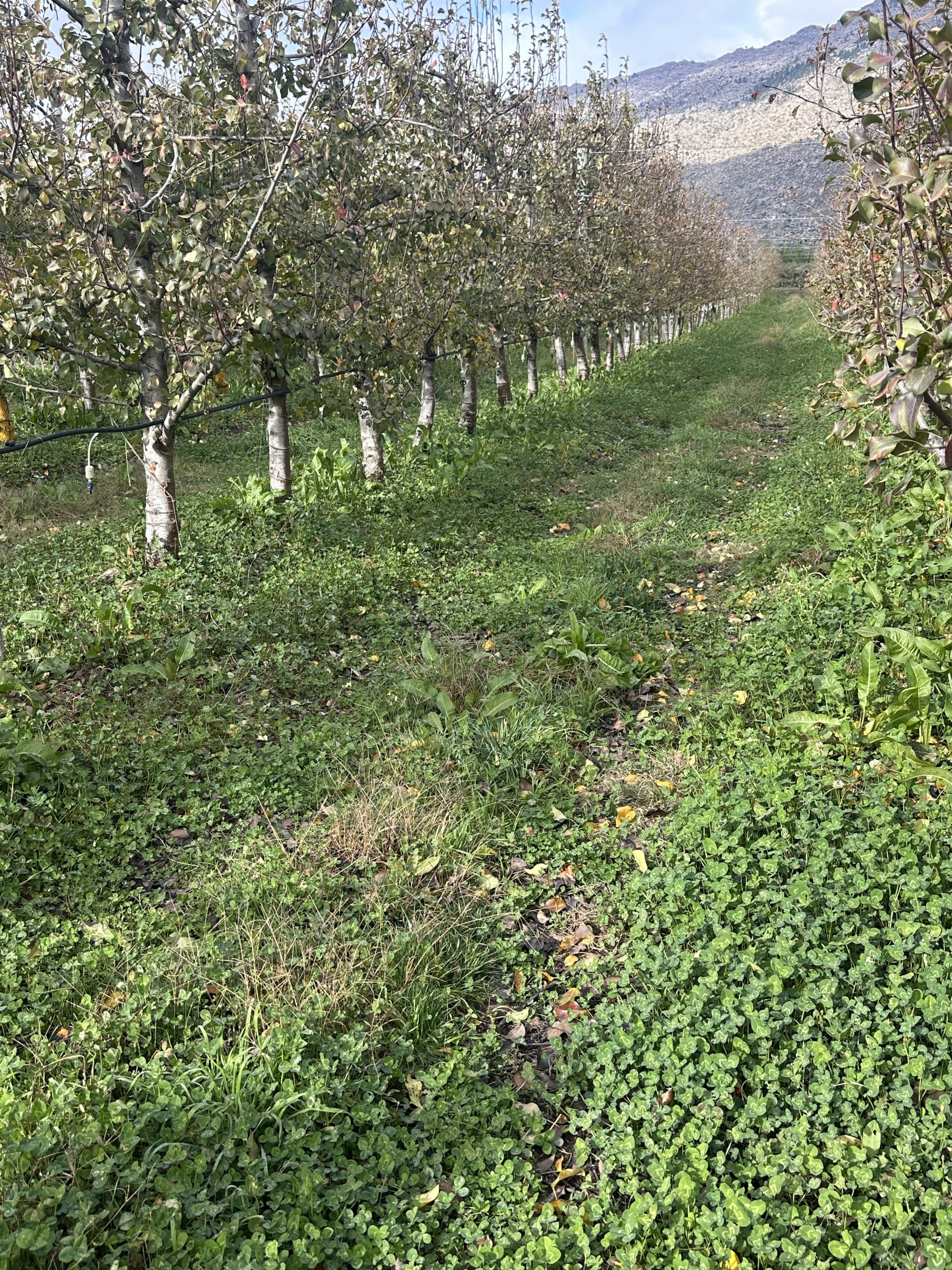
Cover crops are delivering benefits in soil health, pest control, reduced chemical use and and productivity at ZZ2 in South Africa. Image: iSee Creative
Lorraine Farm (ZZ2) – Ceres
The tour kicked off at ZZ2’s Lorraine Farm where Hendrik Pohl, of Holistic Horticulture, has been guiding a transition to regenerative farming, planting cover crops in both the inter row and tree line (called boeme in South Africa).
Compost and mulching with local materials like wheat straw and wood chip is used to build soil carbon and microbial diversity and cover crops, including cereals, and medics such as white and crimson clover were sown in the inter row and a clover mix on the boeme to create a green orchard floor with benefits to pest control, reduced chemical and water usage and increased tree health and productivity.
Key takeaways
- Weed control is a challenge, dealt with by mowing
- Took 3–4 years before intended crops established
- Woolly apple aphid is now virtually non-existent, bee retention in the crop has improved
- Inputs/ha went up, but increased production, so inputs/kg went down
- Need to overcome idea that farms need to be neat
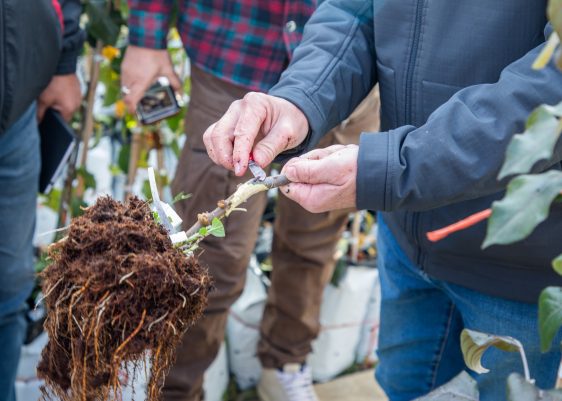
Hendrik Pohl cuts away bark to show tour attendees the seamless green graft. Image: iSee Creative
Cape Sweet Nursery
Cape Sweet Nursery has two hectares of nursery trees under nets, grown in a mix of 7.5L bags and 3.5L containers/ellepots, with the capacity to produce 230,000 trees annually.
- Whip trees are produced by either bench or green grafting scion to tissue cultured rootstocks, transferring to a bag with a mix of coco peat, wood chip and g over the winter and growing for a further 9m, to produce a 1.8-2m tree within 22 months.
Key takeaways
- Medium mix of coco peat, wood chip and gypsum developed to absorb water
- Nets are closed up in the spring to encourage growth
- Success is not the size but the hardiness and conditions in which they grow
Day Two – Tuesday 10 June 2025
Chiltern Farms – Vyeboom Valley

At Chiltern Orchards, third-generation grower Justin Mudge said the company was transitioning from prioritising high-tonnage production to a focus on on-tree quality. Chiltern grows ‘a standard South African mix’ of Gala, varieties sold as Pink Lady®, Cripps Red, Fuji, Braeburn, Granny Smith, Golden Delicious, Packham pears and ‘the king’, the blush pear Forelle that is proving popular in Asian markets. As well as packing their own fruit, they pack for 32 external growers. Low chill requires use of rest (dormancy) breakers, and they net to reduce sunburn.
Key takeaways
- Key driver for future is about return on investment and getting the maximum C1 packout ‘rather than pushing for 100t/ha’
- Cheap, available labour allows for detailed hand-picking of leaves, and labour-saving tech is not a priority

An ‘in-arch graft’ of a Geneva rootstock alongside M7 on a poorly performing block is an experiment to see if it is economic to convert the orchard by changing the rootstock.
Fruitways
Fruitways has 1,250ha of apple and pear orchards and three packhouses packing 125,000 tonnes of fruit a year for the family-owned orchards as well as another 44 growers, for export and domestic. General Manager Agri-Services Keith Bradley said the company was Class 1 tonnage driven and high interest rates meant getting trees into full production by 5th leaf was a priority. Low chill and sunburn were both issues, with basal-dominance a key challenge.
Key takeaways
- Class 1 tonnage is the main driver – ‘can’t farm juice’
- Tools for tackling basal dominance include bending, polling and Geneva rootstocks
- Bigger branches only in vigorous blocks removed in autumn, detail pruning left until after full bloom
Further reading
Growing for quality, tonnage and export in South Africa (SA Tour Day 3 & 4) (June 2025)
Quality first in Dutoit’s data-driven approach to a profitable future (SA Tour Day 5) (2025 July)
Acknowledgement
Future Orchards® is the apple and pear industry’s highly regarded extension program. Future Orchards is delivered by APAL as part of the Developing orchardists of the future (LP23001) project, which is funded through Hort Innovation Frontiers with co-investment from APAL and Pink Lady® and contributions from the Australian Government.