
Bacillus subtilis controls postharvest rots and improves fruit quality after storage
Gordon Brown reviews Egyptian research investigating the effectiveness of Bacillus subtilis against storage rots of apples.
In the 2022 spring edition of AFG I reviewed a research article that demonstrated that commercially available Bacillus amyloliquefaciens could be used to protect trees from crown rot. That review also identified the following:
- Bacillus amyloliquefaciens was originally a strain of Bacillus subtilis and is often referred to as Bacillus subtilis.
- On apples and pears, research has demonstrated that the bacteria inhibits black spot, anthracnose, powdery mildew, Phytophthora, Fusarium, Penicillium, bitter rot and Alternaria.
- Application of Bacillus amyloliquefaciens to the soil is as effective as soil fumigation against apple replant disease.
- Bacillus is best used as a preventative rather than a curative treatment.
- Modes of action identified have included crowding out the pathogen, production of antibiotics and other fungistatic compounds, and stimulation of the plant’s own defence system.
- Bacillus subtilis is found in the intestinal tract of humans so there is no withholding period when using this bacteria for disease control.
There are two Bacillus amyloliquefaciens products registered with the APVMA for disease control – Serifel® and Serenade® – although other unregistered Bacillus subtilis products are marketed as nutrients or probiotics. All claim to be registered for use in organic systems.
Recently Egyptian research has been published that shows that Bacillus subtilis is also effective against storage rots of apples. Initially this research focused on petri dish assessment of Bacillus subtilis action against grey mould (Botrytis cinerea) and then on Botrytis-inoculated apples stored at room temperature. The research then moved on to look at the impact of dipping apples in cell-free extract of Bacillus subtilis on stored fruit. Both the Bacillus subtilis and Botrytis cinerea were strains isolated from apples in Egypt. All trials compared Bacillus subtilis with an untreated control and Nativo® fungicide (produced by Bayer; contains trifloxystrobin plus tebuconazole; not available in Australia).
Petri dish studies
For the petri dish studies the Bacillus was streaked across one edge of the plate and a Nativo fungicide-treated filter paper strip placed in a similar position on another plate. A third plate was streaked with distilled water. These were allowed to sit for two days at 28°C prior to a plug of Botrytis being placed on the opposite side of the petri dish. These were then held at 25°C for seven days to allow the Botrytis to grow and expand. While the Bacillus was not quite as good as the fungicide at restricting the Botrytis growth (Figure 1), it still provided an 80 per cent efficiency of disease control compared to the fungicide treatment.

Figure 1: The growth of Botrytis cinerea after seven days at 25°C on an untreated petri dish, one with a strip of fungicide-treated paper and one with a streak of Bacillus subtilis bacteria.
Fruit inoculation studies
For these studies, whole disease-free fruit were surface sterilised with sodium hypochlorite solution, washed in sterile water, then dried. Fruit were puncture inoculated with Botrytis cinerea followed by dipping in sterile water, Nativo fungicide, or cell-free Bacillus subtilis filtrate. Cell-free filtrate was used to study the impact of Bacillus secretions on disease control and apple responses. Following treatment the fruit were left for 12 days at 25°C.
Both the application of Nativo fungicide and Bacillus subtilis filtrate significantly reduced – by 86 per cent and 72 per cent respectively – the area of rotten fruit around the inoculation point (Figure 2), supporting the petri dish studies. This demonstrates that the Bacillus subtilis secretions are indeed effective at controlling Botrytis cinerea.
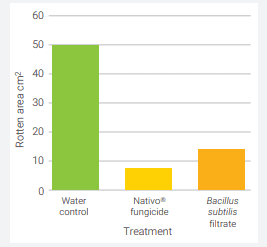
Figure 2: The effect of untreated control, fungicide treatment and Bacillus subtilis filtrate-treated fruit on area of Botrytis fruit rot after 12 days at room temperature.
Normally, when plants are attacked by diseases they produce substances as a defence against infection. These substances include the enzymes peroxidase and polyphenol oxidase as well as fruit phenolics and flavonoids. In this fruit inoculation trial neither Botrytis cinerea (untreated) nor the fungicide used stimulated the plant defence systems, whereas the Bacillus subtilis treatment caused a four- to six-fold increase in the natural defence system of the fruit (Figure 3). Botrytis appears to have developed a mechanism of ‘hiding’ from the fruit so the fruit does not defend itself and the fungicide kills the Botrytis directly without affecting the fruit. In this trial there were no living bacteria cells; however, the bacterial secretions were sufficient to stimulate the plant’s defence mechanisms. Importantly, as the plant’s defence systems work against a wide range of diseases, it can be expected that Bacillus subtilis protects the fruit against a range of postharvest rots and is not specific to Botrytis.
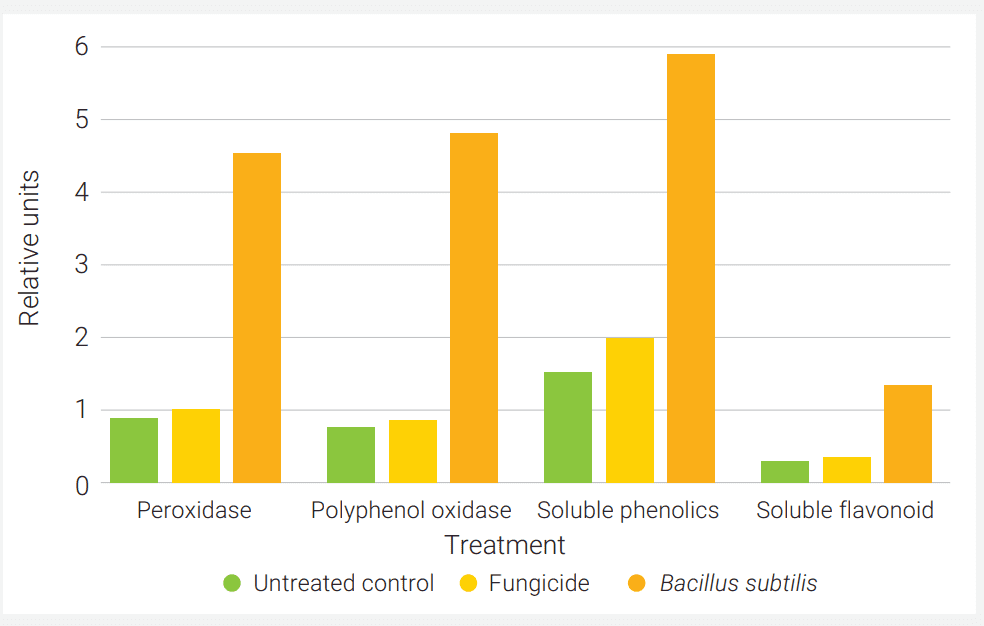
Figure 3: The effect of untreated control, fungicide treatment (Nativo®) and Bacillus subtilis filtrate-treated fruit on peroxidase activity (µM of tetra guaiacol g-1 FW min-1), polyphenol oxidase activity (arbitrary units), soluble phenolics (mg GAE g-1 FW) and soluble flavonoids (mg RE g-1 FW).
Fruit storage trial
For the storage trials, healthy and intact Anna apples were washed and then air dried. Fruit were then dipped in the same treatments as used in the inoculation studies. In this instance fruit were not inoculated with Botrytis so any storage disease could develop. Fruit were stored for 90 days in air at 1°C in boxes with ethylene-absorbing pads. Fruit were studied every five days and declared to be infected if they had a necrotic spot greater than 5mm in diameter. From this the practical storage duration of the crop in storage was determined.
Dipping the fruit in either fungicide or Bacillus subtilis filtrate had an equivalent impact on the appearance of postharvest storage rots (Figure 4). These treatments extended the practical storage duration by 29 days or 24 per cent compared to not dipping the fruit. The cause of the disease spots was not determined so they could have been any storage rot fungi.
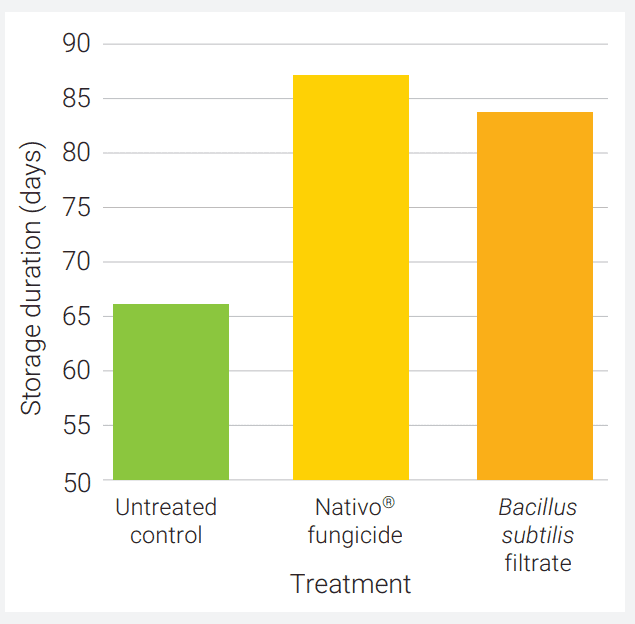
Figure 4: The practical storage duration of apples due to the appearance of storage disease spots.
In addition to assessing fruit for the appearance of necrotic spots, the fruit were also studied for a range of fruit quality characters. Notably, after 90 days of storage, the Nativo fungicide had slightly lower weight loss (17 per cent) compared to the untreated control (19 per cent), although the Bacillus subtilis treatment had very little weight loss (5 per cent) during the storage period. The Bacillus subtilis treatment also caused the least loss of fruit firmness (8 per cent) which was superior to the fungicide treatment (29 per cent softer), while the untreated control had very soft fruit (62 per cent softer) compared to when they were placed in storage.
If a product is to be used to control a disease it needs to be registered with the APVMA for that purpose. Currently only Serifel and Serenade are registered. While both are registered for the control of Botrytis cinerea, neither are registered for use on apples or pears and neither are registered for any postharvest application. Interestingly, a product that contains Bacillus subtilis and is being marketed as a probiotic and growth promoter (Nutri-Life) does have a label recommendation for use on orchards. All the above products are approved for use by the organic industry. There are also many Bacillus subtilis products being sold as probiotics for human consumption.
Take home messages
- Bacillus subtilis/amyloliquefaciens is a bacteria which assists in controlling postharvest diseases and maintaining fruit quality during storage.
- Several Bacillus subtilis products are commercially available in Australia, with some being registered with the APVMA for their control of plant diseases and others being marketed as plant probiotics or fertilisers.
- Bacillus subtilis is a naturally occurring bacteria and is even found in the human gut; several probiotic products are available for human consumption.
- It is illegal to use an unregistered product for the control of plant diseases.
Further reading
- G Brown “Biological fungicides: A viable complement to chemical fungicides”, AFG Spring 2022, https://apal.org.au/biological-fungicides-a-viable-complement-to-chemical-fungicides/
- A Abdelhalim et al. “Enhancing the storage longevity of apples: the potential of Bacillus subtilis and Streptomyces endus as preventative bioagents against post-harvest gray mold disease, caused by Botrytis cinerea”, Plants 2024, 13:1844, https://doi.org/10.3390/plants13131844
This article was first published in the Summer 2024 edition of AFG.



