
Apple crop load management: Can effective carbohydrate manipulation enhance thinning successes?
On-orchard trials in Batlow are investigating carbohydrate supply and demand through defoliation and ASE.
The PIPS 4 Profit program’s Optimising apple production systems (AP22004) project is investigating carbohydrate supply and demand through early autumn leaf removal in Alvina Gala and artificial spur extinction (ASE) in Rosy Glow at Jeremy Smart’s Tingira Orchard in Batlow.
The research team from NSW DPIRD is partnering with APAL’s Nic Finger to investigate not only the effectiveness of these management strategies but also the financial and environmental outcomes. The key questions are:
- Can we improve the efficiency of chemical thinning by manipulating early spring carbohydrate supply for the early variety Alvina Gala?
- How effective is ASE as a non-chemical form of thinning for Rosy Glow?
- What are the economic feasibility and environmental benefits of ASE in Rosy Glow?
The Tingira Orchard trials are underway, with early autumn defoliation completed in the Alvina Gala block (Fig. 1). ASE and spur leaf removal in the Rosy Glow and Alvina Gala blocks will follow in late winter and early spring, respectively.

Figure 1: (a) Flowering, (b) petal fall, (c) fruitlet and (d) fruit stages of reproduction at the Alvina Gala block, Tingira Orchard, Batlow, NSW.
Defoliation trials – Alvina Gala block
Defoliation (leaf removal) treatments will be carried out in autumn and early spring each year. Partial defoliation will be done in autumn at two weeks after harvest and during the chemical thinning window in spring. The trial aims to improve fruitlet sensitivity to chemical thinners by manipulating soluble carbohydrate supply to growing shoots and fruitlets, through partial defoliation. Sensitivity to chemical thinners is thought to be directly related to the balance of available carbohydrates at growing regions including fruitlets and shoot tips (Gonzalez Nieto et al. 2023; Iwanami et al. 2012; Robinson and Lasko 2011).
Leaf removal treatments
- Early autumn: 50 per cent defoliation
- Early spring: 50 per cent defoliation
- Combined: 50 per cent defoliation in early spring, plus 50 per cent defoliation in early autumn
- Control: no defoliation.
Treatment effects on soluble carbohydrates, fruitlet thinning and fruit quality will be assessed.
What are soluble carbohydrates and why are they important?
Soluble carbohydrates are sugars and starches that provide the plant with its immediate energy needs for growth, reproduction and response to stresses like drought. The energy from soluble carbohydrates is readily available to the plant, unlike structural carbohydrates that form the plant’s cell walls. There is evidence that the amount of energy available to the apple tree can influence the success of fruitlet thinning.
Why manage crop load and carbohydrate supply?
Setting the optimal crop load each season is something all growers aim for to avoid biennial bearing and achieve target fruit size and quality. Carbohydrates are central to this as they are the tree’s energy reserves. Managing crop load through early season thinning maximises carbohydrate availability to the remaining fruit and reduces biennial bearing (Bound 2019; Jones et al. 1998).
Setting optimal crop load is a highly demanding task for growers. It can lead to unpredictable outcomes from one season to the next and directly affect current and future productivity and profitability (Verma et al. 2023).
This study will investigate how defoliation in autumn and spring can be used to manage carbohydrate supply to achieve reliable crop load and the best economic outcome.
Tree sensitivity – the influence of carbohydrate allocation on chemical thinning
While chemical thinning is the standard industry practice for managing crop load, success is not guaranteed as it often results in over-thinning or under-thinning. Over-thinning leads to reduced yields, excessively large fruit, decreased flesh firmness and colour, and reduced postharvest life. Under-thinning results in too many fruits, small fruit size, poor quality fruit and reduced orchard profitability.
Precise control with chemical thinning is difficult because of many factors that can affect the process. These include weather conditions before, during and after chemical spraying, cultivar sensitivity, chemical type and mode of operation (Robinson et al. 2012; Sidhu et al. 2022). Environmental influences such as temperature and humidity, and site-specific conditions such as application method and coverage, are all factors affecting the effectiveness of chemical thinning.
However, the tree’s sensitivity to chemical thinners is also an important consideration. This can be affected by the level of bloom, the number of fruit present at spraying, leaf area, temperature, sunlight and tree vigour (Verma et al. 2023). Most of these are directly related to the balance of carbohydrate supply from tree photosynthesis versus carbohydrate demand from competing tree organs (crop shoots, roots and woody structure) (Robinson et al. 2013).
Fruitlet sensitivity changes with carbohydrate availability and relatively high carbohydrate supply to fruitlets can reduce the effectiveness of chemical sprays (Gonzalez Nieto et al. 2023; Iwanami et al. 2012; Robinson and Lasko 2011).
Chemical thinners mostly cause short-term stress during the rapid growth stage of shoots and fruit by inhibiting photosynthesis and enhancing respiration (Dennis 2002). The chemical thinning effect can be enhanced by managing soluble carbohydrate supply in the tree during fruit development. When the competition for photosynthates among the fruitlets is intense, this stimulates the abscission of weaker fruit (Basak 2011; Byers et al. 1991). Chemical thinning is likely to be less effective when management practices and processes in early spring cause an oversupply of carbohydrates to fruitlets so that little competition between fruitlets occurs. On the other hand, processes and strategies that optimise the supply of soluble carbohydrates could enhance the success of orchard chemical thinning activities.
This study will improve tree sensitivity to chemical thinners, through defoliation, thereby enhancing crop load precision in apples.
Other conditions that could enhance or inhibit carbohydrate supply during the apple thinning period and ultimately inhibit or optimise chemical thinning efficacy are shown in Table 1.
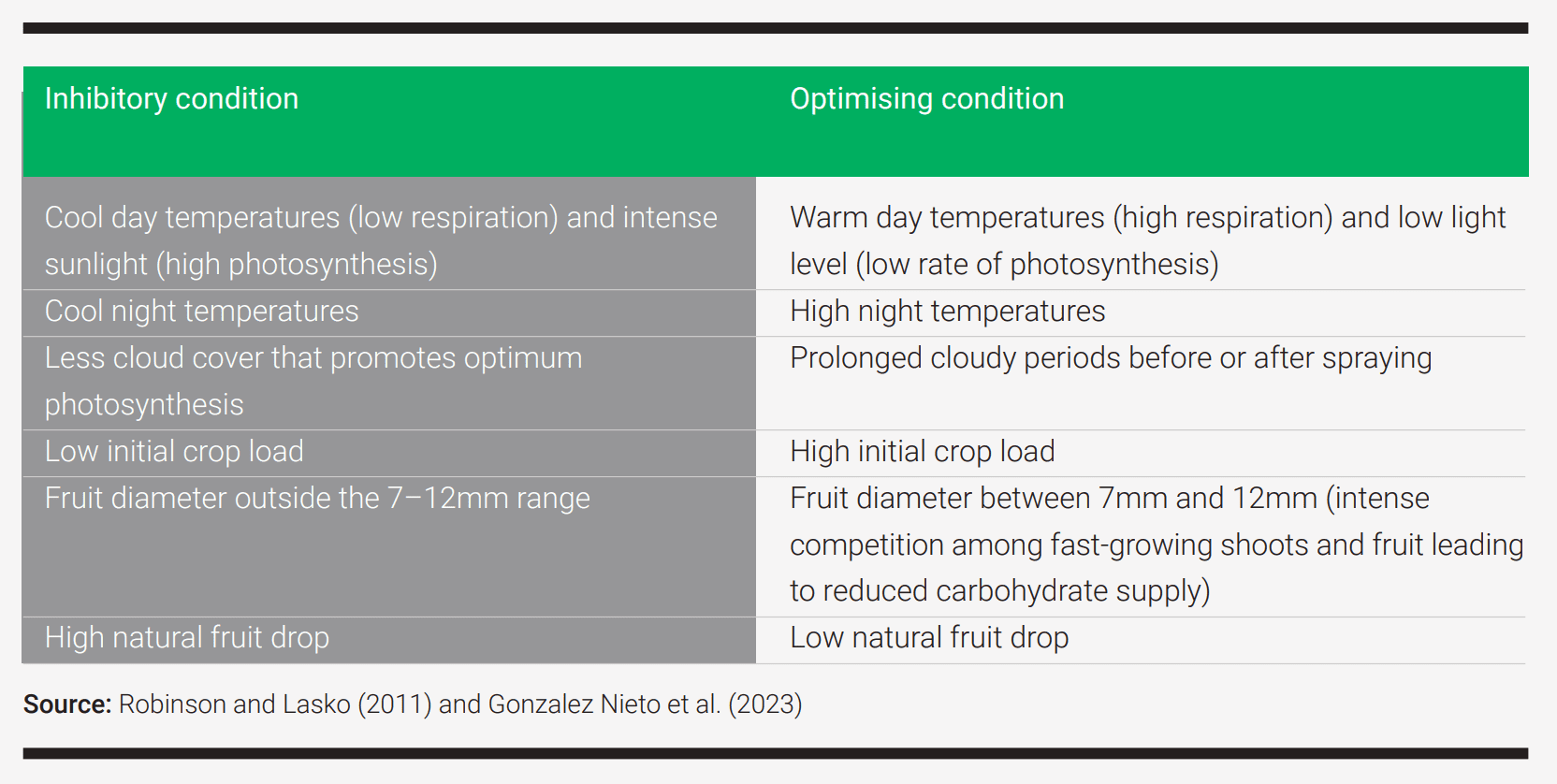
Table 1: Conditions that could inhibit or optimise chemical thinning in apples.
Non-chemical crop load management – Rosy Glow block
In the Rosy Glow block (Fig. 2) we will test ASE as a non-chemical method of managing crop load. This is one way we can enhance the eco-credentials of Australian apple orchards – a feature of the PIPS 4 Profit program.
ASE will be implemented in winter and overlayed with chemical thinning in spring. Three ASE treatment levels and a control will be compared. Treatment effects on soluble carbohydrates, yield and fruit quality will be assessed.

Figure 2: (a) Flowering, (b) petal fall, (c) fruitlet and (d) fruit stages of reproduction at the Rosy Glow block, Tingira Orchard, Batlow, NSW.
Winter pruning using ASE
The benefits of winter pruning are well known – maintaining tree structure, removing diseased branches and unwanted growth, and improving aeration and light penetration in the tree canopy. Yet, it is also a useful strategy for managing crop load (Nissen et al. 2018).
Precision thinning aims to identify a target flower bud load and prune it exactly to that bud load. Artificial spur extinction is a form of precision thinning that uses bud thinning techniques to precisely define where and how much fruit is set on each limb of the tree. ASE aims to promote the vigour and performance of floral spurs, stimulate spur strength and improve fruit quality and regularity of production. ASE is a chemical-free thinning method that is not subject to weather conditions and environmental concerns and has comparable costs to chemical thinning (Bound 2019; Sidhu et al. 2022).
Wrapping it up
The current thinking on the role of carbohydrates in chemical thinning is that there is an optimum level of supply to fruitlets during the apple thinning window. Under-thinning or over-thinning is thought to occur when carbohydrate supply deviates too much from this level, particularly when other factors remain constant.
The likely outcomes of this study include:
- improved grower confidence to incorporate non-chemical methods into orchard crop load management
- better orchard eco-credentials through reduced use of chemical thinners in orchards
- enhanced fruitlet sensitivity to chemical thinning sprays in orchards.
Find out more
Visit youtu.be/cB1DE3oIH9Y to watch a video of Oluyoye Idowu speaking about carbohydrate manipulation to improve chemical thinning outcomes in Batlow, NSW.
Acknowledgement
 The PIPS 4 Profit program’s Optimising apple production systems (AP22004) project has been funded by Hort Innovation using the apple and pear research and development levy, contributions from the Australian Government and co-investment from the Tasmanian Institute of Agriculture, Agriculture Victoria, NSW Department of Primary Industries and WA Department of Primary Industries and Regional Development. It is supported by Lenswood Apples in SA. Hort Innovation is the grower-owned, not-for-profit research and development corporation for Australian horticulture.
References
Basak A (2011) “Efficiency of fruitlet thinning in apple Gala Must by use of metamitron and artificial shading”, Journal of Fruit and Ornamental Plant Research, 19(1):51–62.
Bound S (2019) “Precision crop load management of apple (Malus × domestica Borkh.) without chemicals”, Horticulturae, 5(1):3.
Byers R, Carabaugh D, Presley C and Wolf T (1991) “The influence of low light on apple fruit abscission”, Journal of Horticultural Science, 66(1):7–17.
Dennis F (2002) “Mechanisms of action of apple thinning chemicals”, HortScience, 37(3):471–474.
Gonzalez Nieto L, Francescatto P, Carra B and Robinson T (2023) “Metamitron thinning efficacy of apple fruitlets is affected by different rates, timings and weather factors in New York State”, Horticulturae, 9(11):1179.
Iwanami H, Moriya-Tanaka Y, Honda C, Wada M, Moriya S, Okada K, Haji T and Abe K (2012) “Relationships among apple fruit abscission, source strength, and cultivar”, Scientia Horticulturae, 146:39–44.
Jones K, Bound S and Miller P (1998) Crop regulation of pome fruit in Australia. University of Tasmania.
Nissen R, Bound S, Adhikari R and Cover I (2018) “Factors affecting postharvest management of apples: a guide to optimising quality”, Tasmanian Institute of Agriculture, Fruit Growers Tasmania and Department of Agriculture and Water Resources.
Robinson T and Lasko A (2011) “Advances in predicting chemical thinner response of apple using a carbon balance model”, New York Fruit Quarterly, 19(1):18–20.
Robinson T, Lakso A and Hoying S (2012) “Advances in predicting chemical thinner response of apple using a malusim carbon balance model”, Acta Horticulturae, 932:223–229.
Robinson T, Lakso A, Greene D and Hoying S (2013) “Precision crop load management”, New York Fruit Quarterly, 21 (2):3–9.
Sidhu R, Bound S and Hunt I (2022) “Crop load and thinning methods impact yield, nutrient content, fruit quality, and physiological disorders in Scilate apples”, Agronomy, 12(9):1989.
Verma P, Sharma S, Sharma N and Chauhan N (2023) “Review on crop load management in apple (Malus × domestica Borkh.)”, The Journal of Horticultural Science and Biotechnology, 98(3):299–321, DOI: 10.1080/14620316.2022.2149425.
This article was first published in the Spring 2024 edition of AFG.



