
Beehive sensor technology put to the test
Evaluating the health of bee colonies is crucial to predict pollination efficiency and prevent colony losses.
New sensor-based technology designed to monitor beehives in real time and improve bee health is being put to the test to ensure it meets the needs of beekeepers and growers.
A range of beehive sensors is becoming commercially available, promising to improve some of the workload in evaluating honey bee health by autonomously collecting data such as honey weight, internal temperature, humidity and bee activity. This information helps beekeepers to detect changes in the hive and act when needed.
A Macquarie University research team is evaluating these new tools to understand the quality of the data they collect, what the data can show about hive health and how user-friendly it is, under the Best practices for evaluation of bee health technology (PH22003) project, funded by Hort Innovation. The project will provide recommendations to beekeepers and growers on available options to improve awareness of hive health, including a cost–benefit analysis of the technology, as well as demonstration events and workshops.
Potential benefits
Traditional methods Australian beekeepers rely on to evaluate the health of bee colonies are highly labour intensive, often involving travelling long distances to hives, and physically opening hives and disturbing the bees.
Beehive sensors have been used in the United States for the past four or five years, and the first Australian-made sensors are also starting to come onto the market. Macquarie University’s Dr Théotime Colin, who is running the project with Professor Andrew Barron and Dr Cornelia Sattler, said beehive sensors have the potential to benefit both beekeepers and growers who use pollination services.
“For beekeepers, they have the potential to save them time and reduce operating costs. The main cost saving is improving the health of the hive, and it eliminates the need to travel long distances to check their hives,” Théotime said.
“For growers who use pollination services, if bee health is improved, it will increase hive availability. Also, knowing the health and strength of hives is based on objective data will enhance trust between growers and beekeepers.
“Sensors such as radars that are placed at the entrance of the hive and monitor flight activity are probably of the most interest to growers, because they let them know the bees are actually flying out of the hive during pollination.”
Field trials underway
Field trials testing commercially available sensors from four companies are being undertaken in beehives at Macquarie University’s apiary for 12 months until April 2025. The sensors’ performance will be compared against the university’s gold-standard laboratory methods and precision sensors used to monitor honey bee colony health.
Théotime said the data collected by sensors are important in helping monitor hive health.
“Bees regulate the temperature inside the hives very well at about 34.5°C. How well they regulate the temperature is thought to be an indicator of health of bees inside the hive,” he said. “Some temperature sensors also measure humidity which is important for bees. Too much humidity can lead to disease and infections.”
Honey weight sensors let beekeepers know when honey is ready to harvest, rather than beekeepers relying on estimating a harvest date.
In the wake of the Varroa mite incursion in Australia, monitoring bee health is critical. Théotime said while it’s too early to base Varroa mite detections specifically on data collected by the sensors, the technology has the potential to flag an issue if there is less flight activity or less honey weight than anticipated.
Grower survey
The project team is running an online survey to understand the needs and expectations of beekeepers and growers and the challenges related to the use of sensor technologies. They have also been talking to sensor manufacturers to help match the needs of beekeepers and growers with the technology.
The team is seeking more feedback from growers across Australia about how sensor technology can improve pollination services, and how growers could benefit from the technology. The online survey can be completed here: thesmarthivesurvey.com/.
Acknowledgement
The Best practices for evaluation of bee health technology (PH22003) project is funded by Hort Innovation.
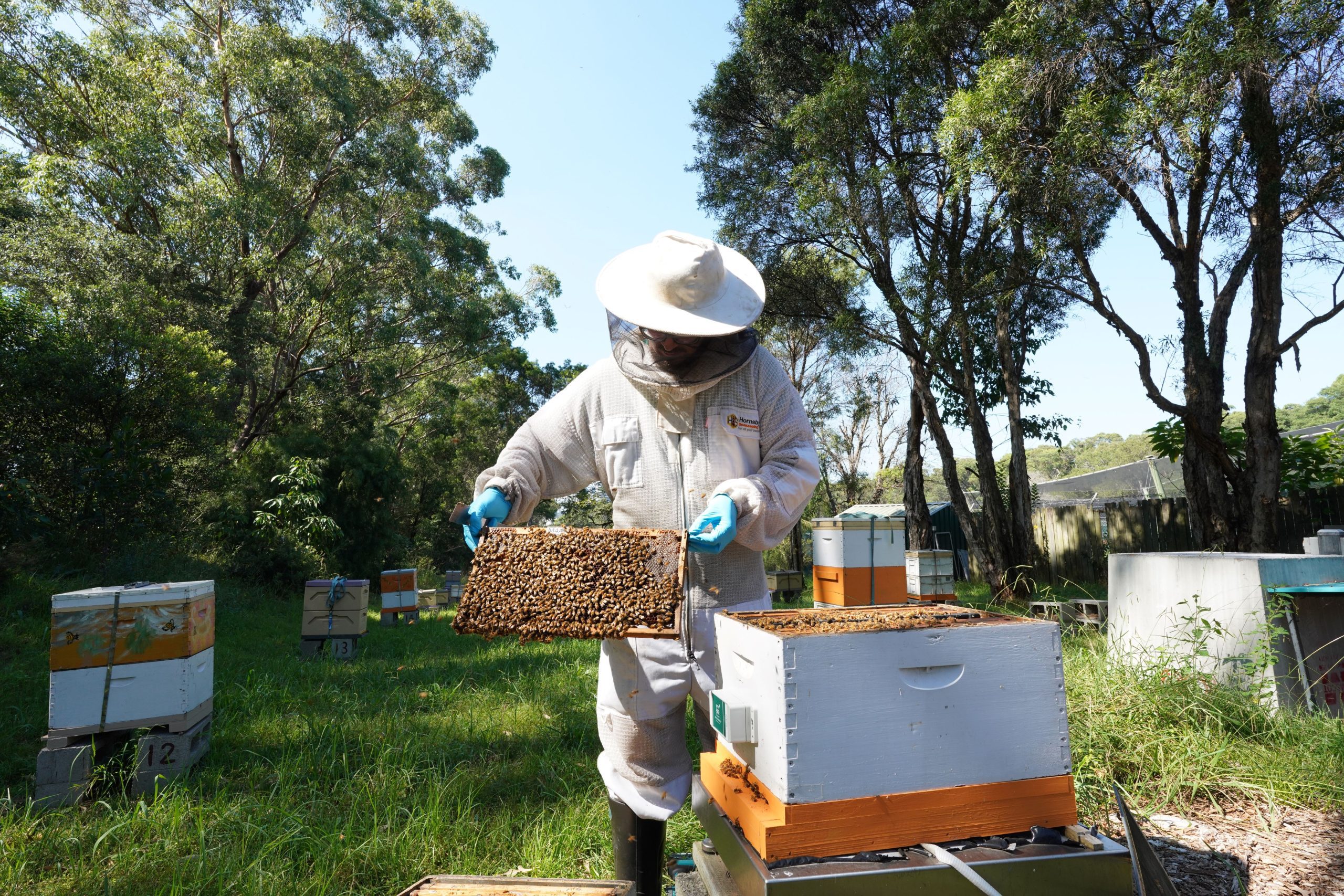
Macquarie University’s Dr Théotime Colin with some of the university’s beehives where the sensors are being tested for 12 months.
This article was first published in the Winter 2024 edition of AFG.



