
Strategies for improving efficiency at harvest
Improving harvest labour efficiency, growing more target fruit and improving bin quality are just some of the strategies growers can use for success.
The Orchard Business Analysis (OBA) report1 shows that harvest labour costs are increasing at a faster rate than the other labour intensive on-orchard tasks of pruning and hand thinning (Figure 1). It is important to understand why and where the rate of increase is coming from, so growers can then develop strategies to harvest fruit efficiently at a lower spend per kg.
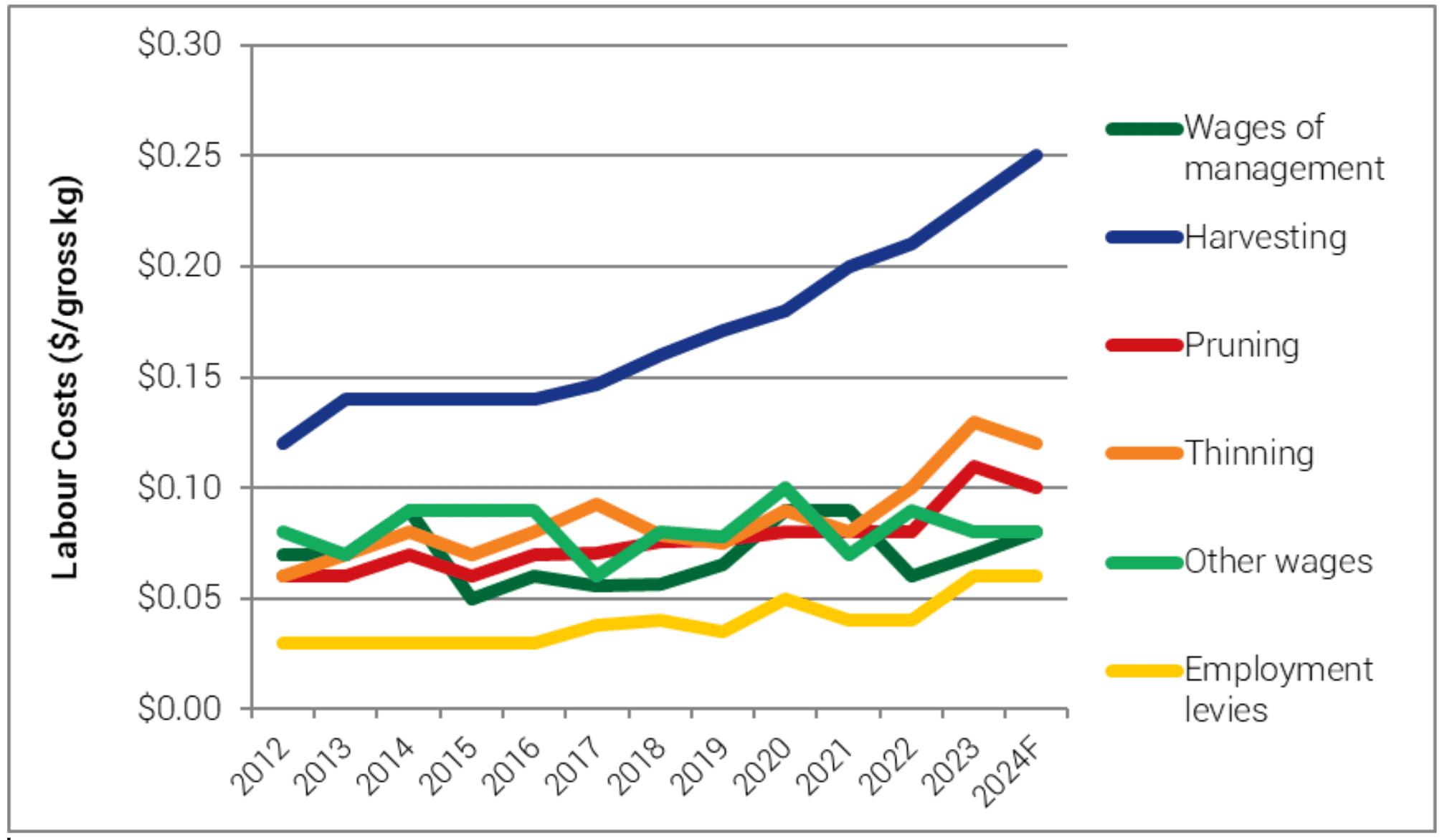
Figure 1: Model labour costs per gross kg over time (2023–24F OBA).
Harvest labour efficiency
The OBA shows orchard labour is 60 per cent of on-farm cost of production and 30 per cent of the total cost. Any efforts to reduce the cost of a task, or even slow the rate of increase of expenditure is good for the bottom line. So why are harvest costs increasing at such a rapid rate compared to other tasks and how can we flatten the line?
Piece rate strategies in recent times have become more difficult to implement, with minimum hourly rates now very high, in addition to regulations that result in growers having to top up piece rate pickers to minimum wage if they don’t pick quickly enough. Consequently, many pickers are now content earning the minimum hourly rate rather than putting in the extra effort to achieve a better pay packet on piece rate, and the incentive has been eroded. The result is that most pickers are paid hourly at harvest and it takes longer to pick a bin, making the cost per bin higher. This is a very difficult issue to address.
For piece rates to work for the picker, a culture of performance must be embedded into the team. This will come from the top and be filtered down through the supervisors and quality assurance staff. The crops must be set up to be easy to harvest and the picker offered full support, for example, good bin movement, clear instructions, good bags and ladders. Another critical component of a successful piece rate pick is that the crop is set up to be easy to pick. This will mean well-coloured, good-sized fruit and easy-access canopies. There are few options to reduce costs, so the focus needs to be on increasing productivity.
Australia’s Pacific Australia Labour Mobility (PALM) scheme and New Zealand’s Recognised Seasonal Employer scheme have been a great success, providing willing workers to get the job done. However, compared to employing domestic-based workers there are additional costs in administering the PALM scheme, including the rolling four-week average minimum work hours, international airfares and pastoral care. The overwhelming positive of the PALM scheme is that the people are strong, fit and generally motivated. Given a good crop, the right culture and good training, they are capable of harvesting quickly and with quality. If you can harness the positives and minimise the additional costs, it is a game changer for many pome fruit businesses in Australia.
Platforms are a relatively new method to improve harvest efficiency. They are a major investment and require purchase capital combined with a plan to realise all the opportunities of using the equipment. Harvest labour is the major on-farm cost but effectively it’s only a quarter of the season. Flexibility to incorporate a platform to assist other orchard tasks like pruning, tree training and hand thinning is key to maximising the value. Some platforms can have the belts removed, freeing up space to be used for other tasks. Another benefit of getting people off tall ladders is the safety aspect; ladders are a frequent cause of orchard injuries.
Platform usage in Australia is increasing as more growers optimise their planting architecture to benefit from the efficiency opportunities. In addition to new blocks being designed with platforms in mind, existing informal spindle plantings can be modified to accommodate platforms by removing branches perpendicular to the row. Branches need to be an arm’s length deep at most, so workers on the platform can reach to the centre of the tree. The key is consistency – that means rows evenly spaced and straight, posts all at the same angle and trees pruned to type. A large self-propelled platform will highlight any deficiencies quickly and any desired gains will evaporate. Platforms work well in V-trellis systems too, providing it’s a steep angle V, approximately 9–12 degrees from vertical.

Although platforms are a major investment, using them year round for pruning, tree training and hand thinning, in addition to picking, is key to maximising their value. Photo: Matt Beaver
A 2022 study by the Western Australia Community Orchard Group comparing platforms versus bag and ladder picking showed that many growers will incorporate a platform into the harvest in addition to traditional picking methods.2 In this study, no orchard used platforms exclusively, though there are some growers who do so. Platform users were able to pick the fruit at a lower cost per bin than average which was a major advantage. This is especially relevant because platforms with crews of approximately six people filling the same bin are typically all on hourly wages. Platforms also open opportunities to employ less physically able people, widening the labour pool and lengthening the work day.
Grow more target fruit
Why do you have Class 2 apples? After harvest, growers would benefit from asking to see a full defect analysis for each block from the packhouse. If you haven’t received one in the past, then asking for one will open many opportunities to improve your horticultural practices, harvest strategy and then packouts.
An overall Class 1 percentage is a good start but alone it is not enough data to inform you of where to focus your efforts to improve packouts. Yearly data will reveal patterns and inform decisions for growing more target fruit – fruit that will return a profit to you after all costs have been paid. Puncture and bruise percentages show a pattern of harvest damage and inform where supervision strategies need to change. Pest and disease damage percentages will do the same for spray programs.
But with target fruit, they need to meet size and colour specifications, and fruit outside these metrics will struggle to make money. Fruit size and colour potential starts as early as pruning. Firstly, growers need to know what specifications the market is demanding. Benchmarking the packout report card against targets will inform what needs to be changed and start the process of how to make changes. Come harvest, you want as high a percentage of target fruit on the tree as you can economically produce.
For example, if Class 1 packout was 70 per cent and the majority of rejected fruit was for colour, then this is where to focus. The underlying causes of poor colour are varied but commonly it is excessive crop load, or high vigour/too many branches resulting in dense shade in the canopy.
Returning to the goal of growing more target fruit, the solutions are first horticultural. The trees are set up to have balanced vigour with light interception throughout the canopy. Pruning opens light windows, fruit counts per tree are established and checked before and after chemical and hand thinning, clusters are thinned to singles. Irrigation practices allow branch terminal buds to set, and nutrition programs match nitrogen amounts to growth targets. Understanding the problem allows deliberate focus on solutions and leads to results, in this case higher coloured fruit on the tree come harvest time.
Some of the PIPS 4 Profit projects are trialling leaf blowing and reflective mulch products and techniques under Australian conditions, and some initial results will be available in 2025. This data will help estimates of potential colour improvements and allow growers to rationalise the expense versus expected revenue gain from implementing these techniques.
Ultimately a grower wants to improve revenue by selling an improved product.
Improve bin quality
It’s hard to reduce costs when most of the costs are set externally. Productivity can be increased though, and this will lead to an increase in quality. It’s very difficult to have pickers do in-field grading and pick at speed, therefore a focus on setting up the tree to grow target fruit first, then removing out-of-grade fruit before harvest, will allow for greater harvest efficiency and more Class 1 fruit in the bin. It’s too late come harvest to try and cull the majority of off-target apples. It goes against a picker’s instincts to fill the bin, and the grower’s nature to gamble means they will want to make money from every piece of fruit in the field.
Setting accurate fruit site counts at pruning will allow you to focus labour into removing fruit to allow for spacing, light and fruit growth, come hand thinning. This will give the remaining fruit the resources to develop and grow to target. If required and justified, further passes can be made before harvest to remove more off-target fruit, increasing the percentage of pickable fruit on the tree, Class 1 fruit in the bin and income per bin.

Setting up the tree to grow target fruit first, then removing out-of-grade fruit before harvest, will allow for greater harvest efficiency and more Class 1 fruit in the bin. Photo: Matt Beaver
Investing in quality
Using packout data, you can form a plan to lift Class 1 percentage and estimate increases in revenue. This extra money provides the funds budgeted for the labour and/or equipment to achieve the Class 1 lift, plus some profit.
Tables 1 and 2 are two examples using OBA 2024F Kanzi® income. Increasing Class 1 while maintaining yield (Table 1) is achieved by investing in changing horticultural practices, using reflective mulch and leaf blowers.
Increasing Class 1 through reduced yield (Table 2) is achieved by not picking Class 2 fruit. If this is done by removing likely Class 2 fruit earlier in the season, then subsequent fruit size increases will offset some of the yield reduction from total fruit count loss. The OBA 2024 forecasts thinning to be $5,825/ha. Spending $1 more per tree, in this example, by hand thinning for fruit size and light interception and any defects, increases Class 1 packout by 10 per cent and leaves a profit of $19/bin after the extra labour cost.
Repeating this exercise with other varieties highlights which varieties will benefit from this strategy. The largest increase in revenue is in varieties like Kanzi and Gala with high Class 1 and low Class 2 returns.
Table 1: Increasing Class 1 packout and maintaining yield.
| T/ha | Packout lift | Gross margin | Increase $/ha | Increase $/bin | Increase $/tree (2,000/ha) |
| 50 | n/c | $20,325 | n/c | n/c | n/c |
| 50 | 5% | $25,375 | $5,050 | $40 | $2.52 |
| 50 | 10% | $32.725 | $12,400 | $99 | $6.29 |
Table 2: Increasing Class 1 packout through reduced yield.
| T/ha | Packout lift | Gross margin | Increase $/ha | Increase $/bin | Increase $/tree (2,000/ha) |
| 50 | n/c | $20,325 | n/c | n/c | n/c |
| 47.5 | 5% | $22,275 | $1,950 | $16 | $0.97 |
| 44 | 10% | $24,400 | $4,075 | $38 | $2.03 |
Steps to success
- Postharvest – Understand your packout.
- In season – Grow more target fruit and improve ‘pickability’.
- At harvest – Improve quality into the bin.
How to cost up harvest labour from ‘tree to truck’
Accurately analysing the total cost of harvest is key to understanding why your costs are increasing and where they are going. You can’t plan if you don’t know why. The largest portion is paid to the pickers, but from tree to truck all costs add up. Successful growers have systems in place where the labour costs are monitored and accessible for each block. This is good for benchmarking and block comparisons as part of an improve or remove discussion. Assigning associated harvest costs before and after the pickers is the next step.
Harvest labour can be divided into three groups:
- Pickers
- Supervisors: quality controllers, managers
- Support: tractor drivers, forklift operators, mechanics, bin repairs
All activities relevant to harvest can be combined to cost up the total labour spend.
Assigning a value to manager’s time (often yours) can be tricky. Don’t overthink it; give yourself a dollar per hour value you would charge someone if you were contracting out your skills. What is harder is differentiating time spent managing harvest logistics, checking QCs and so on versus time managing the orchard as a whole. The active involvement in upper management will differ given the scale and structure of each operation.
Include associated costs like mechanics as well, either outsourced or in-house – it’s an example of a hidden cost and during harvest you will readily pay to keep tractors and platforms rolling.
One final word about cost from the OBA. Upper quartile growers have a similar cost of production (COP) per hectare as other growers, but their COP/kg is significantly lower due to higher Class 1 productivity per hectare. Upper quartile growers also receive 20 per cent more revenue per kg by having good varieties, good colour and the right size. When increasing Class 1 percentage by investing in quality, you improve overall revenue and make harvest more efficient by spending time and money maximising target fruit.
Further information
Cameron presented strategies to maximise profitability, including case studies, at the Future Orchards spring 2024 series of orchard walks. Visit the Future Orchards library to read his presentation slides: https://apal.org.au/programs/future-orchards/future-orchards-library/. A recording of his presentation is available on the APAL YouTube channel: www.youtube.com/@AppleandPearAustraliaLimited
Acknowledgement
Developing orchardists of the future (LP23001) is funded through Hort Innovation Frontiers with co-investment from APAL and Pink Lady® and contributions from the Australian Government.
This article was first published in the Summer 2024 edition of AFG.



