
Sharing ideas to climate change-proof orchards
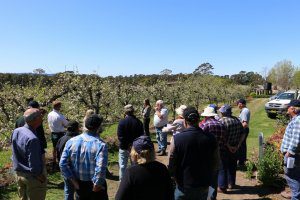
Bill Shields conducting a tour of his Bilpin Orchards with researchers and NSW growers to discuss strategies to mitigate the effects of climate change.
At a recent event in Bilpin, NSW, local growers and national researchers got together to discuss how to reduce the vulnerability of orchards to climate change through understanding potential impacts and adopting strategies to adapt.
The flow of ideas from growers through to researchers and back again is an essential part of doing solid industry-focused research with practical on-farm application. The key is to create plenty of opportunities for such ideas to be shared openly and freely.
A recent grower workshop hosted by Bill and Julie Shields in their home and orchard in BilpinNSW (on a particularly spectacular spring morning), provided the perfect forum for this kind of discussion.
The aim of the workshop was to present the latest outcomes from the apple and pear industry’s national climate change research program to local growers. Broadly, this research is looking at reducing the vulnerability of the industry to future changes in climate through understanding potential impacts and options for adaptation.
The focus at this workshop was on measuring winter chill in the Bilpin region, possible impacts of warmer winters on flowering, pollination and productivity and some new approaches to understanding chill and heat requirements for apples. Bill conducted a highly informative tour around the Shields’ Orchard, which included a look at the trials he is conducting in his own trees using dormancy-breaking sprays to produce earlier and more compact flowering.
The strong level of interest and engagement from the group of growers (who came from the Bilpin region and surrounding districts) produced some great discussion around observations of winter chill and flowering in local orchards. Other topics for discussion raised by the group included the role that soil temperature might play in the timing of bud burst, and the potential impact of high spring temperatures on the viability of pollen, and subsequent impacts on pollination and fruit set.
The event was a truly collaborative effort on a national scale with organisation and coordination by Kevin Dodds (Department of Primary Industries, NSW) and Jenny Treeby (Department of Economic Development, Jobs, Transport and Resources, Vic), and presentations by Rebecca Darbyshire (University of Melbourne) and myself (Department of Agriculture and Fisheries, Qld) – a good example of how government agencies and universities can come together to engage with growers and industry on current and future research issues that matter to industry.
The observations, comments and opinions shared by growers at the Bilpin workshop will help to inform the direction of future research, and it’s likely that many of the linkages made between the participants on the day will continue on long into the future. Encouraging the flow of ideas through the apple and pear industry in all directions can only be a good thing – it will help us to better manage the challenges that face the industry now and into the future.
About the author
Dr Heidi Parkes is a Horticulturist at the Queensland Department of Agriculture and Fisheries and can be contacted on 07 4681 6126 or [email protected].



