
IPDM in focus: pear blossom blast
Pear blossom can be infected by the bacterium Pseudomonas syringae during bloom, when cold, wet weather persists.
Pear blossom blast is a disease caused by the bacterium Pseudomonas syringae. The disease can become a serious problem in regions which commonly have cool, wet weather that persists during long, extended bloom periods. Growers have noted problems with pear blossom blast in Shepparton and the Adelaide Hills.
The most obvious damage caused by the disease is blossom death which results in reduced fruit set. As with all bacterial diseases, it is difficult to manage and there is good evidence that serious infections are usually followed by further problems in subsequent years in which weather favours the disease.
The disease almost exclusively infects pears. While infection on apples is known to occur, symptoms are mild and of no economic significance.
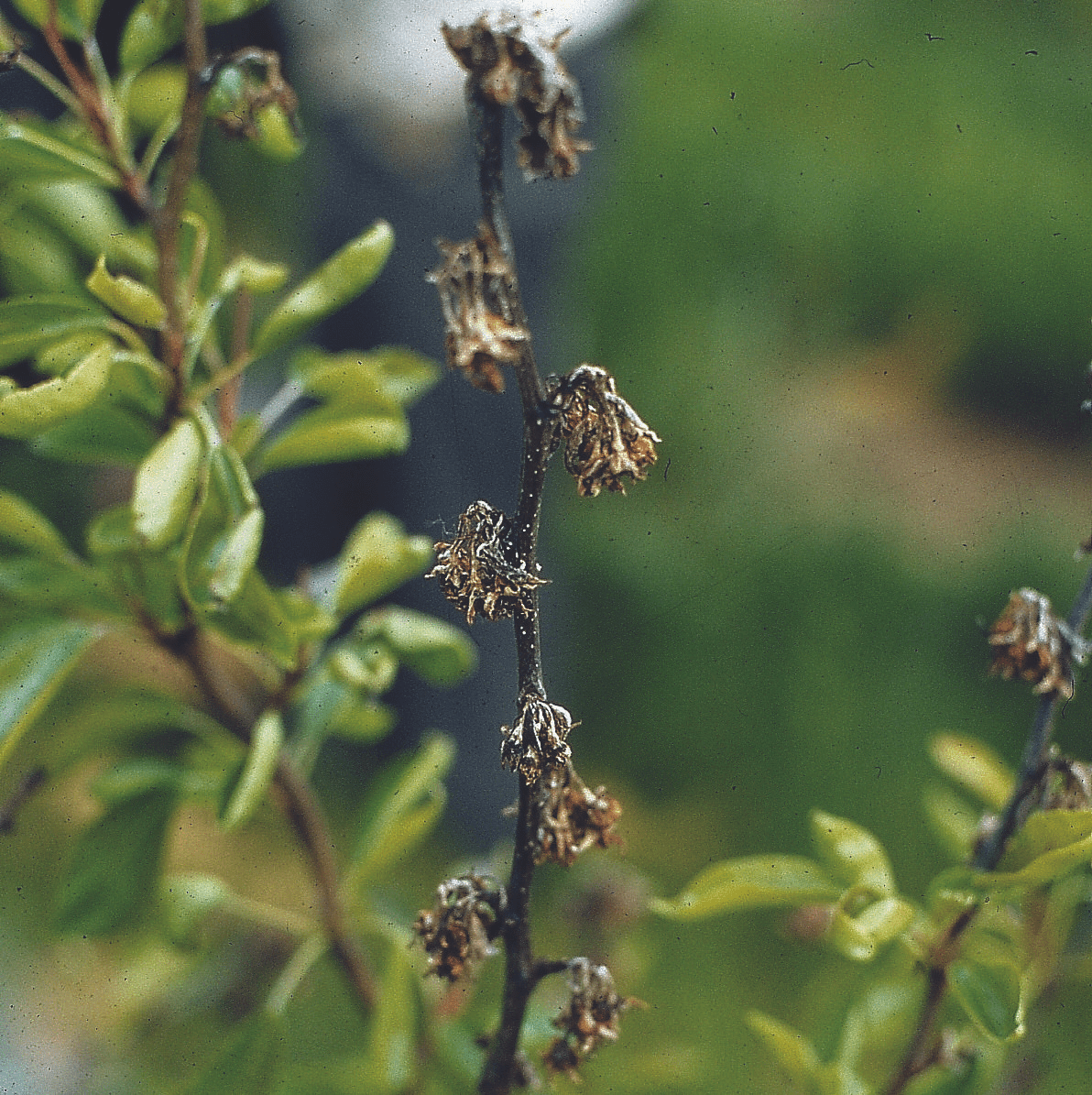
The pathogen invades blossoms through natural openings within the flower. Whole shoots can die back from the disease. Photo: Jay W Scheidt, Oregon State University Extension.
Establishment
Life cycle
The pathogen can live on a wide range of plant types without causing symptoms. During winter it commonly survives in the buds and leaf scars of pear trees. In spring, as leaf and fruit buds begin to develop and weather becomes warmer, populations of the pathogen increase without causing disease. During this time and subsequently, the bacteria are spread to neighbouring trees by wind-blown rain. It is only when the weather becomes cool and wet that conditions favour disease development.
Blossom infection is favoured by cold, wet periods during bloom because the pathogen invades blossoms through natural openings within the flower. The bacterium can promote ice formation, using a process called ice nucleation, which makes frost more likely to form. It then uses the subsequent frost damage to spread through the flower and cause disease, and it can survive on and in fruit and aborted blossom through the growing season.
The number of bacterial cells required to be present for ice nucleation to occur depends on temperature. At –2.2°C one in a million bacterial cells initiate ice nucleation. At –2.8°C it is one in 10,000 and at –3.9°C it is one in 10.
Varietal susceptibility
Although all pear varieties can be infected, susceptibility varies between varieties of European pear. Research conducted in the United States suggests that green-fruited pear varieties may suffer a higher incidence of blossom blight than red-fruited varieties. In the US, the Corella variety is regarded as relatively resistant to blossom blast, but Australian orchardists report this as one of the varieties most prone to damage.
Monitoring
Monitoring your orchard, not only for pests, diseases and weeds, but also for beneficial organisms such as predators and parasitoid wasps, is an important component of implementing integrated pest, disease and weed management.
The one-minute tree inspection technique is recommended for monitoring for pear blossom blast symptoms. As you spend one minute walking around a tree, or along a panel of trellised trees, count and record the number of budworms, loopers, pear slugs, weevils and mealybugs you see. During the same inspection look for the presence of diseases such as pear blossom blast, pear scab, powdery mildew and Alternaria on leaves, and the presence of lacewings, hoverflies and ladybirds.
Unfortunately, if bacterial blast is seen it is too late to do anything about it during the current season, but by recording the location of affected trees you will be able to pay more attention to those areas next season if and when cool, wet weather persists during long extended blossom periods. Extra management, for example frost protection, can then be applied to this area.
Identification
Flowers
If buds are infected, they fail to open and then they dry out and die. After flowering, blast initially develops as small, depressed, shiny black spots on the outer surface of the green portions of the blossom – the sepals, pedicels and receptacles. These spots coalesce to form large diseased areas that become black and, if the weather remains favourable, this blackening spreads to the entire flower truss. The entire spur is often killed. These infections seldom progress past the base of the spur and are usually concentrated in the lower portion of the tree’s canopy.
Shoots
In young trees, symptoms may also develop on the shoots when the outer bark separates from underlying tissue. This gives the bark a papery appearance and the condition is sometimes known as blister bark.
Leaves
Leaf infection is secondary in importance to blossom infection, but it can severely reduce the number of leaves. The symptoms appear as dark, depressed, shiny leaf spots.
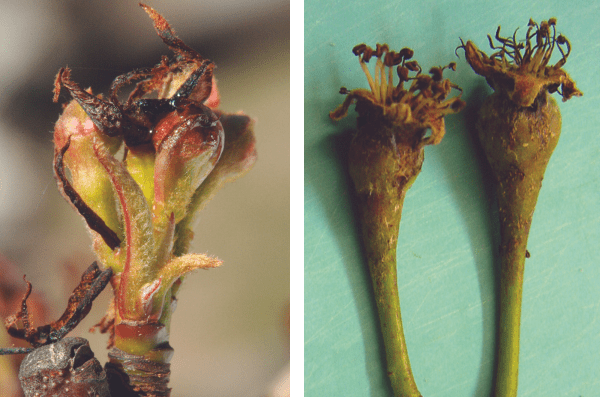
Blossom blast infection on pears. In early stages the disease develops on the green parts of the blossom including the sepals (left). The disease rarely spreads beyond the pedicels (right).
Photos: NSW Department of Primary Industries.
Management
Responsible use of pesticides
Bacterial diseases are difficult to control, particularly as orchardists in Australia do not have access to agricultural antibiotics and there are no products currently registered for the control of pear blossom blast. Application of various copper products for the control of pear scab may also help to manage bacterial blossom blight. These products should be applied at green tip. If extended wet weather occurs during blossom, additional applications (with caution) are allowed and are advisable. Caution should also be used when applying copper-based products to Winter Cole and Josephine pears as damage may occur.
Preventing frost damage
The disease will be more severe where trees are frosted. Anything that can be done to reduce frost damage will have flow-on effects in reducing damage due to blossom blight. Avoid planting susceptible varieties in frost-pockets and consider installing wind machines if you are in a frost-prone area.
Pruning
Pruning and destroying affected tissue helps to lower the amount of disease in the orchard in the future. Be extremely cautious, though. Do not prune during wet, cold and windy weather, and disinfect pruning tools before pruning disease-free blocks.

Acknowledgements
This article was prepared using information from the revised Integrated Pest, Disease and Weed Management manual for Australian Apples and Pears (IPDM Manual), authored by David Williams, Oscar Villata and others, published by Hort Innovation, October 2021.
The article is part of a series of articles that focus on implementation of IPDM.
The PIPS3 Program’s Strengthening cultural and biological management of pests and diseases (AP19002) project has been funded by Hort Innovation, using the apple and pear research and development levy, contributions from the Australian Government and co-investment from Agriculture Victoria. Hort Innovation is the grower-owned, not-for-profit research and development corporation for Australian horticulture.
This article was first published in the Winter 2023 edition of AFG.



