
Best practices to control Alternaria and Glomerella road-tested in Queensland
The first round of the Future Orchards® Trial Incubator is now complete and the findings of the projects are being reported to APAL.
As part of the 2023–24 Trial Incubator, Queensland apple growers road-tested some accepted best practices for control of Alternaria apple leaf blotch (Alternaria mali) and Glomerella (Glomerella cingulata) last season and found that existing practices achieved the best control.
Trial results in most cases confirmed that current practices – based on industry-accumulated knowledge – were well-founded and achieved the most effective control of both diseases, with a few interesting results thrown in.
Stanthorpe-based research company Orchard Services conducted field experiments on Alternaria in a Gala orchard, and on Glomerella on Granny Smith and Cripps Red (sold domestically as Sundowner™) trees.
Alternaria
The key practices looked at were:
- choice of fungicide
- spray volumes
- spray intervals
- spraying start times.
The Gala variety is susceptible to Alternaria and last summer’s weather was very favourable for disease development with 374mm of rain falling over 49 wet days in November, December and January. Leaf infections were first seen in late December and increased progressively, with 55 per cent of leaves on unsprayed trees infected by early February.
The trial provided an opportunity to test newer fungicides, with unknown efficacy, against tried and tested solutions, and a range of application volumes and timings.
Fungicides that are not registered for Alternaria control (Dithane® 750 WG and Serenade® Opti 262 WP), registered for disease suppression only (Belanty® 75 SC), or registered for control but without wide local field experience to date (Sercadis® 300 SC) were applied.
These fungicides were compared to a program of fungicides registered for Alternaria control that have traditionally provided good control, i.e. Pristine® 380 WG alternated with Delan® 700 WG.
Results and discussion
Fungicide comparison
It was confirmed that a program of Pristine alternated with Delan effectively controlled a heavy infection of Alternaria in Gala apples.
This program was superior to spraying Serenade Opti (not registered for Alternaria control), Belanty (registered for suppression) and also Sercadis (registered for control but without wide local field experience) (Figure 1).
Dithane, which is not registered for Alternaria control, did provide good control in this trial. However, this result should be interpreted cautiously as local field experience has shown that orchards treated exclusively with Dithane (or other mancozeb-based products) have sometimes developed high levels of infection with Alternaria.
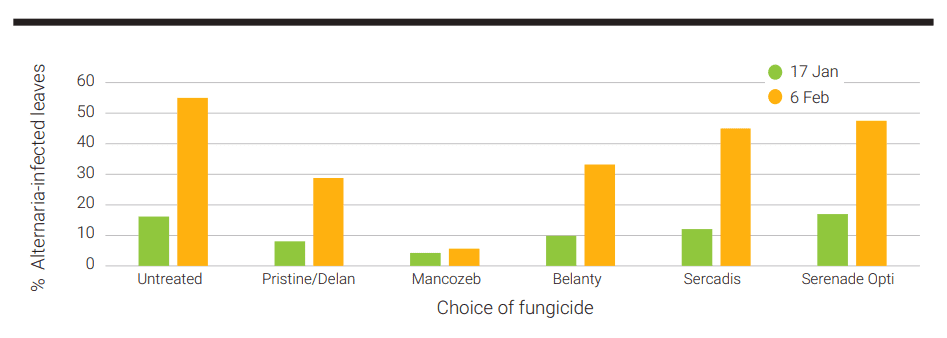
Figure 1: Percentage of Alternaria-infected Gala leaves in Stanthorpe following application of different fungicides.
Water volumes
When Pristine alternated with Delan was applied at either 1X dilute and 2X semi-concentrate spray volumes, similar control of Alternaria was obtained. Spraying at 2X concentrate volumes is a common practice in the Stanthorpe district for improved droplet size and coverage. Apple leaves are an easier spray target than fruit and Alternaria almost always starts on leaves before spreading to fruit. Some pests and diseases are controlled better with dilute (1X) spray volumes than concentrate volumes (for example, mites and powdery mildew) and in the second APAL trial on Glomerella rot 3X spraying was not as effective as dilute 1X or 2X spraying. Possibly because Glomerella develops on fruit and the very small droplets in 3X concentrate spraying may not coalesce to penetrate clumping fruit bunches (Figure 3).
Application intervals
When trees were treated with Pristine alternated with Delan at 9-, 14-, 16- and 21-day spray intervals there was similar control of Alternaria, but the most consistent control was when applications were made at 9-day intervals. This may be a reflection of the particularly wet weather experienced during the trial period (Figure 2).
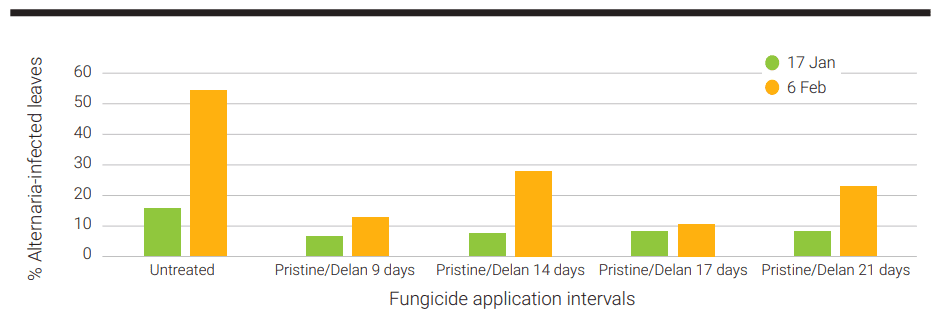
Figure 2: Percentage of Alternaria-infected Gala leaves following fungicide application at different spray intervals.
Timings to start applications
When trees were treated with Pristine alternated with Delan commencing in either early November, late November or mid-December, the control of Alternaria was similar and was superior to starting applications in late December. This was a little bit surprising considering the season was favourable for Alternaria. However symptoms were only first seen on 27 December and the three earliest programs had all commenced before this. In different seasons, different starting dates may prove to be more or less effective (Figure 3).
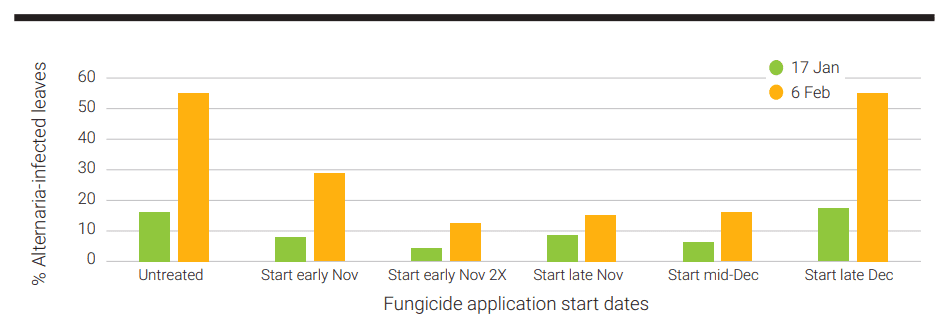
Figure 3: Percentage of Alternaria-infected Gala leaves following treatment with Pristine alternated with Delan, commencing on different dates.
Key takeaways
Alternaria is mainly a disease in districts that receive summer rainfall but can be experienced in all districts if conditions are right, especially on susceptible varieties like Gala and Cripps Pink.
This trial has confirmed that the best Alternaria control is obtained when:
- registered fungicides with known local efficacy are used
- fungicide treatments commence in late spring to early summer
- spray intervals are not too extended if the disease establishes in trees
- spray volumes of dilute (1X) or semi-concentrate (2X) are used – they work equally well on this disease.
Just Pristine and Delan were used as standard registered fungicides to limit the size and complexity of the trial. Sercadis 300 SC, Fontelis® 200 SC, Intervene® 113 WG, Luna® Sensation 500 SC and Belanty 75 SC are all also registered for Alternaria control. There is also a permit for Polyram® 700 DF for Alternaria control. The selection of the fungicides used was made by the apple growers advising the project.
All fungicides were applied at registered rates and the average dilute water application volume was 1,512 L/ha and the 2X semi-concentrate water volume was 649 L/ha.

Alternaria leaf blotch infections.
Glomerella
The key practices looked at in this trial were:
- fungicide choice
- spray volume used
- timing to start spraying.
The late season varieties Granny Smith and Cripps Red (Sundowner) are susceptible to Glomerella and last summer’s weather was very favourable for development of this disease. Just 1.3 per cent of untreated fruit were infected in mid-December, which increased rapidly to 21 per cent of fruit infected by mid-January.
Apple growers don’t always know the efficacy spectrum of newer fungicides on Glomerella, so may be applying fungicide mixtures that may not be necessary. To gain insight, some seven fungicides not registered for Glomerella were compared to two that are registered and provide good control. The opportunity was also taken to compare dilute and semi-concentrate spray volumes and some key timings to commence fungicide applications
Seven fungicides not registered for Glomerella control (Fontelis 200 SC, Sercadis 300 SC, Luna Sensation 500 SC, Pristine 380 SC, Belanty 75 SC, Flint® 500 WG and Seguris® Flexi 125 EC) were compared to two fungicides registered for Glomerella that have traditionally provided good control (Dithane 750 WG and Delan 700 WG).
Results and discussion
Fungicide comparison
The efficacy of Dithane and Delan were confirmed in a high-pressure season. Both these fungicides are registered for control of Glomerella and are widely used by Queensland growers. These two fungicides were superior to all seven of the fungicides not registered for Glomerella control: Fontelis, Sercadis, Luna Sensation, Pristine, Belanty, Flint and Seguris Flexi (Figure 4).
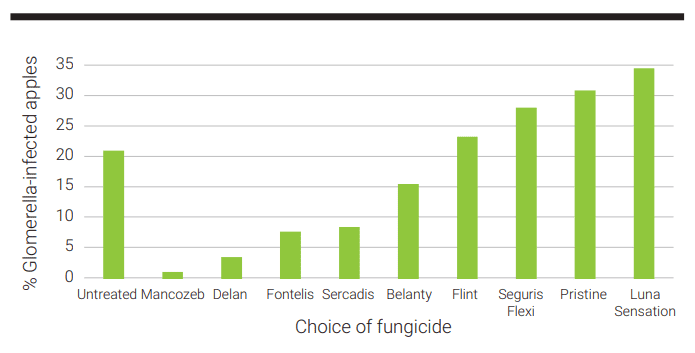
Figure 4: Efficacy of two registered and seven unregistered fungicides on Glomerella infection.
Water volumes
Dithane was more effective for the control of Glomerella in apples when applied at dilute (1X) and 2X semi-concentrate spray volumes than when applied at 3X concentrate water volumes. This is possibly because Glomerella develops on fruit and the very small droplets in 3X concentrate spraying may not coalesce to penetrate clumping fruit bunches (Figure 5).
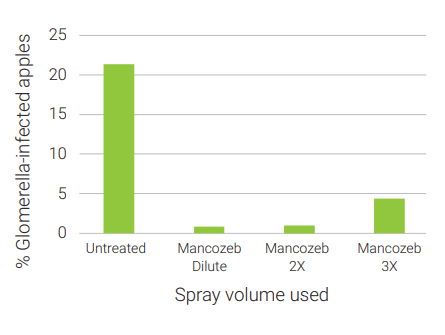
Figure 5: Effect of spray volume of fungicide on Glomerella infection.
Timings to start applications
This part of the trial compared programs of Dithane commencing in either early November, late November, mid-December or late December. The most effective programs were those that started in early November and late November (Figure 6).
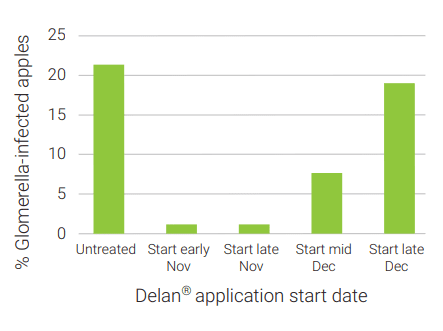
Figure 6: Effect of starting time of fungicide on Glomerella infection.
Key takeaways
Glomerella, which is also known as bitter rot, is a disease in most Australian apple growing regions. It can develop into typical target-shaped rots on fruit in the orchard, or can infect fruit in the orchard which is seen later as a rot during cold storage.
This trial has confirmed that the best Glomerella control is obtained when:
- registered fungicides with known local efficacy are used
- fungicide treatments commence in late spring
- spray volumes of dilute (1X) or semi-concentrate (2X) are used rather than 3X concentrate volumes.
Notes
Just Dithane and Delan were used as standard fungicides registered for Glomerella control to limit the size/complexity of the trial. Ziram and Polyram are also registered for Glomerella control. The selection of the seven newer fungicides not registered for Glomerella control was made by the apple growers advising the project.
All fungicides were applied at registered rates and the average dilute water application volume was 1,440 L/ha, the 2X semi-concentrate volume was 702 L/ha and the 3X concentrate volume was 477 L/ha. Four applications were made to all fungicide treatments.
The commercial apple blocks were chosen because they had a heavy infection of Glomerella in the previous growing season.
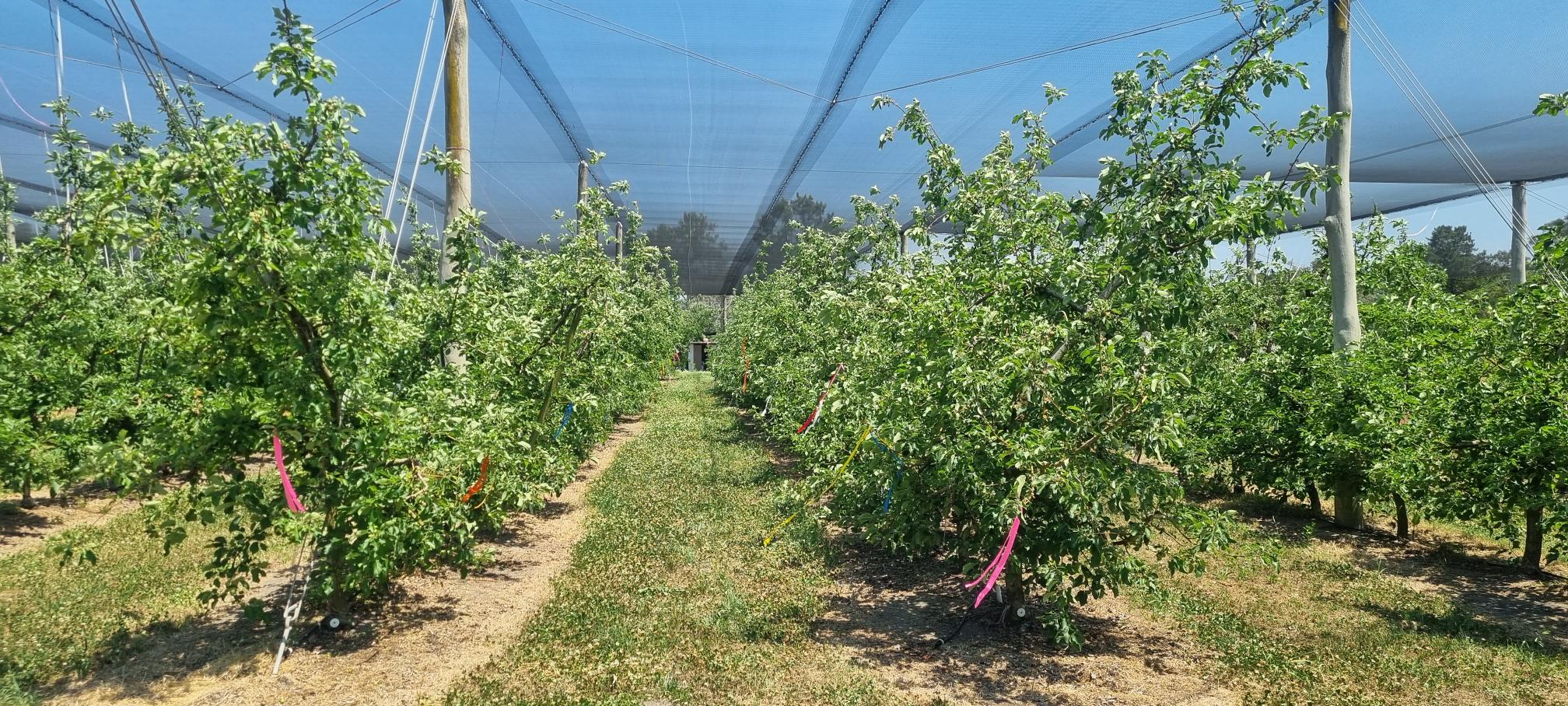
The Cripps Red (Sundowner™) trial site in mid-November 2023. Trees were on M26 rootstocks planted at a density of 1,562 per hectare, and were trickle irrigated and grown under hail netting.
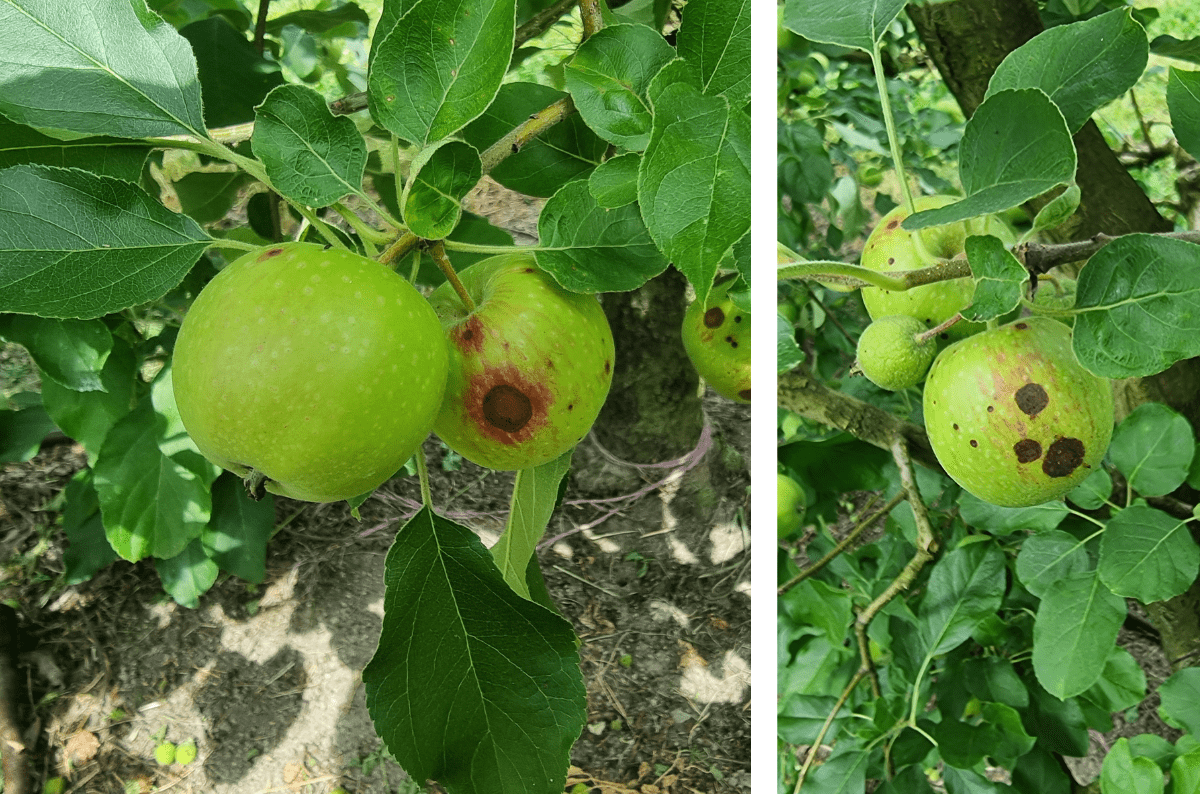
Glomerella on fruit
Read the reports for each trial in more detail here:
Alternaria: apal.org.au/wp-content/uploads/2024/07/APAL-summary-Alternaria-in-apples-trial-report-2023-24.pdf
Glomerella: apal.org.au/wp-content/uploads/2024/06/APAL-summary-Glomerella-in-apples-trial-report-2023-24.pdf
Got an idea for a trial?
The Future Orchards Trial Incubator 2024–25 intake is currently open. The program supports small-scale, single-year research projects with budgets from $2,000 to $20,000. Growers and other industry stakeholders can use the funds for project activities, equipment, or services to then produce reports and outcomes.
Visit the Future Orchards Trial Incubator section of the APAL website for further information and to submit an expression of interest: apal.org.au/programs/future-orchards/trial-program. Alternatively, contact Nic Finger via email: [email protected].
Final trial reports for the trials from the 2023–24 season will be published on the APAL website as they become available.
This article was first published in the Spring 2024 edition of AFG.



