
Preventing patulin problems in apple products
With harvest just around the corner, it’s important that everyone involved in juice-grade fruit be aware of the risks of patulin – from grading staff to packhouse managers.
There were a number of recalls in juice due to patulin levels over the past year, and it’s worthwhile to have a refresher on the key steps everyone can take to prevent contamination of products before they reach supermarket shelves – both in Australia and abroad.
What’s Patulin?
Patulin is a mycotoxin. It is produced by a number of different fungi, but most commonly by the blue mould fungus Penicillium expansum.
Blue mould is one of the most important storage diseases affecting pome fruit worldwide, causing both visible, watery lesions that turn blue-green as the fungus matures, and internal “mouldy core” soft rots.
Learn more about patulin here.

Blue mould originating from wound infection on Granny Smith apple. Spore masses formed along the infection site. Photo: CL Xiao. USDA-ARS.
Why is this important?
Maintaining food safety standards that keep patulin well under the acceptable limit of 50µg/L not only reduces the risk of poisoning, it also maintains consumer and export market confidence in the quality and safety of Australian food products.
Detection of high patulin levels and the resulting product recalls can harm the reputation of our products as clean and healthy.
What can you do?

Dr Jenny Ekman, image via AHR
According to Dr Jenny Ekman, postharvest physiologist at Applied Horticultural Research, high patulin levels in juice products can be avoided by taking the right preventative actions for harvest and post-harvest management.
“This could be an especially challenging year, because it’s been a wet season,” commented Jenny, “Penicillium species are everywhere in the environment, and wet conditions provide the perfect opportunity for them to grow and spread.”
Some key steps for preventing patulin include:
1. Avoid cuts or bruising to the apples
“This is most critical to reducing the risk of blue mould, as it only grows in damaged fruit,” Jenny said. Unlike other fungi, blue mould spores do not produce appressoria, so they cannot directly penetrate the intact skin of the fruit.
“When you’re picking, it’s important to never ‘hear’ the apples, as impacts mean bruising and damage. Fresh wounds provide both an entry point for the fungus and the water and nutrients it needs to grow.”
2. Grow quality fruit and harvest at correct maturity
“Fruit that has been well fertilised with calcium, grown in healthy soil, and not subjected to wet conditions or drought will be most resistant to postharvest disease,” Jenny said.
“While less mature fruit can be quite resistant to blue mould, overmature fruit are highly susceptible, especially if they continue to ripen during storage.”
3. Treat with an effective fungicide
“If you’re using a fungicide, it is most effective if you treat the apples as soon as possible after harvest, and definitely within 24 hours,” Jenny said.
“Delaying fungicide treatment means the spores will have already germinated in harvest wounds and grown into the flesh, protecting the fungal mycelium from the effects of superficial fungicides.”
-
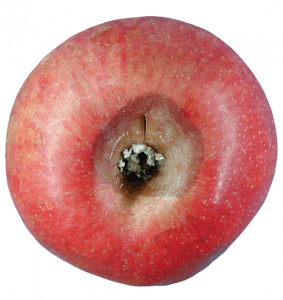
- Calyx-end blue mold on a Fuji fruit; usually associated with drenched fruit.Photo: CL Xiao, USDA-ARS.
-

- Internal view of a Honeycrisp apple with blue mould infection. The decayed tissue was easily separated from the remaining healthy tissue. Photo: TJ Mullinex, Good Fruit Grower.
4. Refrigerate properly
“Sometimes bins of juicing apples can be left outside or not given the same care as eating apples,” Jenny said.
“It’s important to remember that while the fungus itself grows fastest at around 24ºC, some research has found that patulin production is highest at around 16ºC. Even though the P. expansum fungus can continue to grow at temperatures approaching 0ºC, patulin production is greatly inhibited at 8ºC, and virtually prevented at 4ºC. If you have CA, that will help as well.”
5. Keep them clean and dry
“Mould can still grow in dry conditions, but it spreads much faster on wet surfaces,” Jenny said.
“Penicillium spores can easily survive from season to season on contaminated bins and equipment, so cleaning, sanitising and keeping them dry will reduce the initial spore load and growth.”
6. If there’s any mould, don’t pack that apple
“The amount of mould you can see doesn’t necessarily correlate to the patulin levels,” Jenny said.
“There can actually be higher levels of patulin in the intact part of the apple than the mouldy part, and apples with only a small amount of visible mould can contain high concentrations of patulin. It is really important to remove all apples with any signs of blue mould before sending for processing.”
Images via WSU Tree Fruit



